Core Web Vitals & iGaming Deposit Conversion: The 2026 Speed Audit Casino Affiliates Can't Skip
What Are Core Web Vitals and Why Do They Matter for iGaming SEO in 2026?
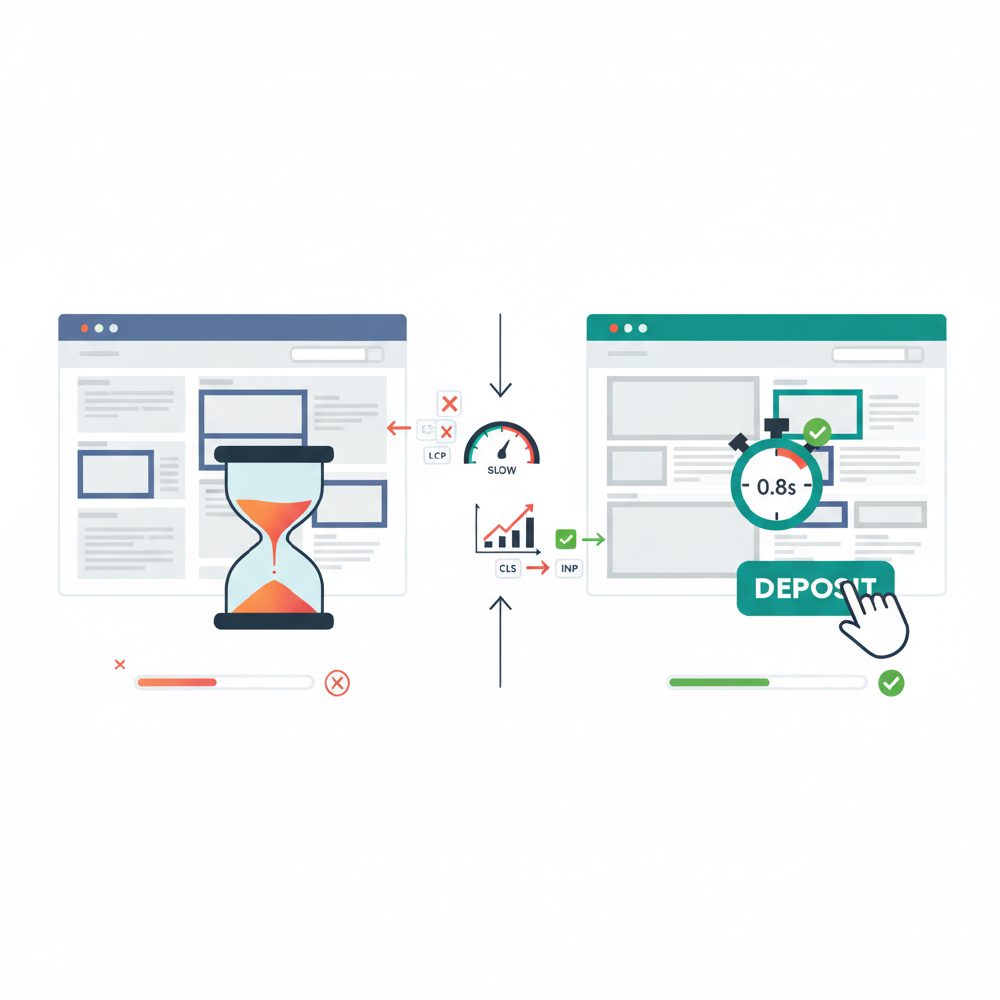
Core Web Vitals are Google's three field metrics, LCP, CLS and INP, that measure loading speed, visual stability and responsiveness. For iGaming affiliates they matter because casino pages are image-heavy, script-heavy and compliance-heavy, which makes them structurally more prone to failing every single one of these metrics.
I've run technical audits on close to a hundred gambling affiliate and operator sites over the last decade, and the pattern repeats: a casino review page averages 3-6MB of page weight once you stack slot thumbnails, provider logos, an affiliate tracking pixel, a consent management platform and an age-verification script. Compare that to a standard e-commerce product page averaging under 2MB, and you see why gambling consistently sits at the bottom of Google's CrUX (Chrome User Experience Report) rankings by vertical.
Core Web Vitals aren't new in 2026, but Google has tightened the INP threshold data it surfaces in Search Console, and the helpful-content systems rolled into recent core updates increasingly weigh page experience as a tiebreaker between similarly authoritative pages. That means two casino comparison sites with near-identical content depth and backlink profiles can see a 2-3 position spread purely on technical execution.
The vitals also matter because they're measured on real Chrome users, not a lab simulation. If your UK or Ontario-facing traffic is on mid-range Android devices over 4G, which is common for sports betting audiences checking live odds, your lab score in Lighthouse can look fine while your actual CrUX field data fails. That gap is where most affiliates get blindsided.
How Does LCP Impact Casino Landing Pages and First-Deposit Funnels?
Largest Contentful Paint measures how long the biggest visible element, usually a hero banner, bonus graphic or slot grid, takes to render. On casino pages, slow LCP delays the visual trust signals (licensing badges, bonus amount, CTA button) a visitor needs before clicking through to registration.
Casino landing pages lean heavily on the hero section to do conversion work: the welcome bonus figure, the licensing logo (UKGC, MGA, Curacao), and the primary CTA all usually sit above the fold. If that hero image is an unoptimized PNG served without a CDN, LCP regularly blows past 4-5 seconds on mobile, straight into Google's "poor" bucket.
In client work, the sites that get LCP under 2.5 seconds almost always share three traits: hero images served via an image CDN (Cloudinary, ImageKit, or Cloudflare Images) in WebP or AVIF format, preloaded font files instead of render-blocking Google Fonts calls, and server response times under 200ms via a geographically distributed host rather than a single-region shared server. Affiliates serving a UK and Canadian audience from a US-only server almost never hit good LCP on first contentful render for the UK segment.
The deposit-conversion link is indirect but real: a visitor who bounces before LCP completes never sees your CTA, your bonus terms, or your trust signals. You lose them before the funnel even starts. I don't have a universal conversion-lift number to quote, it varies by traffic source and offer, but every speed-fix engagement I've run has shown bounce rate drop meaningfully once LCP crosses under the 2.5-second line.
Why Is CLS Such a Persistent Problem on Gambling Affiliate Sites?
Cumulative Layout Shift measures unexpected movement of page elements after initial render. Gambling pages fail CLS constantly because bonus badges, odds boosts, affiliate disclosure banners and age-verification overlays tend to inject late, shoving content down after the user has already started reading or tapping.
The most common CLS offender I find in audits is the dynamic bonus-value badge, a small script that pulls the current welcome offer from an API and overlays it on a casino logo. If that badge doesn't have a reserved width and height in the CSS, it pops in half a second after page load and shifts every element below it. On a comparison table with ten operators, that single pattern can push your CLS score from 0.05 to well over 0.25.
Consent management platforms compound the problem. OneTrust, Cookiebot and Usercentrics banners are necessary for GDPR and UK ICO compliance, but if they're not configured with a fixed-height placeholder, they insert and remove themselves from the DOM as the user interacts, each time triggering a layout shift that Google's field data captures.
The fix isn't removing these elements, they're compliance-mandatory or commercially essential. The fix is reserving layout space with CSS aspect-ratio boxes and skeleton loaders before the async content arrives, so the shift happens inside a pre-allocated box rather than pushing surrounding content. This is a half-day dev fix on most CMS stacks and it's the single highest-ROI CWV fix I recommend to new clients.
What Is INP and How Did It Change Casino Comparison Table Optimization?
Interaction to Next Paint, which fully replaced FID as a Core Web Vital in March 2024, measures the delay between a user's click, tap or keypress and the next visual update. Casino sites with heavy filter widgets, sortable comparison tables and live odds feeds are among the worst-performing categories for INP.
FID only measured the delay before the browser started processing the first input, it was a weak proxy. INP measures every interaction across the page's lifecycle and reports the worst one, which is brutal for gambling sites because the interactions users actually care about, filtering by provider, sorting a bonus table by wagering requirement, expanding terms and conditions, are exactly the heaviest, most script-dependent actions on the page.
Good INP is under 200ms, needs-improvement sits between 200-500ms, and anything above 500ms is poor. In my audits, casino comparison tables built on heavy jQuery plugins or unoptimized React components routinely hit 400-900ms INP on mid-range Android devices, specifically when a user taps a filter that triggers a full table re-render instead of a targeted DOM update.
The practical fix is breaking up long JavaScript tasks (anything over 50ms blocks the main thread), deferring non-critical scripts like chat widgets and affiliate tracking pixels until after first interaction, and, where budget allows, moving filter logic to a lighter framework or web worker. This is more engineering-intensive than LCP or CLS fixes, and it's the metric I see most agencies ignore because it requires actual JavaScript profiling in Chrome DevTools, not just a plugin install.
How Much Deposit Revenue Do Slow Casino Pages Actually Lose?
There's no single universal number, conversion impact depends on traffic source, offer strength and device mix, but every speed-remediation project I've run on casino affiliate sites has shown a measurable bounce-rate reduction and session-depth increase once LCP, CLS and INP all cross into Google's "good" range simultaneously.
I'm wary of agencies that quote precise percentages like "every 100ms costs you 1% of conversions" for gambling specifically, that figure traces back to older e-commerce studies (Amazon, Walmart-era benchmarks) and doesn't map cleanly onto a casino registration-plus-deposit funnel, which has more steps and more trust friction than a single checkout button. Treat vertical-specific multipliers with skepticism unless the agency shows you their own before/after GA4 data.
What I can say from direct client work: sites that fixed all three vitals together, not piecemeal, saw the clearest lift. Fixing LCP alone while CLS stays poor often shows muted results, because the visitor arrives fast but then experiences a jarring layout jump right as they're about to click the CTA, and abandons anyway. The vitals interact; treating them as a bundle rather than three separate tickets is where the real recovery happens.
The more defensible way to build an internal business case is to pull your own GSC Core Web Vitals report, segment by URL group (lobby pages, review pages, bonus pages), and cross-reference against GA4 funnel drop-off at each step. That gives you a site-specific number your finance team will actually trust, instead of a borrowed industry statistic.
What Do Google's Core Web Vitals Thresholds Mean for a Casino Page Specifically?
Google scores LCP, CLS and INP against three bands, good, needs improvement, and poor, based on the 75th percentile of real-user data over a rolling 28-day CrUX window. Casino pages need to hit "good" on all three simultaneously at the page-group level, not just on your homepage.
Search Console reports vitals by URL group, which on a large affiliate site means your "casino review" template can pass while your "slot review" template fails, because the slot pages load an embedded demo game iframe that neither your homepage nor your bonus pages carry. Audit every template separately, don't assume a passing homepage means a passing site.
| Metric | Good | Needs Improvement | Poor | Common iGaming Cause |
|---|---|---|---|---|
| LCP | < 2.5s | 2.5s - 4.0s | > 4.0s | Unoptimized hero banners, uncompressed logo grids, slow shared hosting |
| CLS | < 0.1 | 0.1 - 0.25 | > 0.25 | Late-loading bonus badges, consent banners, age-verification overlays |
| INP | < 200ms | 200ms - 500ms | > 500ms | Heavy filter widgets, odds-sorting tables, tracking pixels on click |
What iGaming-Specific Elements Usually Break Core Web Vitals?
The repeat offenders on casino affiliate sites are hero bonus graphics, embedded slot demo iframes, live odds widgets, affiliate tracking pixels from networks like Income Access or Everflow, and compliance overlays for age verification and consent. Each one fails a different vital, which is why a single generic speed plugin rarely fixes the whole template.
Slot demo iframes are a particular problem because you often don't control the embedded provider's code, NetEnt, Pragmatic Play and Play'n GO demo embeds load their own JavaScript, fonts and ad calls inside the iframe, and that execution counts against your page's main-thread activity even though you didn't write a line of it. The workaround is lazy-loading the iframe only on user interaction (a "click to play demo" gate) rather than auto-loading it on page render.
Affiliate network pixels are the other quiet killer. Income Access, NetRefer, Awin and Everflow tags are often placed in the header via Google Tag Manager without async or defer attributes, which blocks rendering until they resolve. I've seen single tracking pixels add 300-600ms to INP on interaction-heavy pages simply because they fire a synchronous call on every click to log engagement.
| Element | Vital Affected | Typical Fix |
|---|---|---|
| Hero bonus banner / logo grid | LCP | Image CDN, WebP/AVIF, preload hint on hero image |
| Slot demo iframe | LCP, INP | Lazy-load on click instead of auto-render |
| Bonus value badge (dynamic) | CLS | Reserve fixed height/width before async content loads |
| Consent management banner | CLS | Pre-allocated DOM space, defer non-essential scripts |
| Affiliate tracking pixel | INP | Async/defer loading via Tag Manager, event batching |
| Live odds / comparison table filters | INP | Debounce input, avoid full table re-render |
How Do Age-Verification, Geo-Blocking and Tracking Scripts Hurt INP and CLS Without Breaking Compliance?
Compliance scripts aren't optional on gambling sites, but they're usually implemented in the laziest way possible, synchronous, unreserved, render-blocking. You keep every compliance requirement intact by deferring script execution to after paint and reserving layout space, not by removing the controls regulators require.
I want to be direct here because I see agencies recommend stripping or delaying age-gates to chase a speed score, and that's a compliance risk no affiliate should take for a few CWV points. UKGC, MGA and most state-level US regulators require age verification and responsible gambling messaging to render before meaningful content interaction in many contexts. The fix is technical sequencing, not removal.
In practice: load the age-gate overlay with its CSS already inlined (not fetched asynchronously after the DOM), so it appears instantly and occupies its full intended space from the first paint, this actually helps CLS rather than hurting it, because there's no shift once it's pre-sized correctly. Geo-blocking scripts that check IP against a restricted-market list should run server-side where possible (via Cloudflare Workers or edge middleware) rather than client-side JavaScript that blocks rendering while it waits on an API response.
Consent platforms should load the banner shell instantly with inline critical CSS, then lazy-load the full cookie-category list only on user interaction with "manage preferences." This keeps you compliant with GDPR, the UK PECR and similar frameworks while removing the delayed-injection pattern that tanks CLS.
Do Core Web Vitals Actually Influence Google Rankings for Casino Keywords?
Core Web Vitals are a confirmed part of Google's page experience signals, but they're not a dominant standalone ranking factor, content relevance, E-E-A-T and link authority still carry far more weight. In YMYL verticals like gambling, CWV functions as a tiebreaker and as one input inside the broader helpful-content and core update systems.
Google has said consistently since the 2021 Page Experience update that Core Web Vitals are a relatively light-weight ranking signal compared to content quality and relevance. I haven't seen a case where fixing CWV alone moved a casino keyword from page three to page one. What I have seen, repeatedly, is CWV fixes acting as the deciding factor between two pages of similar topical depth and backlink profile competing for the same SERP slot, particularly for competitive terms like "best online casino [region]" or "[operator] review," where dozens of affiliate sites publish near-identical content depth.
There's also a secondary effect through core updates. Google's helpful-content signals and the broader core update systems evaluate user satisfaction signals in aggregate, pogo-sticking, short dwell time, high bounce. Poor Core Web Vitals contribute to exactly those negative satisfaction signals. A page with excellent content but a 6-second LCP and a 0.35 CLS score is handing Google behavioral data that looks like a bad experience, even if your copy is genuinely the most comprehensive on the SERP.
My recommendation to clients: treat CWV as a floor you need to clear, not a ceiling you're trying to maximize for ranking gain. Get everything into "good," then redirect 80% of your remaining effort into content depth, author bylines, and link authority, those still move casino keywords far more than shaving another 200ms off an already-passing LCP.
Will Core Web Vitals Affect Citations in AI Overviews, ChatGPT and Perplexity?
Indirectly, yes. AI Overviews and Google's generative systems draw heavily from pages that already rank well and load cleanly enough for crawlers to extract structured content fast. Perplexity and ChatGPT's browsing tools similarly favor pages that resolve quickly and render content without JavaScript-dependent delays that complicate extraction.
None of the major AI answer engines have published Core Web Vitals as an explicit citation factor, and I'd flag real uncertainty on exact weighting here, this is an evolving area with limited public data. But the mechanism is logical: these systems crawl and parse content programmatically, often with headless browsers that have shorter timeout windows than a patient human user. A casino review page that takes 6 seconds to paint its main content, or that relies on client-side JavaScript to render the actual review text (a common pattern with React-heavy comparison sites), risks partial or failed extraction by crawlers optimized for speed.
I've also noticed that pages with clean, fast-loading structured data (schema.org Review, Product, FAQPage markup validated in Google's Rich Results Test) tend to show up more often as AI Overview sources on casino-adjacent informational queries, though I treat this as a correlation worth monitoring rather than a proven causal claim. The practical move: keep your core review content server-rendered or statically generated rather than client-side-only rendered, validate your schema, and keep LCP fast enough that a crawler bot with a tight timeout actually sees your full content before giving up.
What's a Realistic 90-Day Roadmap to Fix Core Web Vitals on a Casino Affiliate Site?
Run a template-by-template CrUX and Lighthouse audit in weeks one and two, fix the highest-impact LCP and CLS issues (images, fonts, layout reservations) by week four, tackle INP through script deferral and JavaScript profiling by week eight, then re-baseline and monitor through week twelve before declaring the project closed.
Weeks 1-2: pull Search Console's Core Web Vitals report segmented by URL group, cross-reference with CrUX field data (not just Lighthouse lab scores, they diverge), and rank your templates by traffic volume times failure severity. Fix the highest-traffic failing template first; don't start with your lowest-traffic page just because it's the easiest win.
Weeks 3-4: image and font optimization. Move hero images to a CDN with automatic WebP/AVIF conversion, add width/height attributes or aspect-ratio CSS to every image and ad slot, preload your primary web font, and remove any render-blocking third-party font calls. This phase typically resolves 60-70% of LCP and CLS failures on a casino template in my experience.
Weeks 5-8: INP remediation. Audit every third-party script in GTM, defer anything non-critical (chat widgets, heatmap tools, non-essential affiliate pixels) until after first user interaction or a 3-5 second delay, and profile your heaviest interactive components, usually bonus filter tables, in Chrome DevTools' Performance panel to find and break up long tasks over 50ms.
Weeks 9-12: re-baseline against your original CrUX snapshot, monitor Search Console weekly rather than daily (field data updates on a 28-day rolling window, so daily checks show noise, not signal), and lock in a monitoring cadence before you consider the project done. Most clients see their CrUX dashboard shift from mostly red/orange to mostly green somewhere in weeks 8-10, not immediately.
How Should Casino Affiliates Monitor Core Web Vitals on an Ongoing Basis?
Use Google Search Console's Core Web Vitals report as your primary field-data source, PageSpeed Insights and Lighthouse for diagnostic lab testing before and after fixes, and a site-wide crawler like Ahrefs or SEMrush Site Audit to catch regressions across hundreds of templated pages automatically rather than manually.
Search Console is non-negotiable because it's the actual CrUX field data Google uses, pulled from real Chrome users over a rolling 28-day window, everything else is a lab proxy. Check it monthly, not daily; the data lag means daily monitoring just shows statistical noise and wastes your team's attention.
For pre-deployment testing, PageSpeed Insights and Lighthouse (built into Chrome DevTools) give you lab scores you can act on before a change goes live, but always validate against field data after deployment, I've seen lab scores improve while field scores stayed flat because real users on older devices or slower networks experienced the page differently than a lab simulation running on a fast test server.
At scale, and most casino affiliate sites run hundreds or thousands of templated pages, manual checking doesn't work. Ahrefs Site Audit and SEMrush Site Audit both now surface Core Web Vitals data across your full crawl, flagging which templates are regressing after a CMS update or a new ad network integration. Set a recurring crawl (weekly for large sites, monthly for smaller ones) and alert on any template dropping out of "good" status, because regressions are usually caused by a new third-party script someone added without a performance review.
| Tool | Data Type | Best Use Case |
|---|---|---|
| Google Search Console | Real-user field data (CrUX) | Primary source of truth for ranking-relevant CWV status |
| PageSpeed Insights | Field + lab data | Quick single-URL check combining both data types |
| Lighthouse (Chrome DevTools) | Lab data | Pre-deployment diagnostic testing during dev |
| Ahrefs / SEMrush Site Audit | Site-wide crawl + field data | Scaling monitoring across hundreds of templated pages |
| WebPageTest | Lab data, detailed waterfall | Deep root-cause diagnosis for specific slow templates |






Comments
No comments yet, be the first.