Casino Affiliate RevShare vs CPA in 2026: The Model That Compounds With Your Architecture
What's the real difference between casino affiliate revshare and CPA deals?
RevShare pays a percentage of the net revenue an operator earns from a referred player over that player's lifetime with the brand. CPA pays one fixed fee per qualifying new depositor, paid once. RevShare rewards player quality and retention; CPA rewards volume and speed, and that split determines everything else about how you should build around it.
RevShare deals I've negotiated typically sit at 20-40% of Net Gaming Revenue, paid monthly, attached to the player for as long as they remain active with that operator, sometimes years. CPA deals pay a one-time fee, usually 30-45 days after the player hits a qualifying deposit threshold, ranging from roughly $50 in saturated offshore markets to $400+ in regulated Tier-1 markets like the UK or Nordics. The affiliate never sees another cent from that player once the CPA clears.
The risk allocation flips between the two. RevShare ties your income to the operator's ability to retain and monetize the player, churn, bonus abuse, a bad month of big wins, all of it eats into your payout. CPA shifts that risk to the operator: you get paid whether the player deposits once and disappears or becomes a six-figure lifetime depositor. You lose the upside, but you also stop caring about retention mechanics you can't control.
Traffic intent is the deciding variable in practice. If your content pulls high-intent, bottom-funnel comparison traffic, people actively choosing between two licensed operators, those players tend to stick around, and revshare compounds. If you're running broad top-funnel volume plays where a chunk of signups never make a second deposit, CPA locks in value before churn erases it. I've seen sites with near-identical traffic volume earn 3x more under one model than the other purely because of where in the funnel that traffic sits.
| Factor | RevShare | CPA | Hybrid |
|---|---|---|---|
| Payout basis | % of Net Gaming Revenue, ongoing | Flat fee per qualifying depositor, one-time | Small flat fee + reduced ongoing % |
| Payout timing | Monthly, tied to player lifetime | 30-60 days post-qualifying deposit | Split, immediate portion + monthly tail |
| Risk carried by affiliate | High, churn, negative months | Low, paid regardless of retention | Moderate, cushioned downside |
| Best traffic type | High-intent, retention-friendly | Broad, volume-driven, unproven verticals | Mixed-intent programmatic pages |
| Earnings ceiling | Uncapped, compounds with LTV | Capped per player | High, but slower ramp |
How is the revshare percentage actually calculated on NGR?
Most operators calculate revshare on Net Gaming Revenue, gross gaming revenue minus bonus costs, payment processing fees, and sometimes chargebacks or gaming duty, not gross deposits. That deduction stack can quietly turn an advertised 30% revshare into an effective 18-22% of what looks like top-line revenue on the surface.
Contract wording matters more than the headline percentage. I always ask networks for the exact NGR formula and, where possible, 90 days of historical NGR statements for a comparable player cohort before modeling projected earnings. Bonus wagering costs, chargeback provisions, and in UK-facing brands the Point of Consumption Tax sometimes get deducted before your split is applied, none of that shows up in the marketing one-pager networks send you.
Sliding-scale revshare is also standard in 2026 across networks like Income Access and NetRefer-powered programs: 25% for the first 0-10 new depositing customers a month, stepping up to 35-40% once you clear 50 NDCs. That structure rewards volume but punishes affiliates who can't sustain consistent monthly output, which matters if your traffic is seasonal or dependent on a handful of ranking pages.
Verify the math yourself rather than trusting dashboard totals. Pull raw NDC and deposit data from the network's reporting tool, cross-reference against your own GA4 conversion counts, and recalculate the implied NGR percentage quarterly. I've caught discrepancies of 3-5 percentage points between advertised and effective revshare more than once, usually from undisclosed processing fee deductions.
When does flat CPA outperform revshare for an affiliate?
CPA outperforms revshare when the vertical carries high churn, thin operator margins, or real regulatory risk, new unproven brands, crypto casinos, or gray markets. You lock in cash before bonus abuse, negative carryover, or a license issue erases the lifetime value you were counting on.
Gambling churn runs high compared to most affiliate verticals, monthly churn of 10-25% isn't unusual for a mid-tier operator, higher in crypto and offshore casino segments. Run a breakeven calculation before committing to revshare: if average NGR per player is $40/month and you're on 30% revshare, you're earning $12/month per player. A $200 CPA on that same player pays back in roughly 17 months of average performance, money you may never see if the player churns in month three.
New or unproven operator brands push the calculation further toward CPA. A brand without two years of retention data is a bet you're making on their product and compliance team, not just their marketing budget. I've watched affiliates lose entire quarters of expected revshare when an operator lost a license or restructured mid-year, CPA sidesteps that exposure entirely.
This also matters at the page-economics level when you're scaling programmatically. When testing a new geo or vertical cluster fast, say, 200 new location or game-type pages, CPA gives you a predictable per-page ROI you can model against build cost immediately, rather than waiting 12+ months to know if the traffic converts into retained players worth the deeper content investment.
What does a hybrid casino affiliate deal look like in 2026?
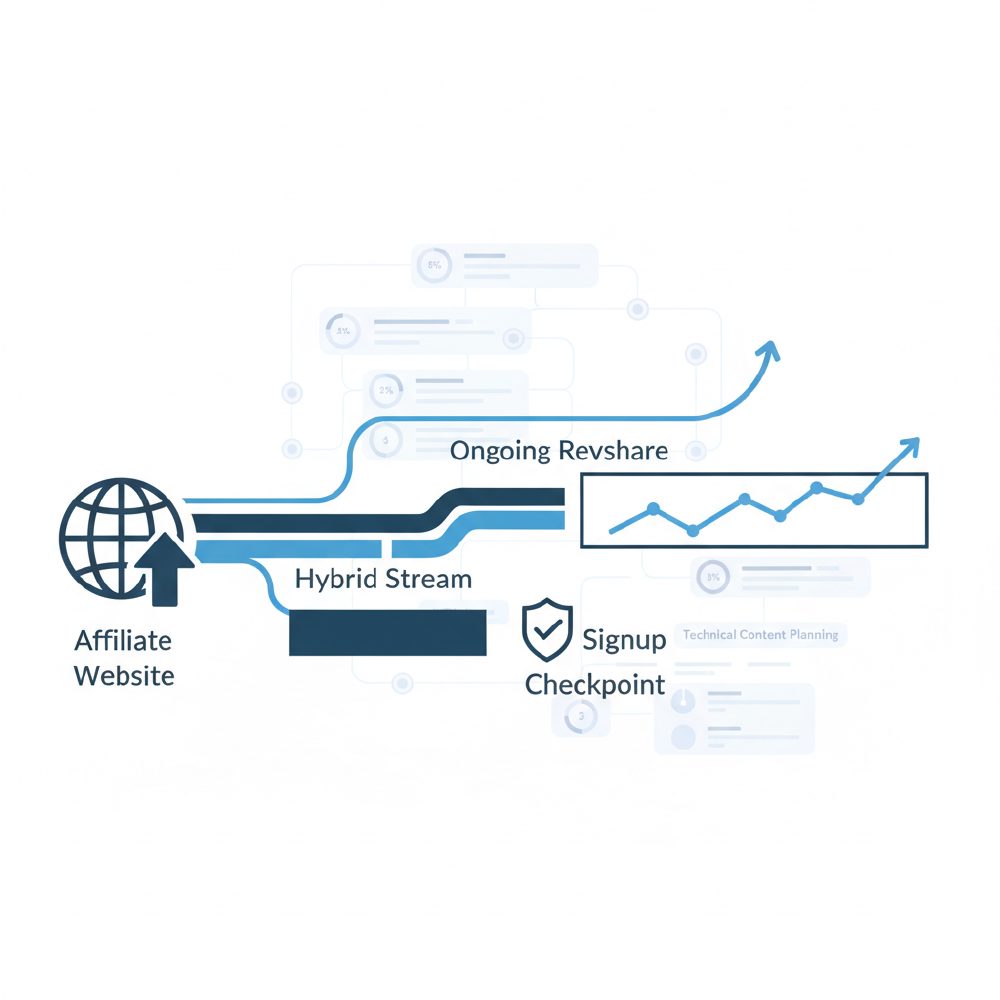
A hybrid deal pairs a reduced upfront CPA, commonly $50-$150, with a smaller revshare tail, typically 10-20% of NGR, so you get immediate cash flow plus long-term upside without full exposure to churn. Most Tier-1 networks now push hybrid as the default offer rather than pure revshare.
Three hybrid structures dominate the deals I see today. The most common is CPA-plus-tail: a flat fee on qualification, then a reduced revshare percentage for as long as the player stays active. Second is tiered CPA, where the flat fee scales with volume, more NDCs a month unlocks a higher per-player rate, similar logic to sliding-scale revshare but applied to the upfront fee. Third, less common but useful for established sites, is revshare-with-floor: a guaranteed minimum monthly payout regardless of player performance, protecting against a bad month without capping upside.
Operators like hybrid because it smooths their own cash outflow, they're not paying full CPA upfront while still incentivizing affiliates to send quality traffic that retains. Affiliates like it because it removes the multi-month wait for revshare to become meaningful while keeping the compounding upside pure revshare doesn't have on day one.
The trade-off is a slower ramp to peak earnings than either pure model at its best. A hybrid deal rarely beats a well-performing pure CPA deal on unproven traffic, and it rarely beats pure revshare on a mature, high-retention player base over 18+ months. It's the right default when you don't yet know which category your traffic falls into.
| Structure | Upfront component | Ongoing component | Best fit |
|---|---|---|---|
| CPA + tail | $50-$150 flat | 10-20% NGR, ongoing | New sites still proving traffic quality |
| Tiered CPA | $50-$400, volume-scaled | None or minimal | High-volume programmatic pages, unproven retention |
| RevShare with floor | None | 20-35% NGR + guaranteed minimum | Established sites with retention data |
How should commission model choice shape your programmatic content architecture?
I map commission model directly to page-tier priority: CPA-heavy hub pages get built and indexed fast for immediate cash flow, while revshare-driving long-tail pages get deeper editorial and internal-link investment because their payoff compounds over 12-24 months. It's an index-budget allocation decision, not just a commercial one.
On sites I've scaled from a few hundred to several thousand indexed pages, the biggest mistake is treating every programmatic page with identical content depth regardless of what commission model it's driving. Pages targeting comparison and "best casino for X" intent that feed CPA deals get built lean and fast, enough unique content to avoid thin-content flags, strong internal links, clear CTAs, because their value is captured the moment a player deposits, and additional content depth doesn't materially increase that payout.
Long-tail editorial pages, strategy guides, bankroll management, game-specific RTP breakdowns, tend to attract more patient, higher-retention traffic that operators value under revshare. Those pages earn deeper investment: original data, author bylines with disclosed gambling-industry experience, structured data, and heavier internal linking back into the hub pages. That's where topical authority actually compounds and where core-update resilience gets built, because Google's helpful-content systems reward exactly this kind of depth on YMYL topics.
Practically, this means index management decisions get tied to commission economics. I'll delay indexing on a batch of low-priority CPA pages until they clear a quality threshold in Search Console, but I'll fast-track crawl priority on revshare-cluster hub pages because their compounding value justifies the crawl budget spend sooner. Treat commission model as an input into your topical map, not an afterthought applied after content is already built.
What revshare percentages and CPA rates are operators actually paying in 2026?
Expect revshare of roughly 20-35% NGR in Tier-1 regulated markets (UK, Nordics, DACH), 25-40% in less saturated Tier-2 markets, and CPA ranging from $150-$400 in Tier-1 down to $50-$150 in Tier-3 offshore markets. These are directional benchmarks from deals I've reviewed, not a published rate card, actual terms vary by network and volume tier.
Tier-1 markets carry the tightest revshare ranges because competition among licensed operators keeps commission budgets disciplined, but CPA rates run highest here because regulated players carry higher average lifetime deposits and lower fraud risk. Tier-2 markets, much of regulated LatAm and Southern/Eastern Europe, often offer higher revshare percentages to compensate for lower average deposit sizes, but CPA sits noticeably lower.
Tier-3 and offshore markets are the widest variance band. I've seen offshore crypto casino programs offer revshare above 45% purely because player lifetime value data is thin and operators are trying to buy traffic quality signal, alongside CPA rates as low as $30-$50 because acquisition cost tolerance is lower in unregulated segments. Treat any number above the ranges below as either a short-term promotional push or a red flag on the operator's underlying financial stability.
| Market tier | Typical RevShare (% NGR) | Typical CPA ($) | Typical Hybrid (CPA + tail) |
|---|---|---|---|
| Tier 1 (UK, Nordics, DACH) | 20-35% | $150-$400 | $75-$150 + 10-20% |
| Tier 2 (rest of EU, regulated LatAm) | 25-40% | $80-$200 | $50-$100 + 12-20% |
| Tier 3 (offshore, emerging, crypto) | 30-45%+ | $30-$150 | $25-$75 + 15-25% |
How does negative carryover quietly erode your revshare earnings?
Negative carryover lets an operator roll a player's losing month forward against your future affiliate earnings, if a referred player wins big in month one, that deficit gets deducted from your revshare in later months until it's fully repaid, sometimes for years. Always get this clause in writing before signing anything.
Here's a realistic example: a player you referred wins $10,000 net in their first month. Under a standard negative carryover clause, that $10,000 becomes a debit against your future revshare from that player specifically, you earn nothing more from them until the operator's cost of that win is recovered from subsequent losing months. For a low-volume affiliate with only a handful of active referred players, one big win can zero out your income from that player for a year or more.
Some regulators are pushing back. The UK and Malta have both seen movement toward restricting or requiring clearer disclosure of carryover terms in affiliate contracts, but it's not a universal ban and enforcement varies by network and jurisdiction, don't assume protection you haven't confirmed in your own contract.
Negotiate a cap on carryover duration or amount before signing, or route higher-volatility, high-stakes-attracting content toward CPA or hybrid deals instead of pure revshare. If your content specifically attracts high-roller search intent, VIP program comparisons, high-stakes slot guides, pure revshare with uncapped negative carryover is the riskiest structure you can choose for that traffic segment.
How do you negotiate better hybrid terms with an operator or network?
Bring documented NDC volume, average deposit size and 90-day retention rate, not just traffic numbers. Once you can show 50+ qualified new depositing customers a month with decent retention, most programs will renegotiate from standard tiers to custom hybrid terms within one or two quarterly review cycles.
Networks respond to proof, not pitch decks. Pull your own conversion data from GA4 and reconcile it against the network's dashboard before any negotiation call, showing that your traffic converts at a specific rate with a specific average deposit size gives you leverage that generic organic-growth claims don't. If you can layer in Ahrefs or SEMrush visibility data showing sustained ranking growth in a keyword cluster feeding that traffic, it strengthens the case that the volume is durable, not a temporary spike.
Ask specifically for a negative carryover cap, escalation to a dedicated account manager rather than a general affiliate desk, and a 90-day trial period on any proposed hybrid terms before locking in a long-term contract. Competing offers from other operators in the same vertical are the strongest leverage, most networks will match or beat a documented competing rate rather than lose a proven traffic source.
Review cycles typically run quarterly at the larger networks. Don't expect a renegotiation to land faster than that unless your volume jump is dramatic, I've had networks fast-track terms within 30 days when a site's NDC volume tripled following a core-update recovery, but that's the exception, not the norm.
What compliance and regulatory shifts in 2026 affect which model you should choose?
UKGC, MGA and emerging US state regulators are tightening affiliate disclosure rules and restricting incentive structures that push vulnerable players toward high-deposit bonuses, nudging more programs toward hybrid or capped-CPA models. Expect disclosure requirements to show up on your own site, not just in the operator contract.
The UKGC's LCCP conditions already require affiliate marketing to avoid targeting self-excluded players and to display responsible-gambling messaging appropriate to the audience, that applies regardless of your commission model, but uncapped revshare with negative carryover creates a structural incentive to over-promote high-stakes play that regulators are watching more closely in 2026. The MGA has issued similar guidance on affiliate accountability, and in the US, state-level bodies like the New Jersey DGE and Ontario's AGCO now require affiliate registration and reporting in several regulated markets.
This is a YMYL trust issue as much as a legal one. Commission model interacts directly with editorial integrity, a site whose top-earning pages funnel traffic toward whichever operator pays the highest CPA regardless of player fit will eventually show up in helpful-content signal degradation, because that misalignment tends to produce thinner, less genuinely useful comparison content over time.
Document your commercial relationships as an E-E-A-T signal rather than hiding them. Author bylines disclosing industry experience, a visible editorial policy stating how operators are ranked or reviewed, and clear commission-model disclosure where required by jurisdiction all function as trust signals to both regulators and to Google's YMYL review criteria, and increasingly to AI answer engines evaluating source credibility for citation.
How do you track and report commission-model performance without breaking your SEO data?
Tag every operator link with a custom GA4 dimension for deal type, CPA, revshare or hybrid, route clicks through a dedicated redirect path, and reconcile network payout dashboards against GSC query-level data monthly. That reconciliation tells you which keyword clusters actually justify revshare-depth content investment versus CPA-only treatment.
Attribution windows are the first mismatch you'll hit. Network dashboards often use 30-90 day cookie or postback windows that don't line up with GA4's default attribution model, so raw click counts between your analytics and the network's reporting will never match exactly, build a monthly reconciliation process rather than trusting either source in isolation. Dedicated affiliate tracking platforms like Voluum or Everflow help bridge this gap by giving you click-to-conversion visibility independent of the network's own dashboard.
Feed this data back into your content prioritization model. If a keyword cluster driving CPA deals shows strong click volume but the operator's average deposit and retention numbers are weak, that's a signal to keep those pages lean rather than investing further content depth there. If a revshare-driving cluster shows rising organic visibility in Ahrefs alongside strong 90-day retention numbers from the network, that's your signal to double down with additional supporting content and internal links.
Cross-check crawl behavior against this same data using log file analysis or GSC's crawl stats report. Pages generating strong CPA conversions but poor crawl frequency are worth a technical audit, internal link equity or sitemap prioritization issues are often the cause, and fixing that crawl allocation issue frequently moves commission revenue faster than any content rewrite would.






Comments
No comments yet, be the first.