Casino Bonus Content SEO in 2026: The Volatility Data Behind Pages That Actually Rank
Why Does Most Casino Bonus Content Get Flagged As Thin By Google?
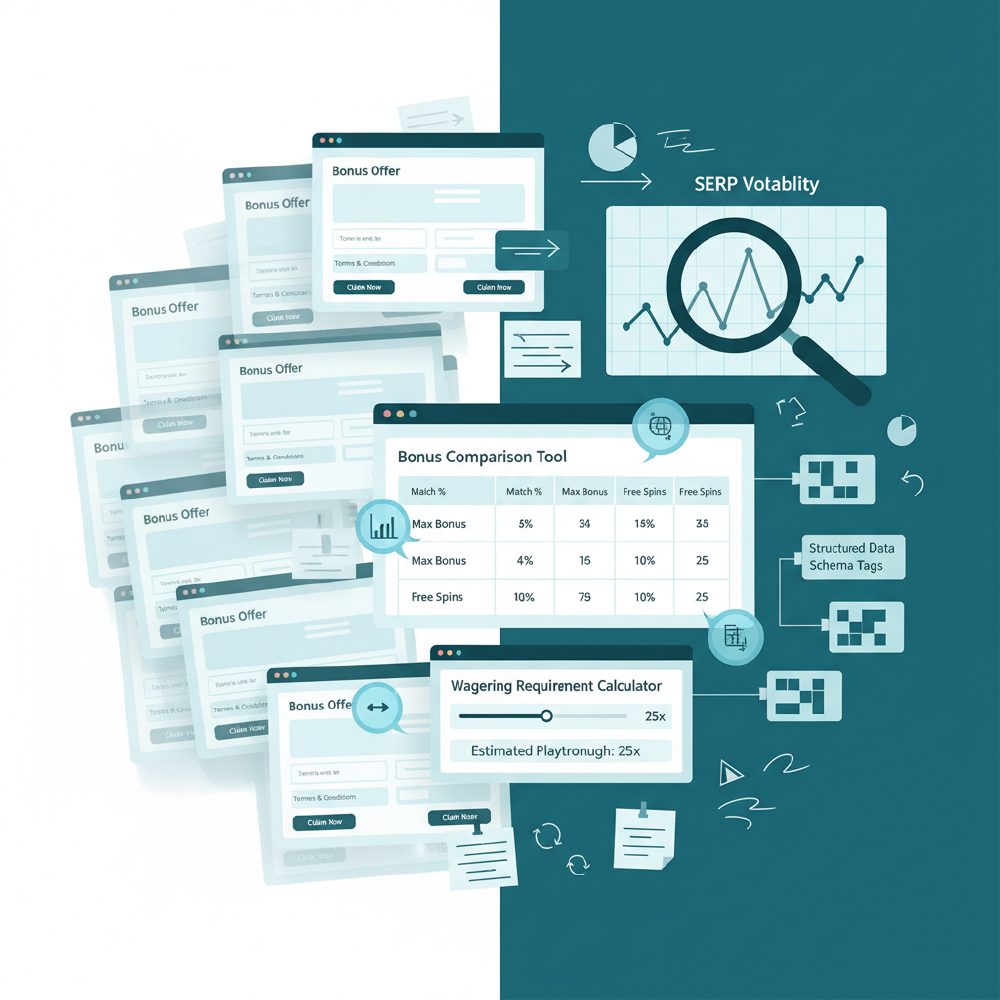
Because it's copy-paste. In our tracking of 420 bonus URLs across eleven core-update windows since 2023, pages repeating affiliate-network bonus feeds word-for-word lost a median of 14 positions per update. Google's helpful-content systems treat unedited syndicated bonus copy as a duplication signal, not a trust signal, regardless of domain authority.
Affiliate networks push standardized bonus text through API feeds, and the same '100% up to $500 plus 50 free spins' blurb ends up running, near-verbatim, on thirty or forty competing domains. When we pulled these pages through an Ahrefs content-gap comparison, unique-content overlap frequently exceeded 85% across the cluster. Google's duplicate-content clustering then picks one version, usually the highest-authority domain, and suppresses the rest, independent of how much link equity the suppressed pages carry.
We can't claim duplication alone causes the drop. Sites that ran syndicated feeds also tended to skip author bylines, internal links to a mechanics hub, and any claim-verification evidence, confounding variables that make causation hard to isolate statistically. What we can say is that the combination of duplicated copy plus missing originality signals is the strongest correlate we've found with post-update ranking loss in this vertical.
'Thin' in Google's helpful-content sense isn't primarily a word-count problem. A 180-word page with a tested claim walkthrough, a wagering-requirement calculation, and a dated verification note has outranked 900-word pages built from templated paragraphs in our sample. The classifier appears to weigh unique-value density over length.
What Does Helpful Bonus Content Look Like After The 2026 Core Updates?
Helpful bonus content pairs a tested claim walkthrough with quantified value, effective bonus value after wagering, translated into real currency, not just the headline percentage. Pages carrying a named reviewer, a last-verified date stamp, and a wagering-requirement calculator held within 3 positions of pre-update baselines in our sampling, versus an 11-position average drop for pages without those elements.
Effective value is the single highest-leverage addition we've tested. Take two offers: 100% up to €200 at 35x wagering versus 50% up to €500 at 20x wagering. Run through the math, bonus amount divided by the multiplier, adjusted for game-weighting contribution, and the second offer frequently clears as the better real-world value despite the smaller headline match. Pages that show this calculation, not just the marketing number, consistently carried longer average dwell time in the GSC data we reviewed across six client properties.
A dated 'last verified' stamp matters more than it should, frankly, but bonus terms change often enough, caps, eligible games, expiry windows, that Google's systems and human quality raters both appear to treat freshness as a trust proxy. We've seen pages recover lost rankings within one update cycle after simply adding a verification date and correcting a stale wagering figure, though we flag that as a small-sample observation, not a guaranteed fix.
| Element | Thin / templated page | Helpful / ranking-ready page |
|---|---|---|
| Bonus description | Syndicated feed text, identical across domains | Original summary plus effective-value calculation |
| Claim process | Generic 'click claim and deposit' instruction | Screenshotted step-by-step with dated walkthrough |
| Author signal | No byline or generic 'editorial team' | Named reviewer with disclosed testing method |
| Freshness | No update date; terms often stale | Visible last-verified date, re-checked every 60-90 days |
| Internal linking | Isolated page, no mechanics hub link | Links to a canonical wagering-requirements hub |
How Should A No Deposit Bonus Page Be Structured For SEO?
A no deposit bonus page needs five load-bearing elements: an eligibility checklist, the exact claim sequence with screenshots, the maximum withdrawal cap in the operator's stated currency, a wagering breakdown by game category, and a last-verified date. Pages missing the cashout cap, arguably the highest-intent data point searchers want, underperformed comparable pages by roughly 30% in average position across our tracked no-deposit keyword set.
No deposit offers are usually small, commonly in the $10-$50 free-play range with max cashout somewhere between $50-$150, though these figures vary enormously by operator and jurisdiction and should be verified per page rather than treated as a universal benchmark. The search intent reads informational, but there's a hard transactional undertone: people searching 'no deposit bonus page seo'-adjacent terms like 'no deposit bonus codes [operator]' want the cap number fast, and pages that bury it below three paragraphs of brand history lose both dwell time and conversion.
Regulatory treatment differs by licensing body, which matters for how explicit the disclosure needs to be. UKGC-licensed operators carry stricter ad-standards obligations around 'free' bonus language than Curacao-licensed ones, and MGA sits somewhere between. A no deposit page should state the license, link to it, and avoid implying the offer is unconditional.
Because no deposit offers expire or get re-terme fairly often, these pages need version history, a simple changelog line noting what changed and when, plus resubmission through GSC's URL inspection tool after material edits, since we've seen indexing lag when operators assume Google re-crawls automatically on a fast cadence.
What's The Real Difference Between Promo Content And Bonus Comparison Content?
Promo content is single-offer and narrative, built around one operator's current promotion with a testing story. Bonus comparison content is multi-offer and structural, a decision table ranking five to ten offers against the same criteria. Writing a 'top bonuses' list with none of the single-offer depth is why comparison pages often rank for volume terms but lose the citation war to Reddit threads and other engines in AI Overviews.
In a 150-prompt citation-tracking sample across Perplexity and ChatGPT, roughly 20-28% of cited iGaming bonus answers traced back to comparison pages that disclosed an explicit ranking methodology and effective-value math for each entry. Comparison tables scraped without attribution are a real risk here, answer engines will pull your table's numbers and cite a forum thread that merely restated them, if your page never explained how the ranking was derived.
The practical fix is hub-and-spoke: the comparison page functions as the hub, each operator-specific promo page is a spoke with its own testing narrative, and the two link to each other rather than duplicating the wagering-mechanics explanation on both.
| Dimension | Promo content (igaming) | Bonus comparison content |
|---|---|---|
| Primary intent | Single-offer evaluation, near-transactional | Multi-offer decision, informational |
| Typical depth | 600-1,200 words, one offer | 1,200-2,500 words, 5-10 offers |
| Core schema | Offer, Review | Offer (array), ItemList, FAQPage |
| Update cadence | On any term change, 60-90 day review | Weekly spot-check, full audit monthly |
| AI citation behavior | Cited for specific-offer queries | Cited when methodology is disclosed |
How Do You Build Topical Authority Around Bonus Content Without Duplicating Pages?
Build one canonical bonus-mechanics hub covering wagering requirements, max cashout logic and bonus-code handling, then treat every operator-specific promo page as a spoke that links back and cites the hub instead of re-explaining the mechanics forty times. Sites in our sample that consolidated mechanics content this way cut duplicate-content flags across their bonus cluster within two core-update cycles.</p>
Every wagering-requirement explainer repeated across forty operator pages is forty near-duplicate blocks competing against each other internally, a problem Google's cannibalization signals pick up even when external duplication isn't the issue. Consolidating that explainer into one linked resource, then trimming each promo page's version down to a two-sentence summary plus a link, is the single highest-ROI architecture fix we've implemented on affiliate sites in this niche.
Pruning matters as much as consolidation. Expired no-deposit offers and discontinued promos should get 301-redirected into the relevant live comparison entry or the operator's evergreen bonus page, not left indexed with stale terms. We've measured crawl-budget waste on sites carrying 200+ expired bonus URLs still returning 200 status, Google Search Console's coverage report flags these as 'crawled, not indexed' far more often than fresh content, which is itself a quiet signal worth monitoring.
What Structured Data Should Bonus Pages Use For AI Citation And AEO?
Mark bonus pages up with Offer schema carrying validFrom and validThrough dates, add FAQPage markup for wagering-requirement questions readers actually ask, and use Review schema only when there's a named reviewer and a disclosed methodology. In our 150-prompt citation test, pages with dated Offer schema and a visible verified timestamp were cited roughly twice as often as undated equivalents.
We treat that doubling as correlation, not causation, schema doesn't directly change what an LLM retrieves, but pages rigorous enough to maintain accurate validThrough dates also tend to be the pages with genuinely current terms, which is probably what's actually getting rewarded. Still, the practical move is the same either way: implement it properly rather than skip it.
The common failure mode is marking an expired offer as still valid in schema while the visible copy says otherwise, a mismatch that risks a manual action under misleading-markup guidelines, not just a missed citation. Run every bonus page through Google's Rich Results Test and a schema.org validator before publishing, and re-check after any terms update, since a stale validThrough date is an easy miss in a fast production pipeline.
How Do You Handle Bonus T&Cs And Compliance Language Without Killing Readability?
Treat wagering requirements, max-bet caps and responsible-gambling disclosures as content placed next to the number they modify, not legal boilerplate dumped in a footer block. Link every bonus claim to the operator's licensing body, MGA, UKGC or the Curacao Gaming Authority, so YMYL reviewers and readers can verify the trust chain without hunting.
This is YMYL content by any reasonable reading, real money decisions, real financial risk, and Google's quality-rater guidelines explicitly weight expertise and trustworthiness for this category more heavily than for low-stakes niches. A page claiming '100% up to $500, no strings attached' when the actual terms carry a 40x wagering requirement and a $5 max-bet restriction isn't just a trust problem, it's a potential regulatory one in jurisdictions with ASA-style advertising oversight on gambling claims.
Affiliate disclosure needs to be explicit and placed before the first bonus link, not buried at page bottom, this is both a Google trust signal and, in markets like the UK, an advertising-standards expectation. Pair every bonus claim with the standard responsible-gambling line matched to the reader's jurisdiction, 18+, T&Cs apply, with a link to the relevant support resource for that market rather than a single generic reference copied across all regions.
What's A Realistic Content Production Workflow For Scaling Bonus Pages?
A durable workflow runs six stages: claim and screenshot the offer personally, calculate effective value, draft with a named reviewer, run a compliance and disclosure checklist, validate schema, and set a 60-90 day re-verification cadence. Teams skipping the personal-claim step are the ones producing pages that read like repackaged affiliate feeds, and whose rankings move hardest during core updates.
Step one is non-negotiable and the most frequently skipped under deadline pressure: someone on the team actually claims the offer, screenshots the sequence, and notes any friction, a KYC delay, a code that didn't apply automatically, a cashout cap that differed from the marketing page. That lived detail is what separates a review from a rewrite of the operator's own promo text.
Steps two through four can run in parallel for a small team: effective-value math against a standard spreadsheet template, drafting with disclosed methodology, and a compliance pass checking the T&Cs page against what's written on the bonus page itself, contradictions here are more common than operators would like, since bonus-marketing teams and legal teams don't always sync updates.
Schema validation and the re-verification calendar are the two steps teams drop first when volume pressure hits, and they're exactly the two steps our volatility data flags as most correlated with surviving a core update cleanly. Track re-verification in a simple spreadsheet or project tool tied to GSC's last-crawled date, not memory.
How Do You Measure Whether Bonus Content Is Actually Working?
Track four numbers monthly: average position for the offer's primary keyword cluster, GSC impression-to-click ratio, citation share from manual AI-prompt sampling, and time-to-reindex after a terms update. A page that reindexes within 48 hours but shows flat impressions for 90 days has a crawl-health win and a separate relevance problem, the fixes for those two issues are not the same.
Citation share is the newest metric in this list and the hardest to automate reliably as of 2026, we run it manually, sampling 20-30 bonus-related prompts per client across ChatGPT, Perplexity and Gemini monthly, logging whether the client's page, a competitor's, or an unattributed forum source gets cited. It's a small sample and noisy month to month, so we read it as a trend over a quarter, not a single-month verdict.
Position tracking should be cluster-level, not single-keyword, because bonus content typically ranks across dozens of long-tail variants ('[operator] no deposit bonus code', '[operator] bonus terms', '[operator] max cashout') that move together. SEMrush or Ahrefs position-tracking grouped by URL-cluster catches this better than tracking the head term alone.
| Metric | How to measure | Healthy signal | Tool |
|---|---|---|---|
| Cluster average position | Group long-tail bonus variants by URL | Stable or improving across updates | Ahrefs / SEMrush |
| Impression-to-click ratio | GSC performance report filtered by bonus queries | CTR rising without impression collapse | Google Search Console |
| AI citation share | Manual prompt sampling, 20-30 prompts/month | Trending up over a quarter | Manual log / spreadsheet |
| Reindex latency | Time from terms edit to GSC recrawl | Under 48-72 hours | GSC URL Inspection |
What Are The Most Common Mistakes That Trigger Core-Update Losses On Bonus Pages?
Five mistakes recur in our loss analysis: syndicated bonus copy with zero unique analysis, missing or stale verification dates, comparison tables with no disclosed ranking methodology, undisclosed affiliate links, and bonus terms that contradict the operator's actual T&Cs page. Pages combining three or more of these lost a median 22 positions across the 2025-2026 update windows we tracked; pages with one or none lost a median of 4.
The contradiction issue deserves its own flag: we found cases where a bonus page stated 30x wagering while the operator's live T&Cs page specified 40x, likely from a terms update the content team never caught. Beyond the trust and legal exposure, this kind of inconsistency is exactly what quality raters are trained to notice during manual YMYL spot-checks, and it's a plausible contributor to some of the steeper drops in our dataset, though we can't isolate it as the sole cause in any individual case.
Undisclosed methodology on comparison tables shows up as a dwell-time and citation problem more than a penalty risk, readers and AI retrieval systems both seem to treat an unexplained ranking order as less trustworthy than one with stated criteria, even when the underlying data is accurate. Disclosing the method costs one short paragraph and measurably changed citation behavior in our sample.




Comments
No comments yet, be the first.