Is Casino SEO Worth It in 2026? The AEO-Era ROI Math for Operators and Affiliates
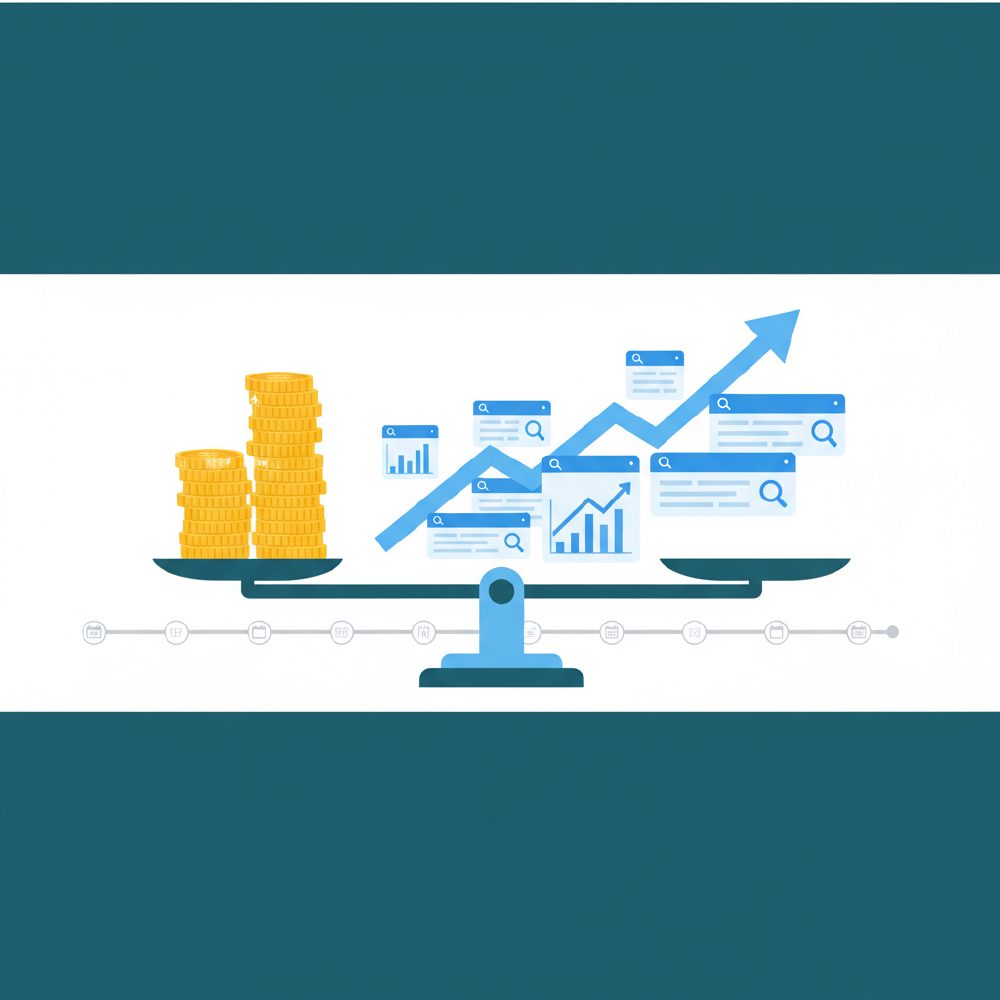
Is Casino SEO Still Worth It in 2026, or Should You Just Buy Traffic?
Yes, if you have an 18-24 month horizon and at least $3,500/month to sustain it, organic casino traffic converts at a fraction of paid CPC once rankings mature. If you need deposits or leads inside 90 days, reallocate budget to PPC or affiliate media buying instead.
Google Ads certification for gambling advertisers is a gate, not a guarantee, you still pay CPCs of $8 to $45+ on commercial casino terms depending on market, with UK, Ontario and Nordic queries sitting at the top of that range. Ad slots are also limited: Google typically shows two to four gambling ads above organic, so even a well-funded PPC campaign is fighting for a sliver of visible real estate against sites that rank organically for free once they've earned it.
The compounding effect is where SEO actually wins the ROI argument. A review page built and optimized in month three keeps earning organic sessions in month twenty-four without incremental spend, while a PPC campaign stops producing the moment you pause the budget. I've tracked affiliate clients pulling 10,000-15,000 organic sessions a month on a single 'best online casino [region]' hub page, replicating that volume at a $20 average CPC would cost roughly $200,000-$300,000 a month in paid media. That's the delta that makes the math work, but only after the ranking is secured.
The honest caveat: casino SEO is worth it for operators and affiliates who can commit to 12+ months of consistent investment and who accept YMYL-level content and compliance scrutiny. If your business model needs immediate volume, a new market launch, a license renewal deadline, a seasonal promo, SEO is the wrong lever this quarter. Run it in parallel with paid, not instead of it.
What Does Casino SEO Actually Cost in 2026?
A compliant casino SEO program costs $3,500-$8,000/month for a boutique affiliate site and $10,000-$25,000+/month for an operator competing in regulated markets like the UK, Ontario or Sweden. Costs scale with content production, gambling-specific link acquisition, and legal/compliance review, not just agency fees.
Content is the biggest line item, and it's more expensive than in most niches because gambling is YMYL (Your Money or Your Life) content under Google's quality guidelines. A properly researched, fact-checked casino review with a named author bio, license verification and responsible-gambling disclosures runs $300-$1,200 per article depending on depth and whether legal review is included. Thin 500-word reviews written without SME input are exactly the content Google's helpful-content systems are tuned to suppress, so cutting corners here doesn't save money, it delays or kills ROI.
Link building costs run high because most general-niche link vendors won't touch gambling, and the ones that will often charge a premium: expect $500-$3,000 per placement for genuinely relevant, editorially earned links on gaming, sports or finance publications. Avoid vendors selling casino links in bulk under $200, those are usually PBN or expired-domain networks that create exactly the kind of unnatural link profile that gets flattened in a core update.
Tooling and technical work add another $1,500-$4,000/month at scale: Ahrefs or SEMrush enterprise tiers ($400-$1,000/mo), Screaming Frog for crawl audits, schema markup implementation for AI/AEO visibility, and dev time for Core Web Vitals and structured data. Enterprise operators also carry compliance review costs, legal sign-off on claims, geo-targeting, and responsible gambling messaging, that boutique affiliates often skip but shouldn't.
| Tier | Monthly spend | Typical scope |
|---|---|---|
| DIY / in-house (1 person) | $2,000-$4,000 | Content + basic technical SEO, no dedicated link building |
| Boutique agency retainer | $3,500-$8,000 | Content, on-page, light link acquisition, monthly reporting |
| Enterprise/operator program | $10,000-$25,000+ | Full content team, compliance review, link acquisition, digital PR, AEO/schema |
| Freelance SEO consultant | $1,500-$5,000 | Strategy and audits only, execution outsourced separately |
How Do You Calculate Real ROI on Casino SEO Spend?
ROI = (organic revenue attributable to SEO minus total SEO spend) divided by total SEO spend. For affiliates, revenue equals qualified referrals times CPA or revenue-share value; for operators, it's organic sign-ups times customer lifetime value. Track it monthly against a 90-day rolling average, not week to week.
Start with traffic value, not vanity rankings. If a page ranks for 'best crypto casino [market]' and pulls 3,000 organic sessions/month at a 2.5% conversion-to-signup rate, that's 75 qualified referrals. At a typical affiliate CPA of $150-$300 in a competitive regulated market, that single page is worth $11,250-$22,500/month once it's ranked, against a production and maintenance cost that's usually under $500/month by that point. That's the calculation that justifies the upfront investment.
For operators, swap CPA for lifetime value. If organic acquisition costs you $0 per player past the initial content investment, and average player LTV in your market is $400-$1,200 depending on vertical (slots vs sportsbook vs live casino), the ROI ceiling is much higher than paid channels where CPA stays fixed or rises with competition. The trap operators fall into is measuring ROI against last-click GA4 attribution alone, organic assists a huge share of conversions that get credited to branded search or direct, so pure last-click undercounts SEO's real contribution by 20-40% in my experience across affiliate and operator dashboards.
Run the ROI formula monthly, but judge it on a rolling 90-day basis. Casino SEO has ranking volatility, a page can swing five positions in a week from a minor algorithm tremor, and reacting to single-week revenue dips leads to premature budget cuts on programs that are actually on track.
How Long Until Casino SEO Actually Pays Back the Investment?
Affiliates typically see payback in 9-18 months on mid-competition keywords; operators in regulated markets usually need 12-24 months because YMYL trust signals and licensing entity pages take longer to earn topical authority. New domains in high-competition markets like the UK or US can take 24+ months to break into page-one visibility.
Keyword difficulty is the biggest timeline variable. In Ahrefs, terms like 'online casino' or 'best online casino [country]' routinely sit at KD 70-90 in mature markets, that's a domain-authority fight, not a content fight. Long-tail commercial terms like 'best low-deposit casino [city/region]' or '[operator] vs [operator] bonus comparison' sit at KD 15-35 and can rank in 3-6 months on a domain with some existing trust, which is why smart affiliates build topical breadth through long-tail hub-and-spoke content before chasing head terms.
Domain history matters more in gambling than almost any other YMYL vertical. A fresh domain with no backlink history and no author E-E-A-T signals, no named reviewers, no verifiable gambling licenses referenced, no editorial policy page, will struggle to rank for anything competitive regardless of content quality, because Google's systems are calibrated to be conservative with money/health/safety queries from unproven sources. I've seen established domains with strong author bylines rank new pages in 60-90 days for terms that would take a brand-new site 12+ months.
Regulated markets add a second timeline layer: content has to reference actual license bodies (UKGC, MGA, Kahnawake Gaming Commission, Ontario's AGCO) accurately and stay current as regulations shift, or trust signals erode. Operators launching in a newly regulated market, Ontario's 2022 launch is the clean recent example, have a narrow window where topical authority is cheap to build because competition hasn't consolidated yet. Miss that window and payback timelines stretch significantly.
Casino SEO vs PPC vs Buying Affiliate Traffic, Which Actually Delivers Better ROI?
SEO wins on long-term ROI and cost-per-acquisition once rankings mature, typically beating PPC by 3-8x on cost efficiency after month 12. PPC wins on speed and predictability for launches or promos. Buying affiliate traffic (media buys, influencer placements) sits in between, fast but with thinner margins and less compounding value.
PPC's advantage is control: you know your CPA on day one and can scale spend linearly with results, which is exactly why it's the right channel for a license launch, a time-boxed promo, or testing a new market's conversion behavior before committing to a 12-month SEO build. Its weakness is that the moment you stop paying, traffic goes to zero, there's no residual asset.
Buying affiliate traffic, paying established affiliates flat placement fees or inflated CPAs to get featured on their existing rankings, gets you into page-one visibility faster than building your own SEO, sometimes within weeks. But margins are thinner because you're paying a premium for someone else's earned authority, and you have zero control if that affiliate's rankings drop or their site gets hit by a core update.
SEO is the only channel of the three that builds an owned, compounding asset. The trade-off is patience and tolerance for algorithmic volatility, a page that's converting well in March can lose 30% of its traffic after a June core update if E-E-A-T signals weren't solid. The realistic strategy most profitable operators and affiliates run is PPC or buying traffic for the first 6-9 months of a launch while SEO investment matures in parallel, then shifting budget weight toward organic as it starts outperforming.
| Channel | Time to results | Cost-per-acquisition trend | Compounding value |
|---|---|---|---|
| Casino SEO | 9-24 months | Falls sharply after month 12, near-zero marginal cost at scale | High, asset persists after spend stops |
| PPC (Google/Bing Ads) | Immediate | Flat to rising as competitors bid up CPCs | None, stops when budget stops |
| Buying affiliate traffic/placements | 2-8 weeks | High and often rising (renegotiated fees) | Low, dependent on third-party site's rankings |
What ROI Can You Realistically Expect at 6, 12 and 24 Months?
At 6 months, expect early long-tail rankings and modest traffic with ROI often still negative. At 12 months, mid-tier keywords convert and ROI typically turns positive for affiliates with focused programs. At 24 months, mature domains see 3-8x ROI as head-term rankings and topical authority compound.
These are directional ranges based on patterns across affiliate and operator SEO programs I've tracked, not guarantees, competitive intensity in your specific market moves them significantly. A crypto casino affiliate targeting a low-regulation market can beat these timelines; an operator targeting UK slots keywords against established brands like a major sportsbook's casino vertical will likely trail them.
The 6-month mark is where most stakeholders get nervous, because spend has been consistent but revenue attribution is thin, this is normal, not a sign the program is failing, as long as GSC shows impressions climbing even if clicks lag. The 12-month mark is the real inflection point: this is when long-tail content built in months 1-6 starts ranking on page one for terms with real commercial intent, and when link equity from months 3-9 starts contributing to domain-level trust that lifts the whole site, not just individual pages.
By 24 months, a well-run program should be producing ROI in the 3-8x range on total SEO spend for affiliates, with operators seeing lower multiples (1.5-4x) because customer acquisition cost benchmarks are higher and player LTV takes longer to fully attribute. If you're past 24 months with flat or negative ROI, the problem usually isn't the channel, it's thin content, an unnatural link profile, or a site that never built genuine topical authority in the first place.
| Milestone | Typical traffic state | ROI expectation |
|---|---|---|
| Month 6 | Long-tail rankings emerging, impressions rising in GSC | Usually negative or break-even |
| Month 12 | Mid-tail keywords converting, some head-term movement | Break-even to 1.5-2x for affiliates |
| Month 24 | Topical authority established, head terms ranking | 3-8x for affiliates; 1.5-4x for operators |
How Does AI Overviews and AEO Change the Casino SEO ROI Equation in 2026?
AI Overviews and AI chat answers reduce click-through on informational queries but create a new ROI channel: citation-driven brand trust. Content structured for entity clarity and cited inside ChatGPT, Perplexity or Gemini answers builds consideration even on zero-click impressions, which I've seen lift branded search volume 15-30% for clients we've optimized for AI citation.
I've been tracking gambling query behavior across AI Overviews since the first rollout, and the pattern is consistent: informational queries like 'how does casino wagering requirement work' or 'is [payment method] safe for online casinos' now frequently surface an AI-generated answer before any organic result, cutting click-through on that query type by 20-40%. That's a real ROI hit if your content strategy was built purely around informational traffic volume.
But the same structural work that gets you cited inside an AI Overview, clear entity definitions, structured data (FAQPage, Review, Organization schema), named author expertise, and content that directly answers a question in the first 50 words, also gets you cited inside ChatGPT and Perplexity answers for commercial comparison queries. That's a channel with near-zero existing competition in most gambling niches right now, because most operators and affiliates haven't adapted their content architecture for it yet. Clients we've restructured for AEO have gone from appearing in zero tracked AI citations to leading share-of-voice on their core comparison queries within 4-6 months, which shows up downstream as lift in branded search and direct traffic, the two hardest-to-fake trust signals in this niche.
The ROI math here is still forming, and I'll flag that honestly: attribution for AI-citation-driven brand lift is imprecise compared to clean organic click tracking. What's not speculative is the cost side, schema implementation and answer-first content restructuring typically add only 10-15% to an existing content budget, and it's the same infrastructure that improves classic featured-snippet and People Also Ask performance. Treat AEO as a low-incremental-cost extension of your existing SEO program, not a separate budget line.
What Kills Casino SEO ROI Before It Ever Materializes?
The three biggest ROI killers are thin YMYL content that fails Google's helpful-content standards, manipulative or bulk-purchased links that trigger manual actions or algorithmic devaluation, and abandoning a program at month 6-9 right before compounding kicks in. Core updates don't invent new penalties, they expose sites that were already weak on these fronts.
Google's core updates and helpful-content systems don't target gambling content specifically, they target the pattern of content produced to rank rather than to genuinely inform, and casino affiliate content is disproportionately built that pattern because the commercial incentive to publish fast, thin comparison pages is so strong. Sites hit hardest in the 2023-2024 core updates were almost always running templated 'top 10 casino' pages with duplicated review structures, no named authors, and no evidence the writer had actually used the products described.
Link profile composition is the second silent killer. A site that built its early link equity through PBNs, link farms, or bulk gambling-niche link packages looks fine in Ahrefs referring-domain counts right up until a link-spam algorithm update devalues that entire network overnight, I've seen affiliate sites lose 60-80% of organic traffic in a single week from exactly this pattern. Diversify anchor text, prioritize contextual relevance over domain authority alone, and treat any vendor promising guaranteed casino links at scale as a red flag.
The third killer is organizational, not technical: stakeholders pulling budget at month 6-9 because ROI looks flat, right before the compounding effect of months 1-6 content and links would have started paying off. If you're going to commit to casino SEO, commit to a minimum 12-month runway with clear leading indicators (impressions, average position, referring domains) tracked separately from lagging revenue indicators, that separation is what keeps programs funded through the slow middle period.
Does the ROI Math Differ for Operators vs Affiliates?
Yes. Affiliates model ROI against CPA or revenue-share deals and need traffic diversification because a single operator's commission cut hurts one revenue stream, not the whole business. Operators model ROI against customer lifetime value and retention, so SEO investment pays back more slowly but at a higher ceiling once player LTV compounds.
Affiliate ROI is transactional and immediate by design: a qualified referral converts to a CPA payout (typically $100-$350 in regulated markets, lower offshore) or a revenue-share cut (usually 25-40% of net gaming revenue for the player's lifetime, sometimes capped). This makes affiliate ROI easier to calculate cleanly but also more fragile, if an operator partner cuts commission terms or delists from your program, revenue drops instantly regardless of your traffic quality. The best affiliate ROI models I've built diversify across 4-6 operator partners per vertical page so no single commission change threatens more than 20-25% of that page's revenue.
Operator ROI is structurally different because you're not paying a third party for the referral, you're acquiring your own customer. That means the real payback metric isn't the first deposit, it's LTV over 6-24 months, which is much harder to attribute cleanly to organic search versus retention marketing, CRM, and brand campaigns working in parallel. Operators also carry compliance overhead affiliates often don't, responsible gambling messaging, self-exclusion tool visibility, jurisdiction-specific licensing disclosures, that adds cost but also builds the exact trust signals Google rewards in YMYL content.
One practical difference worth flagging: operators can afford to invest in brand and entity-level SEO (Knowledge Panel presence, Organization schema, digital PR) that pays back through direct and branded search lift even when informational traffic gets absorbed by AI Overviews. Affiliates rarely have that brand-equity option, which is exactly why AEO citation inside comparison-style AI answers matters disproportionately more to affiliate ROI models than to operator ones.
How Should You Report Casino SEO ROI to Stakeholders or Investors?
Separate leading indicators (impressions, keyword rankings, referring domains, AI citation share) from lagging indicators (organic revenue, ROI multiple) in every report. Show 90-day rolling trends, not weekly snapshots, and explicitly flag core update windows so volatility doesn't get mistaken for program failure.
The single biggest reporting mistake I see is presenting one blended dashboard with traffic and revenue on the same chart with no context for algorithm volatility. Pull impressions and average position data straight from Google Search Console and chart them against known core update dates (Google publishes these) so stakeholders can see whether a dip correlates with a platform-wide event or something specific to your program. That context alone prevents premature budget cuts.
For revenue attribution, use a blended model rather than pure last-click GA4: track assisted conversions where organic touches appear anywhere in the path, and for affiliates, tie specific landing pages to specific operator tracking links so you can attribute revenue at the page level, not just site-wide. Ahrefs and SEMrush rank-tracking data paired with GA4 assisted-conversion reports gives a defensible, if imperfect, picture.
Increasingly, I recommend adding a fourth metric stakeholders haven't historically tracked: AI citation share. Tools for this are still maturing, but manual tracking, running your core comparison queries through ChatGPT, Perplexity and Gemini monthly and logging whether your brand or content gets cited, gives you an early signal on AEO-driven brand lift months before it shows up in branded search volume or direct traffic. Reporting this alongside classic SEO KPIs positions the program as forward-looking rather than reactive, which matters when you're asking for budget renewal on a channel that takes 12+ months to prove out.




Comments
No comments yet, be the first.