White-Label iGaming SEO in 2026: The SEOiGaming Agency Playbook for Scaling Casino Networks and B2B Brands
What is white-label iGaming SEO and how does it differ from single-brand casino SEO?
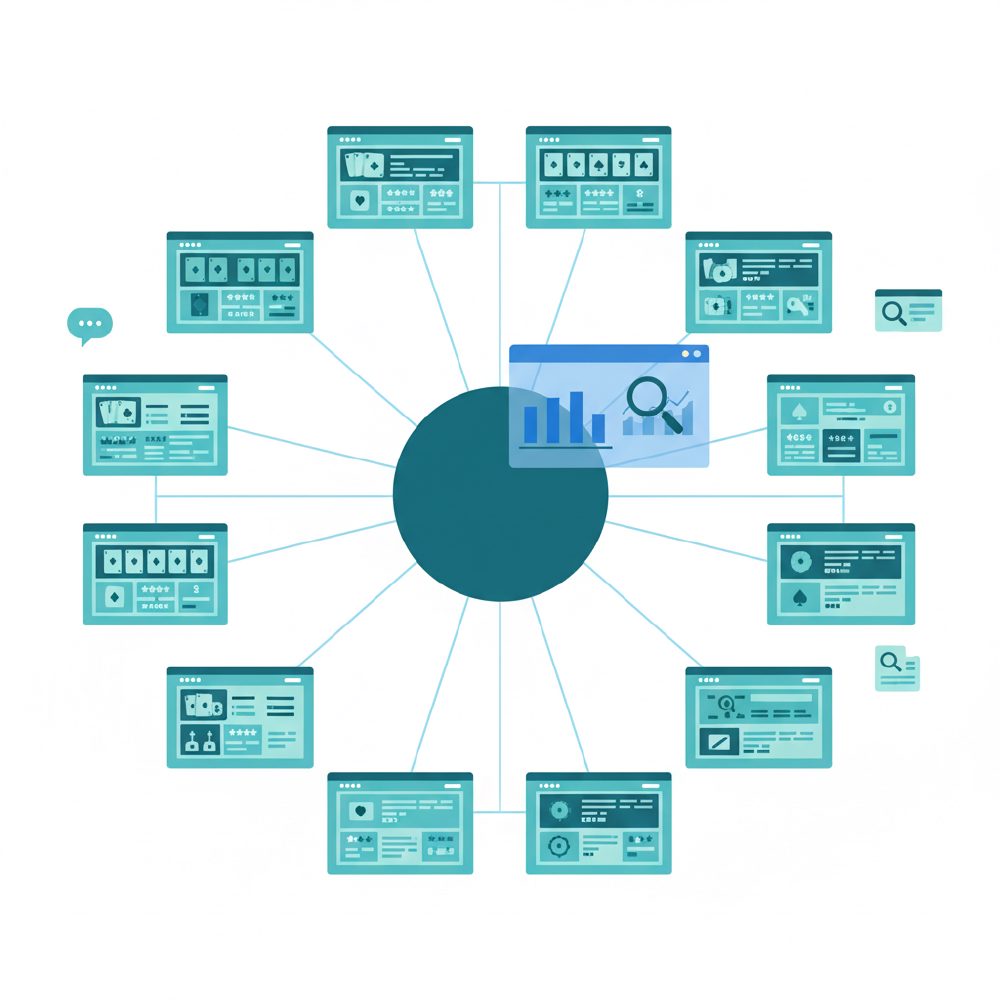
White-label iGaming SEO applies one repeatable strategy, content workflows, technical architecture, schema templates, across multiple casino or sportsbook skins built on the same platform but launched under different brand names. Unlike single-brand SEO, it has to solve shared infrastructure, near-identical templates and diluted authority across five, twenty or fifty properties at once.
The typical scenario I audit looks like this: an operator licenses a platform, SoftSwiss, EveryMatrix, Aspire Global or Digitain are the usual names, and launches 10 to 40 skins targeting different geos or verticals. Marketing wants organic parity with the network's flagship brand, but the underlying stack (game lobby layout, T&Cs pages, payment method blocks) is often 80-95% identical across skins by default. That's the entire problem in one sentence: shared code, but Google evaluates each domain's content on its own merits.
Single-brand SEO is comparatively simple, one domain, one authority curve, one keyword map built around bonus reviews, game guides and payment pages. Turnkey network SEO means building a playbook that's templated in process but not duplicated in output: unique bonus copy, unique review verdicts, localized payment-method pages, distinct author bylines, applied brand by brand rather than copy-pasted.
The trade-off most networks get wrong is speed versus differentiation. A turnkey provider can spin up a technically clean site in six to eight weeks. If 70% of the content is reused CMS boilerplate, though, Google's helpful-content systems, folded into core updates since March 2024, will flag it eventually. I've seen networks lose 40-60% of organic sessions across 15+ skins in a single core update because the platform's default templates were never differentiated past the logo swap.
How do turnkey SEO providers price network-scale iGaming campaigns in 2026?
Turnkey iGaming SEO is priced per brand-tier, not as a flat project fee, expect $2,500-$6,000/month for a single satellite skin, $15,000-$45,000/month for a 10-20 brand network, and $45,000-$120,000+/month for enterprise portfolios of 20-50+ skins with dedicated content, link and technical pods.
Deliverables scale with tier. At the low end you get a technical audit, a shared schema library and templated content batches, enough to launch a skin correctly but not enough to compete for volume terms. Mid-tier retainers add a dedicated content calendar per brand, geo-localized landing pages (Ontario's iGO-regulated bonus disclosures read nothing like a Curacao-licensed offshore equivalent), and individual author E-E-A-T profiles rather than a generic 'Editorial Team' byline repeated across every skin.
Enterprise deals fund entity building work that most networks skip: digital PR to earn independent brand mentions, Wikidata entries, and AI-citation tracking through tools like Profound or Otterly.AI. That last category matters more every quarter, I'm tracking client share-of-voice inside ChatGPT and Perplexity answers, and skins with zero independent press footprint simply don't surface, regardless of how clean the on-page SEO is.
Some agencies now blend retainers with a revenue-share component tied to net gaming revenue attributed to organic traffic, typically 5-15% of organic-attributed NGR on top of a reduced base fee. That model only works if the platform's back office (SoftSwiss and Digitain both support this) can pass postback data into GA4 cleanly. Without solid attribution, revenue share becomes a negotiation nightmare, not a pricing advantage.
| Network tier | Brands/skins | Monthly retainer range | Typical deliverables |
|---|---|---|---|
| Starter | 1-3 skins | $2,500, $6,000/skin | Technical audit, shared schema library, templated content batches |
| Growth | 4-9 skins | $8,000, $22,000 total | Dedicated content calendar per brand, geo-localized landing pages, individual author E-E-A-T profiles |
| Network | 10-20 skins | $15,000, $45,000 total | Central editorial hub, quarterly duplicate-content audits, digital PR per flagship brand |
| Enterprise | 20-50+ skins | $45,000, $120,000+ total | Dedicated content/link/technical pods, AI-citation tracking, entity building (Wikidata, trade press) |
Can multiple casino skins on the same platform avoid duplicate-content penalties?
Yes, but only with real differentiation, unique bonus terms, unique review verdicts, distinct author perspective and localized examples per skin. Swapping the logo and brand name across identical templates isn't a strategy, it's a self-inflicted helpful-content flag that Google now catches reliably at the domain-portfolio level.
Canonical tags won't solve this the way they might for a single-site duplication issue. Cross-domain canonicals would just consolidate ranking signal to one skin and effectively de-index the rest, not what a network wants when every skin is supposed to earn its own traffic and revenue. The real fix is content diversification with a hard floor: I generally recommend a minimum of 30-40% unique text per equivalent page (game review, bonus page, payment guide) plus genuine entity separation between skins.
Run the numbers before you assume you're fine. Audit a 12-skin Curacao-licensed network launched through a turnkey provider's default package, and Siteliner or Ahrefs' content-similarity report will often show 60-90% textual overlap across supposedly independent brands. That's the exact footprint Google's spam systems are built to catch across a portfolio, not just within one domain.
Quarterly batch scans across the whole network, not per-brand audits run in isolation, are non-negotiable at this scale. A single skin can look perfectly clean in isolation while still sharing near-identical paragraphs with three siblings on the same platform.
What site architecture works best for multi-brand casino SEO, subdomains, subfolders or separate domains?
Subfolders concentrate authority fastest for sub-brands under one licence and geo focus. Separate domains isolate risk and read as independent entities to Google and AI answer engines, which matters more the moment brand differentiation and compliance separation are priorities. Subdomains sit in between and rarely justify themselves for competing casino skins.
This decision compounds for years, so get it right before launch. Subfolders pool link equity into one domain and can rank a new sub-section faster, but they also mean one manual action or one bad core-update hit takes the entire portfolio down together. I don't recommend subfolders for genuinely competing white-label skins, only for regional variants of the same core brand that share a licence and a compliance footprint.
Separate domains start from close to zero authority and take longer to build, but they isolate risk correctly and they matter for answer-engine visibility. AI Overviews, ChatGPT and Perplexity build their citation decisions around entity clarity, a distinct domain with its own backlink profile, its own licensing disclosure and its own author bylines reads as an independent, citable source. A subfolder inside a larger multi-brand domain often just gets absorbed into the parent entity's profile in an LLM's knowledge graph, which defeats the purpose of running it as a separate skin at all.
| Architecture | Authority sharing | Risk isolation | AI-citation clarity | Best fit |
|---|---|---|---|---|
| Subfolders on one domain | High, pooled authority | Low, one penalty hits all brands | Low, AI engines see one entity, not per-brand | Sub-brands of one licensed operator, same geo |
| Subdomains | Medium | Medium | Medium, mixed signals for entity separation | Regional variants of the same core brand |
| Separate domains | Low, each starts near zero | High, isolated risk per skin | High, each domain reads as an independent entity | True white-label skins competing under different names |
How do you build E-E-A-T and entity signals across dozens of white-label brands at once?
Build one central editorial hub with named reviewers and a documented review methodology, then apply that same real author expertise consistently across every skin's About page and byline. Don't fabricate a new persona per brand, consistency of real, named experts across the network is itself a trust signal Google and AI engines reward.
The hub-and-spoke model works well operationally: a central methodology page explains how bonuses, RTPs and payout speeds get evaluated, and every skin links back to it while carrying jurisdiction-specific disclosures, MGA, UKGC, Curacao or Ontario's AGCO each require different licensing language and responsible-gambling copy. That's real differentiation, not cosmetic duplication, and it satisfies both compliance and content-uniqueness requirements at once.
Person schema with a consistent sameAs link to one verified author profile across all skins matters more than most networks realize. In my own citation tracking since 2024, casino review pages with a visible named author and structured Person markup get pulled into ChatGPT and Perplexity answers roughly three times more often than pages attributed to an anonymous 'Editorial Team.' AI engines are pattern-matching for demonstrable expertise, and an unverifiable byline is functionally invisible to them.
Resist the temptation to invent ten different fictional experts for ten different skins. That's an E-E-A-T red flag the moment anyone, human reviewer or algorithm, cross-checks author bios against a search and finds nothing.
How are AI answer engines treating white-label casino brands and networks in citations?
AI Overviews, ChatGPT and Perplexity currently under-cite pure white-label skins because they lack independent entity signals, no unique backlink profile, no distinct trade-press mentions, no Wikidata presence, and default to citing the platform's flagship brand or an established affiliate authority instead.
LLMs build their internal sense of a brand from co-occurrence: how often a name appears alongside licensing numbers, years of operation, review counts and third-party mentions across the crawled web. A brand-new skin with zero independent coverage simply doesn't exist in that graph yet, even if the on-page SEO is flawless and the technical audit comes back clean. I've watched this play out consistently across client launches, new skins sit invisible in AI answers for six to twelve months minimum, regardless of ranking position in classic Google results.
The fix is digital PR aimed specifically at entity building, not just backlinks. A mention in SBC News, iGaming Business or Gambling Insider does more for AI citation eligibility than another guest post on a generic gambling blog, because trade press carries the kind of authoritative co-occurrence LLMs weight heavily. Getting a distinct company-registry listing or a Crunchbase profile for a skin, however unglamorous, adds another verifiable entity signal.
To track this properly, run 50-100 seed prompts per brand per month through Profound, Otterly.AI, or manual prompt testing across ChatGPT, Perplexity and Gemini, and log share-of-voice the same way you'd log keyword rankings. Most networks I audit have zero visibility into this metric today, which means they're flying blind on the fastest-growing discovery channel in the category.
What's a realistic ROI timeline for turnkey casino SEO across a network of skins?
Expect months 1-3 for technical foundation and content differentiation, months 4-6 for the first organic lift of 15-30% per skin, months 7-9 for AI citations to start appearing once entity signals mature, and months 10-12-plus for compounding network-wide authority. Full ROI parity with a mature single-brand competitor takes 12-18 months per skin.
Networks that launch a batch of skins and expect uniform month-three traffic are setting themselves up for a hard conversation with finance. SEO compounds unevenly, a flagship skin with better initial link equity and a stronger geo focus will outpace its siblings by months, even on identical retainer spend. That's normal, not a sign the strategy is broken.
Most operators run paid acquisition hard for the first six months precisely because they understand this curve, then shift budget weighting toward organic as rankings and citations mature. Budgeting for that transition explicitly, rather than treating SEO and paid as permanently separate line items, produces better blended CAC over a 12-month window than either channel run in isolation.
| Phase | Months | Focus | Expected outcome |
|---|---|---|---|
| Foundation | 1-3 | Technical fixes, schema, content differentiation audit | Indexation stabilizes, duplicate-content flags cleared |
| Early traction | 4-6 | Content velocity per brand, internal linking, initial digital PR | 15-30% organic session lift per skin, ranking clusters forming |
| Entity emergence | 7-9 | Author E-E-A-T, trade press mentions, structured data maturity | First AI Overview / Perplexity citations appear for flagship skins |
| Compounding | 10-12+ | Network-wide authority, link consolidation, lifecycle triage | Network-level share-of-voice growth, ROI parity approaching single-brand competitors |
How should B2B iGaming SEO differ when the buyer is an operator, not a player?
B2B iGaming SEO targets platform providers, operators and affiliate networks searching terms like 'white label casino platform cost' or 'casino affiliate program software.' Content has to address licensing costs, integration timelines and revenue-share terms, not bonuses, and the buying committee researches through trade press and LinkedIn as much as through Google.
The intent gap between B2C and B2B iGaming queries is enormous and gets flattened too often. 'Best online casino bonuses' is a B2C query with a fast, transactional intent; 'white label casino platform cost' or 'turnkey sportsbook solution comparison' is a B2B query sitting inside a three-to-nine-month evaluation cycle involving compliance, finance and operations stakeholders who won't convert on the first visit and don't care about bonus copy at all.
Content built for this buyer needs comparison pages (platform A vs platform B on integration time, supported markets, revenue models), ROI calculators, and case studies with real numbers, even directional ranges are more useful to a procurement team than another feature list. Backlinks from SBC News, iGaming Business or EGR carry disproportionate weight here because B2B buyers actively cross-check vendor claims against trade press before issuing an RFP; a domain with zero trade-press footprint reads as unproven to this audience regardless of its Domain Rating in Ahrefs.
What are the biggest risks in scaling SEO across a white-label casino network?
The three biggest risks: Google penalizing the entire portfolio for templated duplicate content, a single manual action or core-update hit cascading across skins that share infrastructure fingerprints, and over-investing in SEO for skins the network plans to sunset within 12-18 months. Align spend to each skin's expected lifecycle, not blanket parity.
Cascading risk is the one most networks underestimate. Even on separate domains, Google can detect footprint patterns, shared GA property IDs, identical schema markup errors, backlinks purchased from the same low-quality sources, that link skins together for spam-evaluation purposes. This is the primary reason network-wide traffic drops show up simultaneously during core updates: the algorithm isn't punishing ten unrelated sites, it's recognizing one operator's fingerprint across all ten.
The second risk is purely financial discipline. I've reviewed networks paying flat per-brand retainers for skins generating under 50 organic sessions a month, six months after launch, with no plan to kill or downgrade underperformers. Lifecycle-based investment, reviewing every skin at the six-month mark against clear kill criteria, protects budget far better than an equal-spend-per-brand policy that assumes every skin deserves the same runway.
How should you structure a white-label SEO retainer contract with an agency?
Structure retainers around a shared core-services fee, technical, schema, reporting infrastructure, plus a per-brand content/link module, so cost per additional skin drops as network volume grows. Typical setups blend a $3,000-$5,000 base platform fee with $1,500-$3,000 per active brand module, with unit cost declining past ten brands.
Beyond price structure, the contract terms matter more than the rate card. SEO isn't month-to-month work, insist on a minimum six-month commitment so an agency can actually execute the foundation-to-compounding curve described earlier, rather than getting judged on month-two traffic and cut before results materialize. KPIs should tie to organic sessions, keyword rankings, and, increasingly, AI-citation share where trackable, reported quarterly alongside duplicate-content and backlink-profile audits across the whole portfolio.
Data portability is the term operators forget to negotiate and regret later. GSC and GA4 properties should be owned by the client, not the agency, with the agency granted access rather than holding the keys. I've seen networks lose months of historical ranking data during an agency transition simply because property ownership was never specified in the contract. It's a five-minute clause that prevents a genuinely painful renegotiation later.





Comments
No comments yet, be the first.