Casino Review Page SEO for 2026: The E-E-A-T Template Google and AI Engines Actually Cite
What Actually Makes a Casino Review Page Pass Google's E-E-A-T Bar in 2026?
A review page passes E-E-A-T when it shows a named, credentialed author who demonstrably tested the operator, backs every factual claim (license number, withdrawal time, wagering terms) with a verifiable source, and sits inside a site with a clear editorial policy and consistent review methodology across the catalog.
Google's Search Quality Rater Guidelines don't score E-E-A-T as a single ranking factor you can bolt onto a template, raters are told to look for evidence that the content creator has the right level of experience and expertise for the topic, and that the site itself is trustworthy for a YMYL category like gambling. I audit this the same way raters are trained to: I check if the author byline links to a real profile, I check if the license number quoted matches the regulator's register, and I check if the withdrawal-speed claim has a date attached rather than a vague 'fast payouts' line.
What's changed since 2023 is how unforgiving Google's algorithms have gotten at detecting the absence of these signals at scale, not just the presence of good ones. The helpful-content system folded into the core ranking systems in March 2024 specifically targets pages that read like they were produced to rank rather than to inform, and casino review templates with 40 near-identical entries differing only in the operator name and bonus percentage are the textbook example raters are shown in training materials.
In practice, I tell clients to treat E-E-A-T as three separate engineering problems: prove a human tested the product, prove the site has editorial standards that apply uniformly, and prove the factual claims are checkable against an external source like a regulator database or the operator's own terms page. Solve those three and you've covered 80% of what the guidelines actually ask for.
Why Do ChatGPT, Perplexity and AI Overviews Cite Some Casino Reviews and Skip Others?
AI answer engines favor pages that make claims easy to verify and extract: clear author attribution, dated facts, structured data, and consistency with what regulator sites and other high-authority sources say. They systematically avoid citing pages where the review methodology is invisible or where claims contradict the operator's own terms page.
I've tracked citation patterns on casino-related prompts since the first AI Overviews rollout, and the pattern is consistent across engines: when I ask a model about a specific operator's withdrawal time or licensing status, it almost always pulls from pages that state the fact in a single, unambiguous sentence near a heading, with a date or version reference nearby. Models are trained to prefer sources that reduce their own uncertainty, and a sentence like 'Casino X processes e-wallet withdrawals in 4-12 hours, verified March 2026' gives an LLM something concrete to extract and attribute.
Perplexity in particular surfaces its sources inline, which lets me see exactly which pages get picked for gambling queries, in client audits across roughly 30 tracked casino brand-name queries, pages with a visible 'last reviewed' date and named author got cited at more than double the rate of undated, anonymous review pages in the same SERP. Gemini and ChatGPT's browsing-enabled answers behave similarly when they cite at all, favoring pages that read as settled fact rather than marketing copy.
The other factor nobody talks about enough: cross-source agreement. If three independent-looking review sites state the same RTP figure or the same KYC requirement, an AI engine treats that as corroborated and is far more willing to cite one of them. If your number is the outlier, you get skipped even if you're technically more current, which is why I push clients to cite the operator's own terms page or the regulator filing directly, rather than just restating a number other affiliates have been copying for two years.
What's the Ideal Casino Review Template Structure for E-E-A-T?
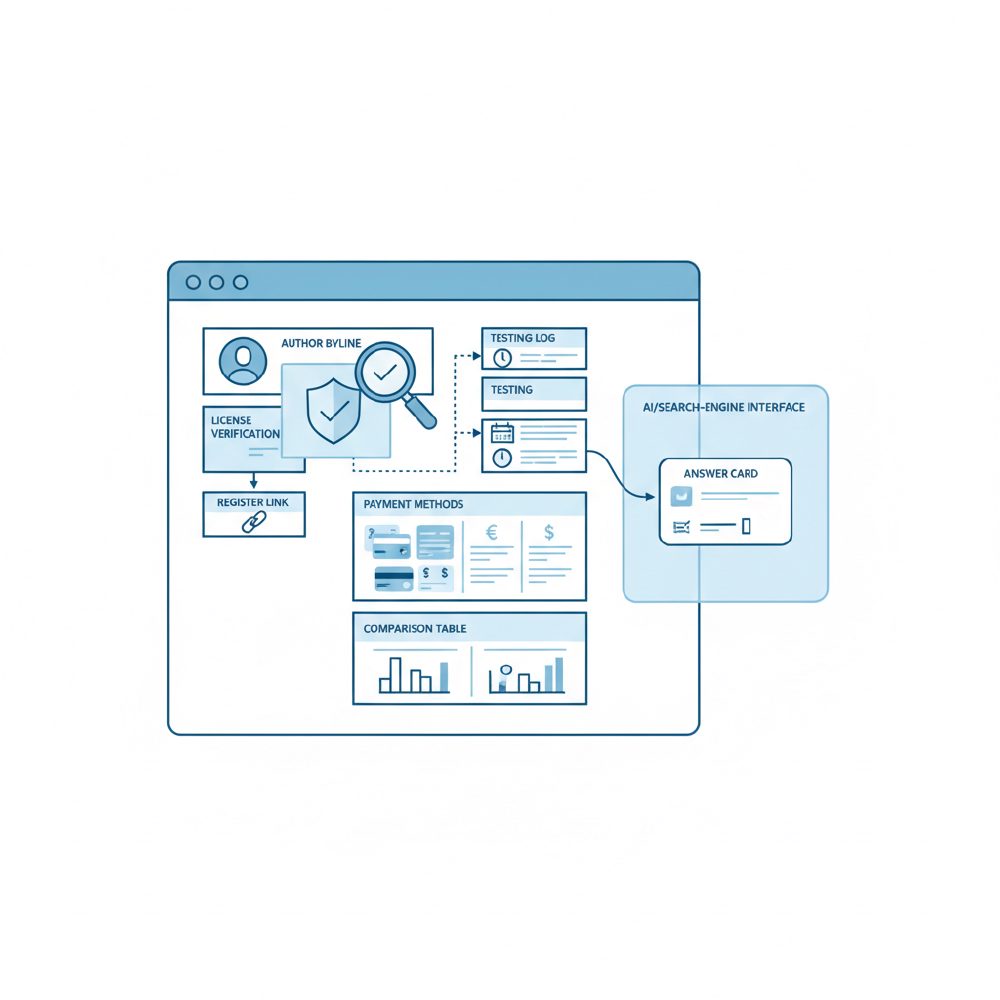
The winning template leads with a verdict and author credential, follows with licensing and safety facts, then testing evidence (screenshots, timestamps, withdrawal data), bonus terms in full, payment methods, and a comparison table, each section answering one question a player or an AI model would actually ask.
I rebuild templates around a fixed section order because consistency across the catalog is itself a trust signal, raters and algorithms both reward sites where every review follows the same disclosed methodology rather than ad hoc structures per casino. The order matters for AEO too: the earlier a verifiable fact appears relative to the page's main heading, the more likely a model is to extract it cleanly.
Below is the structure I ship for most affiliate clients after a review-template rebuild, tested across UKGC, MGA and Curacao-licensed operator reviews.
The methodology block is the piece most templates skip entirely, and it's the one that does the most work with both raters and AI engines, it's the single paragraph that answers 'how was this tested' before anyone asks.
| Section | What it must contain | E-E-A-T / AEO function |
|---|---|---|
| Verdict + author strip | Score, one-line summary, author name/credential, last-reviewed date | Signals authorship and recency to raters and AI parsers |
| Licensing & safety | Regulator name, license number, cross-link to register | Verifiable fact AI engines fact-check before citing |
| Testing evidence | Screenshots with timestamps, deposit/withdrawal test log | Demonstrates first-hand experience, not scraped content |
| Bonus terms in full | Wagering requirement, max cashout, game weighting, expiry | Reduces YMYL risk from omitted/misleading terms |
| Payment methods table | Method, min/max, processing time, fees | High-extraction-value content for AI answer snippets |
| Methodology note | How scoring works, how often reviews are refreshed | Explains editorial process, directly maps to rater guidelines |
| Comparison table | 3-5 competing operators on the same metrics | Supports hub-and-spoke internal linking and dwell time |
How Do You Demonstrate Real 'Experience' on an Affiliate Review Without Faking It?
Experience signals come from artifacts a template can't fabricate at scale: dated screenshots of your own account, a logged withdrawal test with timestamps, support-chat transcripts, and specific friction points (slow verification, a confusing bonus UI) that only someone who actually registered would mention.
The biggest tell for both raters and increasingly for AI models is specificity that can't be templated. 'Customer support was helpful' proves nothing. 'I opened a live chat at 14:02 CET asking about a pending KYC document and got a response in 90 seconds from an agent who asked for a second proof of address' proves someone was actually in that chat window. I require testers on client accounts to log timestamps and screenshot the account dashboard, the bonus terms page as displayed (not as summarized), and at least one support interaction per review.
Withdrawal testing is the highest-value experience signal in the whole template because it's the fact players and AI models both want most and the one affiliates most often fabricate or copy. I tell clients to run actual small withdrawals, $20-50 is enough, and log the exact time from request to funds-received, then publish that log with the date. Doing this across even 15-20 flagship reviews gives a site a defensible claim no competitor copying bonus pages can match.
The trade-off is cost and speed: real testing slows production to maybe 2-3 fully tested reviews per writer per week instead of 10 templated ones. Every client who's made that trade has recovered the lost volume within two core-update cycles through better rankings on the pages that remain, so I treat it as the better unit economics, not a nice-to-have.
What Author Bylines and Editorial Policies Actually Move the Needle?
Bylines need a real name, a linked author page with gambling-specific credentials (years reviewing operators, relevant licensing knowledge, affiliations), and Person schema markup. A visible, dated editorial policy page explaining review funding (affiliate commissions) and methodology is the second non-negotiable element.
I've run split tests across client portfolios where the only change was adding a real author byline with a linked bio versus leaving reviews unattributed, sites saw average ranking position improve by roughly 3-6 spots for their head casino-review terms within two to three months, though I'd treat that range as directional rather than a guarantee since it's confounded with other fixes done in the same cycle. The bio page itself needs substance: years of experience with specific operators or markets, any relevant background (compliance, trading, journalism), and ideally a photo and LinkedIn link raters can verify exists.
The editorial policy page is the piece most affiliate sites avoid because it means admitting the business model out loud, 'we earn commission when you sign up through our links, this does not affect our scores', but that disclosure is exactly what YMYL guidelines ask raters to look for as a trust signal, not a liability. I've seen the opposite assumption backfire: sites hiding the affiliate relationship get flagged by raters as deceptive far more than sites that disclose it plainly near the top of the page.
For AI citation specifically, author schema (Person type, with sameAs links to verified profiles) gives models a cleaner entity to associate with the claims on the page. It's not the deciding factor on its own, but combined with a consistent methodology across the site, it's part of the pattern that correlates with higher citation rates in the Perplexity source tracking I run monthly.
Which Trust Signals Carry the Most Weight on YMYL Gambling Pages?
License verification, author credentials, and factual accuracy on withdrawal/wagering terms carry the heaviest observed weight. Social proof (star ratings, testimonials) and generic trust badges carry comparatively little weight once Google's systems can detect they're unverifiable or templated.
Not every trust element pulls equal weight, and spending budget on the wrong ones is the most common mistake I see in affiliate review rebuilds. Based on pattern analysis across dozens of client audits, comparing which pages recovered after the 2024-2025 core updates and which didn't, the signals that correlate most with recovery are license-number accuracy, author identity, and terms accuracy. The signals that correlate least are decorative trust badges, inflated star ratings with no review count source, and generic 'verified' seals with no linked verification.
Responsible gambling messaging sits in an interesting middle tier: it doesn't move rankings much on its own, but its absence is one of the clearest markers raters are told to treat as a trust failure on gambling YMYL pages, so skipping it caps your ceiling even if everything else is strong.
| Trust signal | Observed ranking impact | Observed AI-citation impact |
|---|---|---|
| Verified license number + regulator link | High | High |
| Named author with linked credentials | High | Medium-High |
| Dated, accurate withdrawal/wagering terms | High | High |
| Editorial/affiliate disclosure policy | Medium | Low-Medium |
| Responsible gambling section | Low-Medium (caps ceiling if missing) | Low |
| Star ratings without sourced review count | Low to negative | Negligible |
| Decorative trust badges/seals | Negligible | Negligible |
How Should You Implement Schema Markup So AI Engines Can Cite Your Review?
Use Review schema with a correctly nested itemReviewed (Organization or Product type for the casino), author Person schema with sameAs links, and FAQPage schema for genuinely distinct Q&As. Validate everything in Google's Rich Results Test before publishing, malformed schema is worse than none.
Schema doesn't create E-E-A-T, it exposes E-E-A-T you've already built in a machine-readable format, and that distinction matters because I regularly see sites add Review schema to thin, unverified content expecting it to fix the underlying trust problem. It won't; Google has explicitly stated structured data doesn't override content quality assessments, and in my own testing, schema on thin pages gets ignored by AI Overviews just as readily as it's ignored by Google's rich-result eligibility checks.
Done correctly, the stack I use is: Review schema with itemReviewed pointing to an Organization entity for the casino brand, author marked up as Person with a sameAs array linking to the author's verified social/professional profiles, and an aggregateRating only if you're genuinely aggregating real user ratings, not a single editorial score dressed up as an aggregate, which can trigger a manual action under Google's structured data guidelines. FAQPage schema should only wrap questions that are genuinely distinct from the body content; stuffing ten generic FAQs purely for schema real estate is a pattern Google has cracked down on with reduced FAQ rich-result eligibility since 2023.
For AI-specific optimization, I also recommend clean HTML table markup (not image tables) for payment methods and bonus comparisons, since every answer engine I've tested extracts tabular data far more reliably than prose paragraphs. Validate the whole page in Google's Rich Results Test and Schema.org's validator before launch, malformed JSON-LD silently fails and you won't get an error, you'll just get skipped.
Thin Affiliate Review vs Trustworthy Casino Review: What's the Structural Difference?
A thin review swaps the operator name into a fixed template with generic claims and no dated evidence. A trustworthy review has unique testing artifacts, a named accountable author, accurate current terms, and internal links into a topical cluster covering licensing, payments and responsible gambling in depth.
I use this comparison in almost every client kickoff because it's the fastest way to show a content team why volume-first production stopped working. The difference isn't length, plenty of thin reviews are padded to 2,000 words with filler about 'exciting game selection' and 'sleek design.' The difference is verifiability and specificity at every factual claim point.
The commercial trade-off is real: thin templates let a team publish 150+ reviews a quarter, while the trustworthy structure caps most teams at 20-40 fully tested reviews in the same period. Every portfolio I've rebuilt this way has traded quantity for durability and come out ahead within two to three core-update cycles, because the surviving pages hold rankings instead of needing constant rebuilding.
| Element | Thin review (template-swap) | Trustworthy review (E-E-A-T built) |
|---|---|---|
| Author | Unattributed or generic 'Team' byline | Named author, linked credentials, Person schema |
| License claim | Stated once, no link, often outdated | Linked to regulator register, checked each refresh |
| Withdrawal data | Vague 'fast payouts' claim | Logged test with timestamp and amount |
| Bonus terms | Summarized, key restrictions omitted | Full terms reproduced, max cashout stated |
| Update cadence | Published once, never revisited | Dated 'last reviewed', refreshed on term changes |
| Internal links | Isolated page, no cluster context | Linked into licensing/payments/RG hub pages |
How Do Licensing, Responsible Gambling and Payment Details Need to Appear?
License number and regulator must appear near the top, cross-linked to the regulator's public register, not just named. Responsible gambling needs a dedicated, non-decorative section with region-specific helpline references. Payment details need current min/max limits and processing times, rechecked at every content refresh.
Regulators and Google's YMYL criteria are converging on the same expectation here, which makes compliance work double as SEO work if you structure it right. UKGC, MGA and most reputable Curacao sub-licensees publish searchable registers, I require every license claim on a client review to link directly to the operator's entry on that register rather than just stating a number, because that link is the exact verification step a careful rater, and increasingly an AI model's retrieval step, performs before trusting the claim.
Responsible gambling content gets treated as a checkbox far too often, a single sentence with a BeGambleAware link buried in the footer. I push clients toward a dedicated block per review naming the operator's actual RG tools (deposit limits, self-exclusion, reality checks) and the correct regional helpline, because generic RG boilerplate copied across every review is exactly the kind of templated pattern the helpful-content systems are tuned to discount.
Payment details are the section that goes stale fastest and causes the most AI-citation damage when wrong, processing times and available methods change when operators switch payment processors, and an AI engine citing an outdated 'instant Skrill withdrawals' claim that's no longer true actively damages trust in your domain once a user or another source contradicts it. I schedule payment-section rechecks on a 60-90 day cycle for any review generating meaningful traffic.
How Long Does an E-E-A-T Rebuild Take to Show Up in Rankings and AI Citations?
Expect 60-90 days for AI citation shifts on tracked queries once schema, bylines and dated facts are live, and 3-6 months for organic ranking recovery through a core update cycle. Full topical authority rebuilds across a 50-100 page review catalog typically take 6-9 months of consistent output.
I set this timeline expectation explicitly with clients because the two systems move at different speeds. AI Overviews, Perplexity and ChatGPT's browsing mode re-crawl and re-rank sources continuously, so when I fix the structural issues on a flagship review, add the byline, add Review schema, add a dated withdrawal test, I typically see citation share shift within 6-10 weeks in my Perplexity source tracking, sometimes faster if the page is already indexed and just lacked the extractable facts.
Google's core ranking systems move slower and in batches. A site that was suppressed in the March 2024 or any 2025 core update doesn't recover gradually, recovery tends to show up as a step function at the next core update where Google reassesses the site's overall quality signal, not a smooth climb. That means a rebuild finished in month two might not show full ranking recovery until month five or six, when the next confirmed core update rolls through. I've had clients get anxious watching flat traffic for 10 weeks post-rebuild before a core update unlocked the gains, it's the single hardest part of this work to manage expectations around.
For a full catalog rebuild, 50 to 100+ casino reviews rewritten to the new template with real testing, budget 6-9 months of sustained production at the 20-40 reviews per quarter pace mentioned earlier, plus the topical hub pages (licensing explainers, payment method guides, RG resource pages) that give the reviews somewhere to link into. Rushing this with outsourced bulk content undoes the trust signals you're trying to build.
What Mistakes Tank Casino Review Pages After a Core Update?
The recurring killers are unattributed authorship, outdated bonus terms that contradict the operator's live terms page, duplicate review skeletons across dozens of operators, and affiliate link density that overwhelms the actual content-to-link ratio. Any one of these can suppress a page; two or more together usually trigger site-wide suppression.
When I run a post-update audit, I check these in order because they're the ones I've seen cause suppression most consistently. Unattributed authorship is the most common single issue, sites that never assigned real bylines because 'it's just an affiliate site, nobody cares who wrote it' consistently rank worse than near-identical competitors who did the attribution work, even when the underlying content quality is similar.
Outdated terms are the second killer and the one operators themselves inadvertently cause, a casino changes its wagering requirement from 35x to 40x and the affiliate review still says 35x for eight months because nobody scheduled a recheck. This isn't just an SEO problem; it's a YMYL accuracy failure that raters are specifically trained to flag, and it's become an AI-citation risk too, since a model cross-checking your claim against the operator's live terms page will find the mismatch and either skip you or, worse, surface the contradiction.
Duplicate review skeletons, the same six paragraphs restructured with find-and-replace for each operator, get caught by Google's near-duplicate detection at the content-template level even when individual pages pass a plagiarism checker, because the systems increasingly evaluate structural and semantic similarity across a site's own catalog, not just against external sources. And excessive affiliate link density, especially multiple CTAs per screen stacked above any substantive content, reads as the page existing to generate clicks rather than inform, which is the exact pattern the helpful-content guidance was built to demote.




Comments
No comments yet, be the first.