Affiliate vs Operator SEO in 2026: Who Actually Wins the SERP (And Why)

What's the real structural difference between affiliate and operator SEO?
Affiliates sell trust and comparison; operators sell the product itself. Affiliates win through content depth, topical authority and third-party credibility. Operators win through domain strength, brand search volume and product-page optimization. The ranking mechanics, link profiles and E-E-A-T signals each model needs diverge sharply from the first strategy decision onward.
I've built content programs for both sides of this market, and the gap starts at the business model, not the keyword list. An affiliate's entire asset is the content itself, reviews, comparisons, guides, monetized through CPA or revshare deals with the brands it covers. An operator's content is a cost center sitting underneath the real product: the game lobby, the cashier, the sportsbook. That changes what 'good SEO' even means for each.
Look at domain authority in Ahrefs or SEMrush and you'll see the pattern immediately. Established operator domains often sit in the DR 70-85 range, built on decades of news citations, regulator listings and unsolicited brand mentions they never had to ask for. Leading affiliate properties, think Gambling.com Group assets or Casino.org, typically run DR 60-75, built almost entirely through deliberate content-led link acquisition. Neither number is 'better.' They're built through completely different mechanisms, and copying one model onto the other site type wastes budget.
The practical consequence: an affiliate site chasing operator-style domain growth through press-release volume will burn cash with nothing to show in rankings. An operator trying to out-content an affiliate on comparison pages usually trips a conflict-of-interest problem Google's quality raters are specifically trained to flag under YMYL guidelines.
Why do operator domains often outrank affiliates for brand and category terms?
Operators win brand and navigational searches almost automatically because they're the entity being searched for. Decades of news citations, regulator register listings, sponsorship deals and app store presence give operator domains entity-level trust that no affiliate backlink campaign can replicate on someone else's brand terms.
Search 'bet365 login' or 'betmgm app download' and Google isn't running a content-quality contest, it's matching intent to entity. The operator's own domain is the obvious answer, reinforced by UKGC or MGA public register links, verified app store listings, and thousands of organic news mentions the brand never paid an SEO agency to earn. That's structural dominance affiliates can't buy their way into, and I tell every client not to waste link budget trying.
Category terms work similarly when the operator has first-mover brand recognition in a market, 'William Hill sports' type queries in the UK, or a newly licensed operator's branded terms in Ontario or New Jersey. The operator's compliance pages, licensing footer links and sponsorship-driven press coverage (think shirt sponsorships generating thousands of unlinked and linked mentions) build topical authority around their own name that no third-party site matches.
Where this breaks down is the moment the query stops being about one brand and starts requiring judgment between brands. That's the hinge point where affiliates take over, and it's a bigger share of search volume than most operator SEO teams want to admit.
Where do affiliates consistently beat operators in the SERP?
Affiliates own comparison, 'best of', bonus-comparison and review-intent queries because the search itself demands unbiased, multi-brand judgment an operator structurally cannot provide about itself. Google's quality systems treat single-operator self-promotion on these query types as a trust red flag under YMYL review criteria.
Try ranking an operator's own blog post for 'best online casinos 2026' and watch what happens, it either doesn't show up, or it gets buried under five affiliate comparison pages and an AI Overview citing three of them. The query carries implicit comparative intent, and an operator telling you it's the best option isn't a credible answer to that intent. Google knows it, and increasingly so do large language models summarizing the SERP.
This is where affiliate content depth matters more than raw domain authority. A 3,000+ word comparison guide with a named author, a disclosed testing methodology, deposit/withdrawal screenshots and an editorial policy page outperforms a thinner operator promo page even when the operator domain carries 15-20 points more DR. I've watched affiliate pages with real hands-on testing evidence hold top-3 positions against operator domains with triple the backlink count, purely on relevance and trust signals specific to comparison intent.
Bonus-code and 'no deposit bonus' queries sit in the same bucket, with one caveat: if an operator has an exclusive, trackable promo code, their own landing page can rank for the exact-match code string. Affiliates still win the broader category page because that's where the comparison judgment happens.
Which query types does each side typically win, and why?
Brand and navigational queries go to operators through entity match. Comparison, review and bonus-comparison queries go to affiliates through independent judgment and content depth. Hybrid queries, like single-brand bonus codes, split based on exclusivity deals and who controls the trackable offer.
I map this out for every new client before we write a single brief, because mismatched expectations waste the first six months of a campaign. The table below reflects what I've seen hold across UK, US state-regulated and offshore niches through 2025 into 2026, directionally consistent, though exact SERP composition shifts per vertical and jurisdiction.
| Query type | Example search | Typical winner | Why |
|---|---|---|---|
| Brand/navigational | "bet365 login" | Operator | Entity match, app store presence, owned trademark |
| Comparison/best-of | "best online casinos 2026" | Affiliate | Implicit comparative intent, operator self-promotion is a trust risk |
| Bonus comparison | "no deposit bonus codes" | Affiliate | Multi-brand aggregation; affiliate tracks and updates codes across operators |
| Exclusive promo code | "[operator] exclusive bonus code" | Split / Operator-leaning | If the operator owns the exact trackable offer, their landing page can compete |
| Brand review | "betmgm review" | Affiliate (mostly) | Google treats third-party review as more credible than brand's own FAQ page |
| Responsible gambling info | "gambling addiction help" | Regulator/charity sites | Neither commercial model outranks .gov/.org authority here |
How do E-E-A-T and YMYL requirements differ for affiliate sites vs operator sites?
Affiliates prove E-E-A-T through named author bylines, disclosed testing methodology and transparent disclosure pages. Operators prove it through licensing badges, regulator verification, payout-speed data and responsible-gambling certifications. Both sit squarely in YMYL territory, but the specific trust signals Google's quality raters check differ by model.
Google's Search Quality Rater Guidelines treat gambling content as YMYL because bad advice can cost readers real money, and that bar applies to both site types, just measured differently. I audit affiliate E-E-A-T by checking whether authors have real gambling-sector credibility, whether the site discloses its affiliate relationships clearly, and whether reviews show actual account creation, deposit and withdrawal evidence rather than recycled operator marketing copy.
Operator E-E-A-T audits look completely different. I'm checking licensing footer accuracy against the actual UKGC, MGA or state-level register, verifying SSL and payment security badges aren't stale, and confirming responsible gambling tools (self-exclusion, deposit limits) are genuinely accessible, not just mentioned in a compliance page nobody can find. An operator's blog content still needs author expertise if it's publishing strategy or odds-explainer articles, that content gets evaluated the same way an affiliate's would.
| E-E-A-T pillar | Affiliate site priority | Operator site priority |
|---|---|---|
| Experience | Hands-on account testing, deposit/withdrawal screenshots | Internal QA rarely disclosed publicly |
| Expertise | Named authors with gambling/finance credentials, editorial policy page | Compliance and RG team bios, licensing documentation |
| Authoritativeness | Backlinks from igaming trade press, cited data studies | Regulator register listings, sponsorship press coverage |
| Trust | Clear affiliate disclosure, verified payout claims, contact transparency | SSL, licensing badges, verified RG tools, payout speed proof |
What link-building approach wins for affiliates versus operators?
Affiliates win links through content-led digital PR, data studies and genuine guest contributions in igaming and business press. Operators win through sponsorship deals, sports partnerships and earned media that generates brand mentions whether they ask for them or not. Both models get burned the same way by link schemes under Google's spam policies.
Affiliate link profiles I consider healthy sit in the 1,500-4,000 referring domain range for a category-leading site, built almost entirely through content people actually want to cite, original research, state-by-state regulatory breakdowns, payment-method guides. I run link intersect reports in Ahrefs against the top three ranking competitors every quarter to find where our content gap is costing us link opportunities nobody's filled yet.
Operators rarely need to run the same playbook because sponsorship and sports partnerships generate backlinks as a byproduct of marketing spend that has nothing to do with SEO. A stadium naming deal or kit sponsorship throws off hundreds of organic news mentions, some linked, most not, but Google's mention-based authority signals still pick up the pattern. That said, I've seen operator SEO teams get greedy and buy niche-edit links into old blog posts to juice category pages, which is the fastest route to a manual action in a vertical Google already scrutinizes closely.
Affiliates took the harder hit industry-wide from the September 2023 Helpful Content Update and the March 2024 core update, a lot of scaled, templated 'top 10 casino' content built on thin AI-generated text and recycled operator marketing lost 40-70% of organic traffic in a single rollout window, based on what I saw across client and competitor accounts (treat that range as directional, not a universal figure). Operators were largely untouched because their core pages aren't competing on 'helpfulness' in the same sense.
How does content strategy differ between comparison reviews and operator product pages?
Affiliates build hub-and-spoke topical maps around comparisons, reviews, bonus guides and strategy content, publishing high volume across a vertical. Operators build product, category, promotions and legal pages optimized for conversion and compliance accuracy over search depth, with far lower page-count-to-value ratio but tighter regulatory stakes.
A mature affiliate site in the casino vertical often runs 100-300+ published articles per major market, individual operator reviews, payment-method guides, state-specific legal pages, slot strategy content, responsible gambling resources, all interlinked through a hub-and-spoke architecture that feeds topical authority back to the core 'best casinos' pillar page. That volume is the engine. Cut it and rankings erode within two or three core update cycles.
Operator content footprints look nothing like that. You'll typically see a tight set of core pages per market, homepage, promotions, a handful of game category pages, legal/licensing, responsible gambling, and maybe a sparse blog, plus thousands of auto-generated individual game pages that carry almost no unique text. The SEO value there comes from internal linking structure and schema, not editorial depth.
Structured data reflects the split. I push Review schema, FAQ schema and ItemList schema hard on affiliate comparison pages because that's exactly what AI Overviews and rich results pull from. Operators get more value from Organization, Product/Game and Event schema, plus LocalBusiness markup where land-based venues are in play. Mixing these up, an affiliate over-investing in Product schema, an operator trying to force Review schema onto its own promo page, wastes dev time for zero ranking lift.
Who wins on technical SEO, page speed and Core Web Vitals?
Operators generally have larger dev teams and better raw infrastructure, but affiliates often post stronger Core Web Vitals because their page templates are lighter. Operator game lobbies loaded with iframes, geolocation scripts and live chat widgets regularly push mobile LCP past 3-4 seconds; a clean affiliate build on WordPress or headless architecture can hold LCP under 2.5s.
I've pulled PageSpeed Insights and GSC Core Web Vitals reports on both site types in the same vertical and the pattern repeats: operator platforms carrying live game lobbies, embedded chat, geolocation verification and session-tracking scripts routinely struggle with Largest Contentful Paint and Interaction to Next Paint on mobile. That's not a competence problem, it's the cost of running a real-money transactional product with compliance tooling bolted on.
Affiliate sites have no such baggage. A well-built comparison site on a modern stack, with images properly compressed and third-party scripts trimmed to essentials, can genuinely outperform an operator domain on every Core Web Vital metric despite running on a fraction of the dev budget. I've moved affiliate client sites from "needs improvement" to "good" CWV status in under six weeks just by auditing render-blocking scripts and lazy-loading below-the-fold comparison tables.
Where operators claw it back is server-side infrastructure, CDN sophistication, server response time under load, and uptime during traffic spikes around major sporting events. Those aren't ranking factors Google weighs as heavily as CWV, but they matter for conversion, which is the metric operators actually care about more than organic position.
How do Google core updates hit affiliate and operator sites differently?
Helpful Content signals and the 2023-2024 core updates disproportionately hit thin affiliate listicles lacking real testing evidence or author expertise, while operator product pages mostly stayed insulated because they're not graded as informational 'advice' content. Operator risk comes more from licensing and compliance accuracy than content thinness.
I watched a meaningful share of casino affiliate sites in the broader iGaming niche take significant traffic hits through the September 2023 Helpful Content Update and the March 2024 core update, sites running scaled, low-effort 'top 10' pages with no original testing, no real author identity, and heavy reliance on recycled operator copy. Recovery for most required real structural change: adding verified author bios with gambling-industry credentials, publishing genuine testing methodology, and in some cases pruning or noindexing hundreds of thin pages to stop them dragging down the whole domain's helpfulness signal.
Operators rarely show up in the same casualty lists because their core pages, cashier, game lobby, promotions, aren't competing for informational intent in the way an algorithm grading 'helpfulness' is designed to evaluate. Their exposure sits elsewhere: inaccurate licensing claims, broken responsible-gambling links, or promotional terms that don't match what the regulator has on file can trigger manual review risk, but that's a compliance problem as much as an algorithmic one.
The lesson I give every affiliate client now: treat every comparison page like it needs to survive a human quality rater reading it cold. If the page can't answer "who actually wrote this and what did they personally test," it's exposed at the next core update regardless of how many links point at it.
What SEO budget and timeline should affiliates expect versus operators?
A competitive affiliate casino niche typically needs $8k-$25k/month in content and link investment to reach top 10 within 9-18 months. Operators often spend $30k-$100k+/month across multiple markets and languages, but new-market ranking timelines run similarly long because legal and compliance review cycles slow content publishing on their side.
These are directional ranges from campaigns I've run and benchmarked against competitor spend patterns, not fixed quotes, actual numbers shift with jurisdiction competitiveness and whether you're entering a saturated market like UK casino affiliate SEO versus a newer regulated US state. Affiliate budgets go almost entirely into content production (research, writer/editor time, author credibility building) and link acquisition (digital PR, data studies, outreach). Hit that spend consistently for 12-18 months and a mid-competition niche site can realistically break into page one for its core comparison terms.
Operator SEO budgets scale with market count, not just competitiveness, running SEO across five US states plus the UK plus a couple of EU markets multiplies translation, legal review and local compliance content costs fast. I've seen operator marketing teams assume bigger budget means faster rankings, then get stuck for months waiting on legal sign-off for a single promotions page while an affiliate competitor ships ten comparison articles in the same window. Budget size doesn't buy speed when compliance gatekeeping sits between content and publish.
| Metric | Affiliate site | Operator site |
|---|---|---|
| Monthly SEO spend | $8k-$25k (single-market niche) | $30k-$100k+ (multi-market program) |
| Primary spend allocation | Content production, digital PR, outreach | Multi-language content, legal/compliance review, dev resource |
| Time to top-10 for core terms | 9-18 months | 12-24 months (often compliance-gated, not SEO-gated) |
| Main bottleneck | Link acquisition velocity, content depth | Legal sign-off cycles, regulatory content accuracy |
Who wins on AEO and AI Overviews citations, affiliate or operator content?
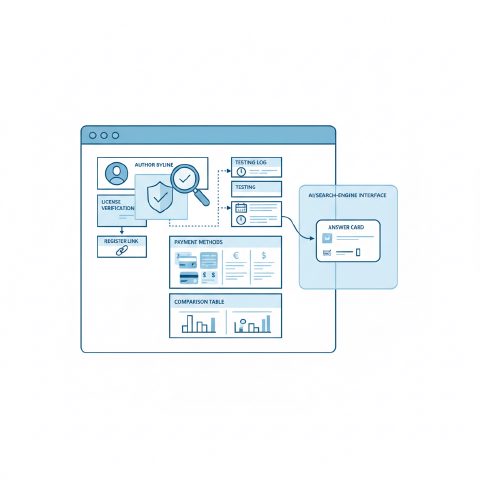
Affiliates currently get more AI Overview, ChatGPT and Perplexity citations for comparison and 'best of' queries because structured, methodology-led content with clear schema reads as a neutral source to answer engines. Operators get cited mainly for factual brand-specific queries, licensing status, game rules, payout terms, not comparative judgment.
I've been tracking citation patterns in AI Overviews and Perplexity results across casino comparison queries since early 2024, and the pattern holds: answer engines pull from pages that look like independent analysis, not promotional copy. An affiliate page with a clear answer-first paragraph, FAQ schema, and a visible testing methodology gets lifted into the summary far more often than an operator's own promotions page making the same claim about itself.
That's not an accident of training data, it mirrors how these models are built to weight source credibility. A first-party sales page claiming "best bonus on the market" carries the same red flag for an LLM that it does for a human quality rater. Affiliates that invest in structured data, Review, FAQ, HowTo schema validated through Schema.org's validator or Google's Rich Results Test, are feeding exactly the clean, extractable format these systems prefer.
Operators still win AI citations on factual queries where they're the authoritative source by definition, "is [operator] licensed in Ontario," "what's the minimum withdrawal at [operator]." That's a narrower slice of search volume than comparison intent, but it's growing as users increasingly ask chat interfaces direct brand-verification questions instead of searching Google directly.



Comments
No comments yet, be the first.