Crawl Budget Casino Audits in 2026: Why Googlebot Skips Your Best Pages on Large Affiliate Sites
What is crawl budget and why does it matter for large casino affiliate sites?
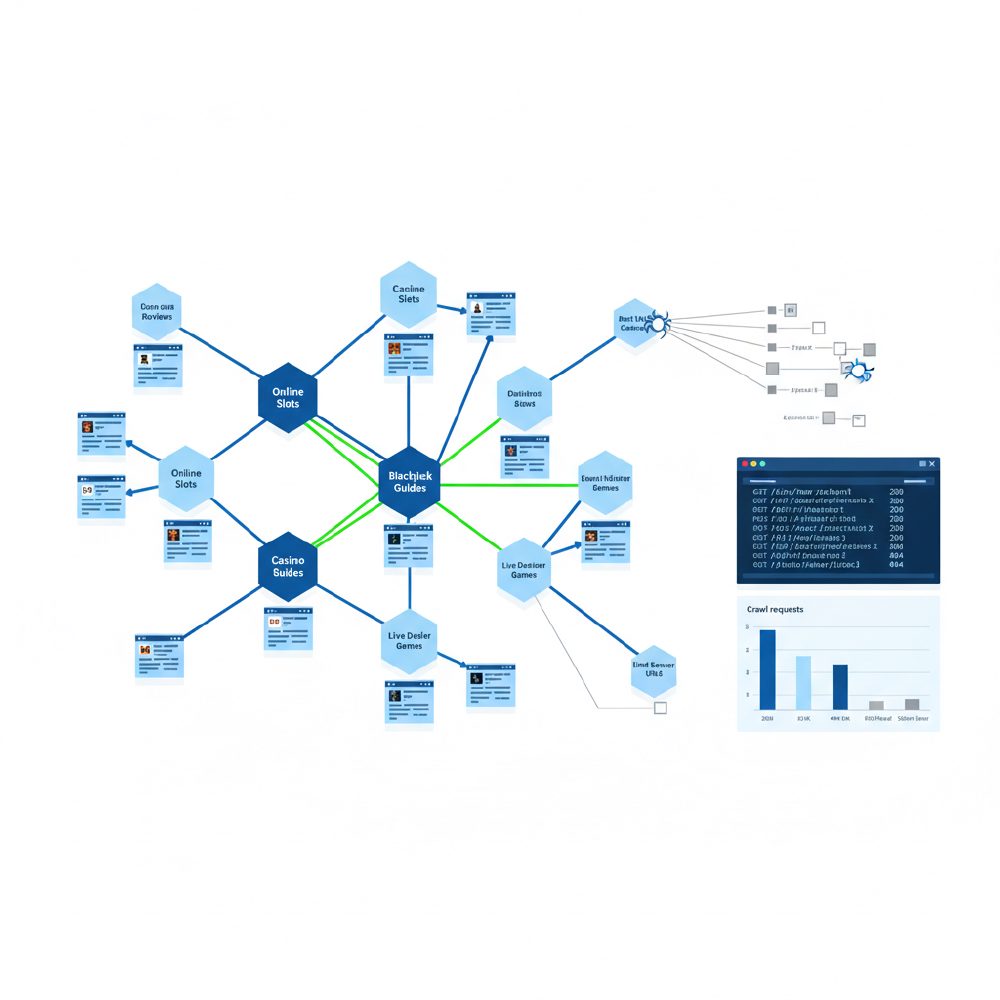
Crawl budget is the number of URLs Googlebot will fetch on your domain in a given window, set by crawl rate limit (server capacity) and crawl demand (perceived freshness and value). On a 15,000+ page casino site, a constrained budget means new bonus reviews sit uncrawled for days while Googlebot loops through thin sort-and-filter URLs.
Google's own documentation on crawl budget still says it primarily affects sites north of roughly one million URLs, and I get pushback from clients who read that and assume it doesn't apply to their 20,000-page slot database. In practice it kicks in far earlier on gambling sites because of how the URL space balloons: separate folders per licensing jurisdiction, currency switchers, pagination on provider and game-type taxonomies, and affiliate tracking parameters appended to internal links all multiply crawlable URLs without multiplying unique content.
I audited a 28,000-page slot review site last year where GSC's Crawl Stats report showed 94% of daily crawl requests hitting /slots/ taxonomy pages with sort parameters (?sort=rtp, ?sort=volatility), while brand-new slot reviews waited an average of 11 days for first crawl. That's not a content problem. That's a budget allocation problem, and no amount of rewriting the review copy fixes it.
The mechanism Google uses matters here too: crawl rate limit throttles based on server response health (TTFB, error rates), and crawl demand is driven by perceived page value and freshness signals, internal links, update frequency, and historical engagement. Casino sites that refresh bonus terms weekly but bury that content four clicks deep send Google a confusing signal: 'this changes often' competing with 'this is hard to reach.'
How do you know if Googlebot is wasting crawl budget on your casino site?
Check three sources: GSC's Crawl Stats report (Settings > Crawl Stats) for response code and crawl purpose breakdowns, raw server/CDN logs filtered by verified Googlebot user-agent, and the gap between sitemap-submitted URLs and actually-indexed URLs in the Coverage report. A 20%+ gap signals real waste.
GSC's Crawl Stats report is a good starting alarm but it's sampled, aggregated, and delayed by a day or two, it tells you something's off, not exactly where. Look at the 'By response' breakdown first: if more than 10-15% of requests are 301s, 404s, or soft-404s on a site you believe is clean, you've got crawl traps. Then check 'By purpose': a healthy ratio leans toward refresh crawls on existing high-value URLs rather than constant discovery crawls on new parameter combinations.
Raw logs are the ground truth. Pull 30 days from your CDN (Cloudflare Logpush, Akamai DataStream) or server (Nginx/Apache access logs), filter by Googlebot user-agent, and verify authenticity via reverse DNS lookup on the 66.249.x.x range, a meaningful share of 'Googlebot' traffic in unverified logs is spoofed scraper or SEO tool traffic, which skews your analysis if you don't filter it out.
Red flags I look for specifically on casino sites: pagination depth beyond page 5 getting crawled as often as page 1, session or currency parameters (?currency=CAD, ?lang=fr) appearing as unique crawled URLs, and affiliate tracking tags (?btag=, ?aff_id=, ?subid=) showing up in logs at all, those should never be internally linked in a crawlable form.
| Factor | GSC Crawl Stats | Raw server/CDN logs |
|---|---|---|
| Data latency | 1-2 day delay, rolling 90-day window | Real-time or near real-time |
| Accuracy | Sampled and aggregated by Google | Exact, every request logged |
| Bot verification | Assumes Googlebot is genuine | You must verify via reverse DNS |
| URL-level detail | Limited, grouped by response/purpose | Full URL and parameter visibility |
| Cost | Free, built into Search Console | Needs log access + tool (Screaming Frog, Botify, OnCrawl) |
| Best use | Quick health check, trend monitoring | Root-cause diagnosis, before/after proof |
What is log file SEO and why does it matter more for gambling sites than most verticals?
Log file SEO is analyzing raw server or CDN access logs to see exactly which URLs, parameters, and bots Googlebot actually requested, not the sampled data GSC surfaces. Gambling sites need it more because geo-redirects, currency switchers, and affiliate tags multiply unique crawlable URLs per page by 5-20x compared to a typical content site.</p>
I pull logs through Cloudflare Logpush or direct server access.log exports, then parse with Screaming Frog's Log File Analyser for sites under ~500k rows, or Botify/OnCrawl when the volume gets heavier and I need crawl-vs-GSC-vs-Ahrefs overlays in one dashboard. The goal is a frequency table: which directories get crawled most, how that compares to where your revenue and indexed value actually sit, and whether verified Googlebot behavior matches what you'd expect from your internal linking.
A multi-market casino comparison client runs /uk/, /ca/, /ie/ geo folders plus a currency parameter on top. Logs showed Googlebot spending 61% of its daily hits on /ca/ pages that were near-duplicates of /uk/ pages with £ swapped for CAD and minimal unique regulatory content. That's a textbook crawl-budget drain: real duplication dressed up as localization.
Without logs, you're guessing based on GSC's rounded numbers and sitemap coverage stats. With logs, you can say with certainty 'Googlebot hit this exact URL 340 times in 30 days and it's a 410-byte redirect page', and that precision is what gets engineering teams to actually prioritize the fix instead of treating it as an SEO nice-to-have.
How does crawl budget optimization differ for casino and gambling verticals vs other niches?
Casino sites carry three crawl-budget multipliers rare elsewhere: regulatory geo-variants per licensing jurisdiction, live bonus and odds data forcing frequent re-crawl demand, and affiliate tracking parameters appended to internal links. Each multiplies crawlable URLs without multiplying unique content, which drains budget faster than a typical e-commerce or SaaS site with the same page count.
Licensing-driven duplication is the one most teams underestimate. A site serving UKGC, MGA, and Curaçao-licensed operators often spins up near-identical pages per jurisdiction because legal or compliance teams want jurisdiction-specific disclaimers. If the only difference between /uk/casino-x-review/ and /ie/casino-x-review/ is a paragraph of licensing text, you're asking Google to crawl, compare, and largely discard duplicate content, twice.
Bonus and odds freshness is the second multiplier. Promo pages with expiry dates genuinely need frequent re-crawl, and that's legitimate crawl demand worth spending budget on. The problem is when expired promos get soft-404'd (thin 'this offer has ended' page with no redirect or consolidation) rather than redirected into a live equivalent, Google keeps re-checking a dead page indefinitely.
Affiliate tracking parameters are the third, and the easiest fix with the biggest payoff. On one client site, switching internal affiliate tracking from URL parameters (?btag=) to a cookie-based or JS-redirect model cut unique crawlable URLs by roughly 40% within two months, verified in Botify's crawl report, with zero loss of attribution data in the affiliate platform.
Which casino page types waste the most crawl budget?
Faceted filter and sort URLs (provider, RTP, volatility combinations) typically consume 35-50% of crawl requests on large casino sites while contributing almost no unique indexable value. Expired bonus pages, deep pagination, and currency/locale duplicates follow close behind.
This breakdown comes from pooling log file audits across several large casino comparison and slot-database clients over the past two years, treat the percentages as realistic ranges, not a universal law, since mix varies by site architecture and faceted nav implementation.
The pattern holds consistently enough to prioritize fixes by page type rather than trying to audit every URL individually. Faceted and sorted combinations are almost always the single biggest line item because they're combinatorial, ten providers times five volatility bands times three sort orders generates 150 crawlable permutations from one template.
| Page type | Typical crawl share observed | Ranking/indexation value | Primary fix |
|---|---|---|---|
| Faceted filter/sort URLs (provider, RTP, volatility) | 35-50% | Very low, near-duplicate content | Robots.txt disallow + canonical to base category |
| Deep pagination (page 4+) | 10-15% | Low, rarely the entry point users search for | Flatten via 'view all' or stronger internal linking |
| Expired bonus/promo pages (soft-404) | 5-10% | Zero once expired | 301 redirect to live equivalent, don't leave as thin page |
| Currency/locale duplicate URLs | 10-20% | Low unless genuinely localized content | hreflang + canonical consolidation |
| Affiliate tracking parameter variants | 5-15% | Zero, should never be indexable | Switch to cookie/JS tracking, block in robots.txt |
| Core review, guide, and comparison pages | often under 30% | High, this is where revenue sits | Protect and strengthen internal links here |
How do you fix crawl efficiency on a large casino site?
Work in this order: consolidate duplicate parameter URLs with canonical tags and robots.txt disallows, redirect (don't soft-404) expired bonus pages, flatten pagination and internal link depth to three clicks or fewer, improve server response time, then strengthen internal links into priority pages via hub-and-spoke silos.
Sequencing matters more than most technical checklists admit. Fixing internal linking before you've dealt with parameter bloat just means Googlebot discovers your improved silo faster while still burning most of its budget on sort URLs, you get partial credit at best. Start with the robots.txt and canonical cleanup on faceted navigation; this is the highest-leverage, lowest-risk move because you're not removing indexed content, you're stopping new waste.
Next, run a 301 audit on every bonus or promo page that's expired in the last 12 months. Redirect each to the closest live equivalent (same operator, current offer, or the operator's review page) rather than letting it sit as a thin 'offer ended' page. I've seen sites carrying 800+ of these zombie pages, each getting re-crawled every few weeks for no reason.
Then address depth: use Screaming Frog's crawl depth report to find priority pages sitting 5+ clicks from the homepage and rebuild the internal linking so nothing commercially important sits beyond three clicks. Finally, layer in server performance work, faster TTFB raises your crawl rate limit ceiling, so the other fixes have room to take effect.
Realistic timeline: GSC Crawl Stats usually shows a shift in response code and purpose mix within 4-8 weeks. Indexation of previously-starved pages and knock-on ranking movement typically takes 3-4 months, confirmed with a before/after crawl comparison in Ahrefs Site Audit or Screaming Frog rather than gut feel.
Should you block, noindex, or canonicalize low-value casino pages?
Use robots.txt disallow for infinite parameter combinations you never want crawled at all, noindex for pages Google must still crawl but shouldn't index (thin locale variants), and canonical for near-duplicates you want consolidated into one indexable URL. Mixing these up wastes more budget, a noindexed page still gets crawled repeatedly to confirm the tag.
This is where I see the most self-inflicted damage. Teams panic about crawl waste and slap a blanket robots.txt disallow on an entire directory that includes pages Google has already indexed. Google can't see a noindex tag or a redirect on a page it's blocked from crawling, so that URL often stays indexed indefinitely with a 'blocked by robots.txt' warning in GSC, the opposite of the intended outcome.
The correct sequence for an already-indexed low-value page: add noindex first, wait for GSC to confirm removal from the index (usually 1-4 weeks), then add the robots.txt disallow once you're sure nothing valuable is blocked. For pages that were never indexed, like new faceted sort combinations spun up by a new filter feature, you can disallow in robots.txt from day one with no transition needed.
Canonical tags are for genuine near-duplicates you want Google to consolidate equity into one URL, not a substitute for the other two. A canonical tag doesn't stop Googlebot from crawling the duplicate, it still costs crawl budget, it just tells Google which version to rank. If your actual goal is reducing crawl requests, canonical alone doesn't solve that; pair it with parameter handling or disallow once you've confirmed the canonical is being honored.
| Method | Stops crawling? | Removes from index? | Best use case on casino sites |
|---|---|---|---|
| Robots.txt disallow | Yes | No (existing indexed pages may linger) | Never-indexed parameter/sort URL combinations |
| Noindex meta tag | No, still crawled to check tag | Yes, once processed | Thin locale duplicates you must still let Google see |
| Canonical tag | No, duplicate still crawled | Consolidates ranking signals, not a hard removal | True near-duplicate content you want merged into one URL |
How does site architecture affect crawl budget on casino sites?
Hub-and-spoke architecture, a pillar page linking out to spoke reviews and guides, gives Googlebot a shallow, predictable path to every priority URL, cutting average crawl depth and letting internal link equity flow efficiently. Flat architectures with deep pagination force Googlebot to burn requests just discovering pages instead of refreshing them.
Crawl depth is measurable, not theoretical. Screaming Frog and Botify both report average click-depth from homepage to any given URL, and the target I push clients toward is three clicks or fewer to every commercially important page, bonus reviews, top-level game guides, comparison tables.
I restructured a 12,000-page sportsbook comparison site from flat, paginated category listings into a proper hub-and-spoke topical map last year: a pillar page per sport/market linking directly to every operator review and guide in that cluster. Average crawl depth dropped from 6.2 to 3.1 clicks, and Botify's crawl report showed a 22% increase in unique URLs crawled daily within six weeks, not because total crawl budget grew, but because less of it was spent on pagination traversal and more landed on pages that mattered.
This also directly supports the editorial side of the strategy: hub-and-spoke content clusters are how you build topical authority for both classic rankings and AI answer-engine citation, since structured, interlinked clusters make it easier for Google and for LLM-based tools to understand which page is the canonical answer on a given subtopic.
What role does server and hosting performance play in crawl budget for casino sites?
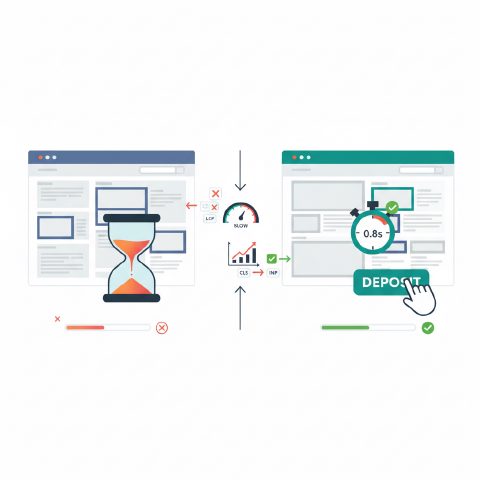
Crawl rate limit scales with how fast and reliably your server responds. Google explicitly throttles crawling when response times rise or 5xx errors spike, to protect your server, not because it dislikes your content. Casino sites running heavy live-odds widgets often see TTFB above 800ms, which caps daily crawl requests regardless of content quality.
This is the piece technical SEO audits underweight because it sits with the dev team, not the content team. GSC's Crawl Stats report includes an 'average response time' chart, if that line trends upward, Google is likely pulling back crawl rate independent of anything you've done on the content side.
Heavy client-side JavaScript is a common culprit on casino sites specifically: live odds comparison widgets, bonus calculators, and real-time RTP tickers often render entirely in the browser, which means Googlebot's renderer has to execute JS before it can see content, a slower, costlier process than fetching static HTML. That contributes to the 'two-wave' indexing delay Google has documented, where the initial crawl gets the shell and a second rendering pass (which can take days) gets the content.
Practical targets: TTFB under 200ms, server-side rendering or hybrid rendering for anything commercially critical (don't make the main review copy depend on client-side JS execution), and a CDN (Cloudflare, Fastly, Akamai) in front of origin to absorb bot traffic spikes without degrading response time for real users. None of this is exotic engineering, it's prioritization that usually gets deprioritized until an SEO audit puts a number on the cost.
How do you monitor and prove crawl budget improvements over time?
Track four metrics monthly: total crawl requests by response code in GSC Crawl Stats, the volume of 'Discovered, currently not indexed' pages in Coverage, average crawl depth to priority URLs via Screaming Frog or Botify, and days-to-first-crawl for newly published content. Improvement shows as falling 404/duplicate crawl share and faster discovery-to-index speed.
I run this as a standing monthly line item, not a one-off audit deliverable, because crawl patterns drift as new content, filters, or affiliate campaigns get added. A dashboard pulling GSC API data plus a monthly log pull gives you a trend line instead of a single snapshot, which matters because a one-month improvement can get undone by a dev team shipping a new faceted filter without SEO sign-off.
The metric clients care about most is days-to-first-crawl on new publishes, because it's the one that maps directly to revenue timing, a new bonus review that sits uncrawled for 11 days is 11 days of lost organic exposure during a promo window that might only run 30 days. Getting that number down to 1-3 days is a realistic target on a well-architected casino site and a strong proof point that budget fixes worked.
What's the biggest mistake operators make when trying to fix casino crawl budget?
The biggest mistake is disallowing already-indexed URLs in robots.txt before noindexing them first. Google can't crawl the page to see a noindex tag or redirect once it's blocked, so the URL often stays indexed indefinitely with a 'blocked by robots.txt' warning, the opposite of the intended fix.
The second most common mistake is overcorrecting on pagination, removing it entirely rather than restructuring it. I've seen teams delete paginated archive pages wholesale to 'save crawl budget,' which strands deep catalog pages with zero internal links pointing to them at all. That doesn't save budget, it just makes discovery worse; Google now has to rely purely on the sitemap, and sitemap-only discovery tends to get lower crawl priority than pages with genuine internal link support.
The third mistake, more cultural than technical: treating crawl budget work as a one-time project rather than an ongoing architecture discipline. A new filter feature, a new affiliate tracking integration, or a new geo-market launch can undo six months of crawl efficiency work in a single sprint if nobody flags the SEO implications before it ships.
Do small casino affiliate sites under 5,000 pages need to worry about crawl budget?
Rarely as a true budget constraint, Google's own guidance points to sites above roughly one million URLs as the main affected group. A 3,000-page casino review site usually has an internal linking or crawl efficiency problem, not a budget problem, though it's still worth checking if new pages take longer than 5-7 days to get first crawled.
I get this question constantly from smaller affiliate operators who've read a crawl budget article and assumed it applies to them. For most sites under 5,000 URLs, the real issue is usually weak internal linking (new pages not linked from anywhere prominent), a missing or stale XML sitemap, or genuinely low perceived site authority driving low crawl demand, not Google running out of capacity to crawl you.
That said, the log-file diagnostic habit is worth building early regardless of size, because it's the same skill set you'll need when the site grows past 10,000-15,000 pages, which happens fast in this vertical once you expand into multiple game-provider databases or multi-market comparison content. Better to build the monitoring muscle before the problem is urgent.





Comments
No comments yet, be the first.