Casino Site Deindexed? The 2026 Recovery Roadmap for Affiliates
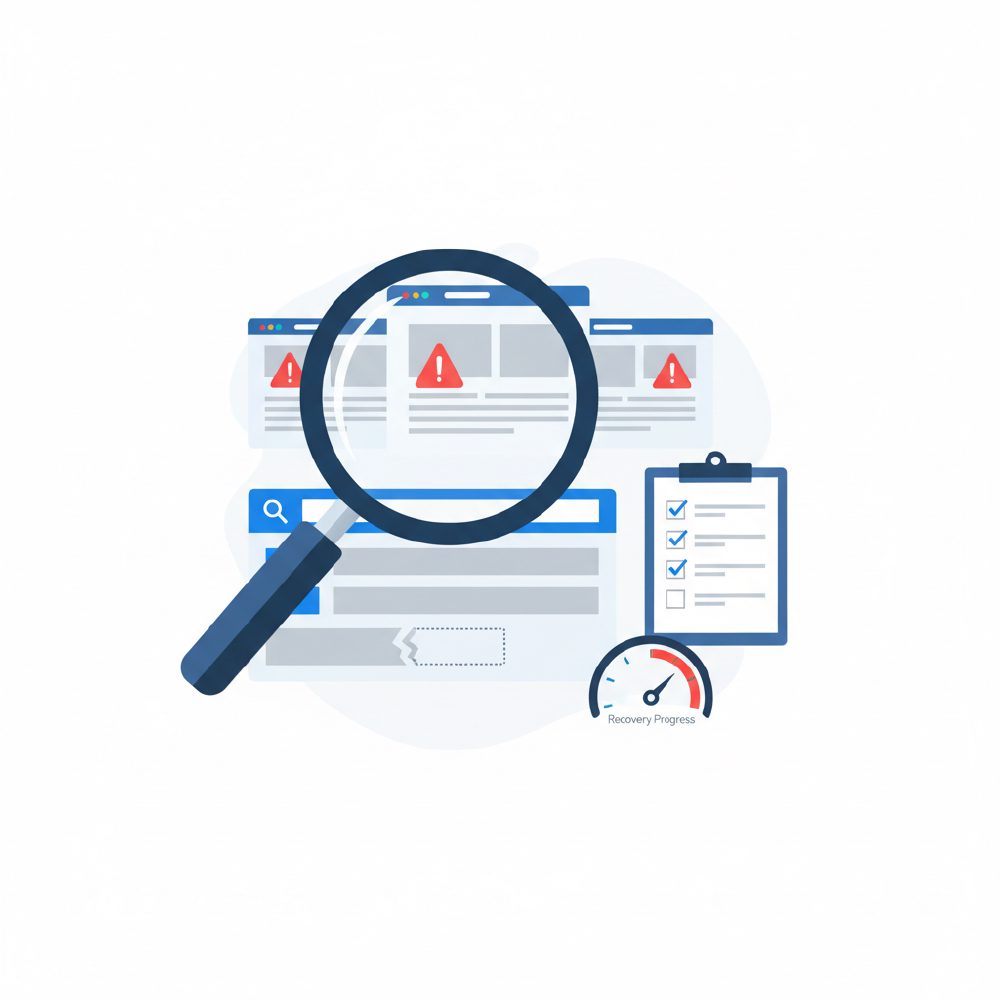
Why Was My Casino Site Deindexed in the First Place?
Casino sites get deindexed for three reasons: a manual action tied to thin or deceptive YMYL content, an algorithmic trust collapse following a core update, or a technical fault like a blocked robots.txt, a stray noindex tag, or a hacked site serving spam. Pull GSC's Manual Actions and Removals reports first, the cause dictates the fix.
I treat the first hour of any deindexing case as triage, not panic. Open Google Search Console and check two reports before anything else: Manual Actions (under Security & Manual Actions) and Coverage (under Indexing). If Manual Actions shows a violation, usually 'thin content with little or no added value,' 'unnatural links,' or 'cloaking and/or sneaky redirects' for gambling sites, you're dealing with a human reviewer decision, and the fix has to address that specific language.
If Manual Actions is empty, you're looking at either an algorithmic drop or a technical fault. Algorithmic trust collapses on gambling affiliate sites almost always trace back to helpful-content signals folded into core updates since March 2024, pages that list 'top 10 casinos' with no first-hand testing, no named author, and duplicated bonus tables across dozens of near-identical URLs. Technical faults are the easiest to miss and the fastest to fix: I've seen three affiliate clients in the past 18 months lose full indexation because a staging-to-production migration left a template-level noindex live for weeks before anyone noticed organic traffic had flatlined.
Don't skip the Safe Browsing check either. Gambling domains get flagged for malware or deceptive content far more often than other verticals because bad actors cluster in the niche, and a compromised ad network or a hacked plugin can get a clean site blacklisted through no fault of the editorial team.
| Cause type | Typical trigger | Where to check | Fix urgency |
|---|---|---|---|
| Manual action | Thin affiliate content, unnatural links, cloaking | GSC Manual Actions report | High, requires reconsideration request |
| Algorithmic | Helpful-content/core update trust signals | GSC Performance + Coverage trend | Medium, rebuild authority over months |
| Technical | Noindex tag, blocked robots.txt, 5xx errors | GSC URL Inspection, Screaming Frog crawl | Urgent, often same-day fix |
| Security | Malware, hacked content injection | Google Safe Browsing, Sucuri scan | Urgent, clean before resubmitting |
How Do I Confirm My Gambling Site Was Actually Removed From Google?
Check GSC's URL Inspection tool and Coverage report first; a site: search alone is unreliable and often returns false negatives. If URL Inspection shows 'URL is not on Google' across your key pages and crawl stats show Googlebot requests dropping to near zero, you've confirmed true deindexing, not just a ranking collapse.
Affiliate owners panic the moment organic traffic craters, but a ranking drop from position 3 to position 60 is a completely different problem than a page disappearing from the index entirely. I've had clients convinced they'd been deindexed when the real issue was a core update demotion, the URLs were still indexed and crawlable, just ranked badly. Confusing the two wastes weeks on the wrong fix.
Run URL Inspection on your homepage, your top five money pages, and two or three random long-tail review pages. 'URL is on Google' with a recent crawl date means you're not deindexed, you have a ranking problem, which calls for content and authority work, not a reconsideration request. 'URL is not on Google, not indexed' is the real signal.
Cross-reference with the Crawl Stats report under Settings. A sudden drop to zero or near-zero Googlebot requests over a 7-14 day window, paired with non-indexed status, confirms Google stopped treating your domain as crawlable. If you run server log analysis through Screaming Frog Log File Analyser or Botify, you'll see the exact point Googlebot stopped visiting, which helps you date the incident against any deployments, plugin updates, or link campaigns you ran around that time.
What's the Difference Between a Manual Action and an Algorithmic Deindexing?
A manual action is a human reviewer's documented decision, visible in GSC, that requires a formal reconsideration request to lift. An algorithmic deindexing or demotion happens automatically through a system update with no notification and no appeal process, the only way back is to genuinely improve the signals the algorithm is measuring.
This distinction changes everything about your recovery plan. Manual actions come with a reason code and, in most cases, example URLs. You fix the specific violation, document it, and submit a reconsideration request, Google reviews it and either lifts the action or tells you it's still present. There's a clear process and a clear end state.
Algorithmic deindexing has no appeal button. If a core update or the helpful-content classifier decided your casino comparison pages add no unique value, there's no form to submit saying 'we disagree.' You rebuild the actual content quality, author credibility, and link profile, then wait for the next crawl and reassessment cycle, which on affiliate domains I've managed typically shows directional movement within 8-12 weeks, with full recovery sometimes spanning two or three core update cycles.
The practical upshot: manual actions are a sprint, algorithmic trust rebuilding is a marathon. Don't submit a reconsideration request when there's no manual action to reconsider, it does nothing and wastes a review cycle you might need later for an actual violation.
| Factor | Manual action | Algorithmic deindexing |
|---|---|---|
| Visible in GSC? | Yes, with reason code | No, inferred from Coverage trends |
| Appeal process | Reconsideration request | None, only recovery through quality signals |
| Typical timeline | 2-8 weeks after fix + request | 3-6+ months across update cycles |
| Root fix | Address the specific cited violation | Rebuild E-E-A-T, content depth, link quality |
How Do I Audit for Technical Issues Before Requesting Reindexing?
Run a full crawl with Screaming Frog or Sitebulb and check meta robots tags, X-Robots-Tag headers, robots.txt directives, canonical consistency, and server response codes across every template. Confirm Google Safe Browsing shows a clean status and that no hosting-level firewall is blocking Googlebot's IP ranges before you touch Search Console.
Technical faults are embarrassingly common on casino affiliate sites because template changes ripple across thousands of review and comparison pages at once. A single misconfigured plugin update can push a blanket noindex,nofollow directive site-wide, and because traffic erosion is gradual as pages drop out of the index over days, teams often miss the cause for weeks.
My audit checklist runs in this order: robots.txt for accidental Disallow: / rules, meta robots and X-Robots-Tag headers (check the raw HTTP response, not just the rendered DOM, a lot of CMS platforms inject conflicting directives), canonical tags pointing to the wrong URL or a staging domain, and server response codes via a full crawl looking for unexpected 404s, 403s, or 5xx errors on previously indexed URLs.
For JavaScript-heavy casino sites built on React or Vue frameworks, I also check rendered vs raw HTML in GSC's URL Inspection tool, if Googlebot's rendered version is missing content blocks that exist in the raw source, indexation suffers even without an explicit block. Finally, confirm hosting didn't get IP-blacklisted; some budget hosts used heavily in the gambling affiliate space share IP ranges with spam operations, and that alone can suppress crawl frequency.
How Do I Write a Reconsideration Request Google Actually Approves?
Document the specific violation cited, show dated before/after evidence of the fix, attach a disavow file if unnatural links were the issue, and explain the process change that prevents recurrence. Vague requests that just say 'we fixed it' get rejected on the first pass in the majority of cases I've reviewed for clients.
Google's reconsideration reviewers read hundreds of these a week, and generic language gets a generic rejection. Structure the request around three things: what was wrong, what you changed, and why it won't happen again. For thin-content violations, that means naming the exact pages removed or rewritten, with URLs and dates. For unnatural links, it means a disavow file submitted through the Disavow Links tool, plus documented outreach attempts to remove the links manually first, Google explicitly wants to see removal attempts before disavowal.
I always attach a short editorial policy summary to link violations and thin-content violations alike: who writes the content, what the fact-checking process looks like, how bonus terms and odds data get verified against operator sources, and how often pages get refreshed. This matters more in gambling than almost any other niche because reviewers are specifically trained to scrutinize YMYL trust signals.
Submit once, wait for the full review cycle, usually 1-3 weeks for the response, longer during major core update periods, and don't resubmit identical requests hoping for a different reviewer. If it's rejected, the response almost always includes new example URLs; treat that as a second, more specific diagnostic pass rather than a dead end.
How Long Does Casino Site Reindexing Take in 2026?
Technical fixes like removing a rogue noindex tag can reindex within 2-10 days once you request a recrawl through URL Inspection. Manual action lifts typically take 2-8 weeks after a submitted reconsideration request. Algorithmic trust rebuilding after a core update demotion runs 3-6 months and often spans multiple update cycles.
Timeline expectations are where I spend the most time managing client anxiety, because the recovery curve genuinely differs by cause. A pure technical fix, pulling a noindex directive, fixing a robots.txt block, resolving a canonical error, can see individual URLs return to the index within days once you submit them through URL Inspection's 'Request Indexing' function, though site-wide recovery across thousands of pages takes longer as Googlebot works through its recrawl queue.
Manual actions move on Google's internal review schedule, not yours. In my experience managing these for affiliate clients, the response window runs 1-3 weeks for the initial decision, and if approved, visible ranking and traffic recovery follows within another 1-4 weeks as the algorithm re-evaluates the domain's full page set. Total elapsed time from submission to meaningful organic traffic return: roughly 4-8 weeks for a clean first approval.
Algorithmic recovery is slower and less certain by nature. There's no single approval event, you're waiting for the next core update or helpful-content refresh to re-score your domain against improved signals. I tell clients to budget 3-6 months minimum and treat any traffic recovery inside that window as a positive signal rather than full resolution.
| Deindexing cause | Fix action | Typical recovery window |
|---|---|---|
| Noindex / robots.txt error | Remove directive, request recrawl | 2-10 days |
| Canonical or redirect error | Correct canonical, resubmit sitemap | 1-3 weeks |
| Manual action (links/content) | Fix + reconsideration request | 2-8 weeks |
| Algorithmic/core update demotion | Rebuild E-E-A-T and content depth | 3-6 months |
| Malware/hacked content | Clean site, request Safe Browsing review | 1-4 weeks |
What E-E-A-T Fixes Does Google Expect From YMYL Gambling Sites?
Google expects verifiable author expertise with named bylines and credentials, a transparent editorial policy page, responsible-gambling disclosures, and licensing information matched to each target market. Thin, unsigned 'top 10 casino' pages without these signals remain the most common reason gambling sites get re-flagged after an initial recovery.
Gambling sits firmly in Google's Your-Money-Your-Life category, alongside finance and health, which means the quality bar for reviewer guidelines is higher than almost any other affiliate niche. After recovery, the sites that stay recovered are the ones that treat E-E-A-T as permanent infrastructure, not a one-time cleanup before resubmission.
Concretely, that means every review page carries a named author with a real bio, ideally someone with documented gambling industry or compliance experience, not a generic 'Editorial Team' byline. It means an About page and editorial standards page that explain how operators get selected, how bonus terms get verified, and how often pages get updated. It means linking out to responsible-gambling resources like GamCare or BeGambleAware, and citing primary regulatory sources, UKGC, MGA, or Curacao eGaming licensing registries, rather than just repeating another affiliate's claims.
For AI answer-engine citation specifically, structured data matters: Organization and Person schema tied to named authors, Review schema with genuine rating criteria, and FAQ schema that mirrors real user questions. Perplexity and AI Overviews both favor content with clear sourcing and author attribution when selecting which pages to cite in gambling-related answers, so this isn't just a Google ranking lever, it's an AEO lever too.
Do I Need Licensing Disclosures to Get Reindexed in Regulated Markets?
Yes. In regulated markets, UK, Sweden, Ontario, and increasingly the EU, Google's YMYL review process checks that reviewed operators hold valid licenses from bodies like the UKGC, Spelinspektionen, or AGCO, and that your site discloses this clearly. Missing, outdated, or vague licensing information is a recurring reconsideration rejection reason I see in client cases.
This gets overlooked constantly because affiliate teams focus on content quality and links while treating licensing disclosure as a legal afterthought handled once during site launch. That's backwards for 2026. Reviewer guidelines explicitly instruct quality raters to check whether gambling sites reference appropriate licensing and whether that information is current, a stale license badge for an operator that's since lost accreditation is a trust violation, not a cosmetic issue.
Build a licensing data layer into your content workflow: a database field per operator tracking license number, regulator, and renewal status, surfaced consistently across every review page and updated on a quarterly audit cycle at minimum. If you operate across multiple jurisdictions, match the disclosure language to the regulator relevant to that market, UKGC requirements differ from MGA or Ontario's AGCO in what must be disclosed and how prominently.
I've seen reconsideration requests rejected specifically because example pages showed operators flagged by a regulator as unlicensed in that reviewer's test market, while the site's badge still showed them as verified. That's a fast, fixable problem once you know to check for it, and it should be part of your standard pre-submission audit.
Should I Migrate to a New Domain Instead of Fighting for Reindexing?
Only as a last resort. Domain migration after repeated manual actions sacrifices existing authority, takes 6-12 months to rebuild comparable rankings, and risks Google linking the new domain back to the old one through shared WHOIS data, hosting IP, analytics IDs, or backlink overlap. Fix root causes on the existing domain first.
I get asked this at least once a quarter, usually from a founder who's frustrated with a slow reconsideration process and wants a clean slate. It's rarely the right call. A domain that's built authority over years carries link equity, brand signals, and historical trust that a brand-new domain simply doesn't have, you're starting from zero on a niche where competitive keywords already demand strong Domain Rating and years of consistent content history.
It also doesn't guarantee escape from the underlying problem. If Google associates the new domain with the old through shared server infrastructure, matching Google Analytics or GTM container IDs, overlapping affiliate network IDs, or an aggressive backlink migration that reuses the same anchor text patterns that triggered the original manual action, the new domain inherits the same scrutiny, sometimes faster, because the pattern is now recognizable.
The scenario where migration genuinely makes sense: your existing domain has a toxic, unrecoverable backlink history from a previous owner or a long-gone black-hat campaign that predates your acquisition, and cleanup via disavow plus reconsideration has failed multiple review cycles. Even then, budget a full year for the new domain to reach parity, and keep the old domain's clean pages 301-redirected only after Google confirms the manual action is lifted, never migrate mid-penalty.
How Do I Prevent My Casino Site From Being Deindexed Again?
Set up weekly GSC Coverage monitoring, automated noindex and robots.txt change alerts through a tool like ContentKing or Little Warden, a quarterly backlink audit in Ahrefs or SEMrush, and a documented editorial policy enforced before any page goes live. Prevention costs a fraction of a 3-6 month recovery cycle.
Every client I've taken through a deindexing recovery asks the same follow-up question: how do we stop this happening again. The answer is monitoring infrastructure that catches problems in hours, not months. GSC Coverage and Manual Actions reports should be checked weekly, not quarterly, and ideally piped into a Slack or email alert through the Search Console API so a drop doesn't sit unnoticed over a long weekend.
Deploy change-monitoring on technical SEO elements specifically, noindex tags, robots.txt content, canonical tags, and HTTP status codes, using a tool like ContentKing, Little Warden, or a custom script against Screaming Frog's command-line crawler. These catch the accidental template-level mistakes that caused most of the technical deindexing cases I've diagnosed.
On the link side, run a quarterly audit in Ahrefs or SEMrush looking specifically for spikes in low-quality, exact-match anchor text links, a common sign of negative SEO attacks or an affiliate network partner buying links on your behalf without disclosure. Disavow proactively rather than waiting for a manual action notice. And lock down editorial standards in writing: no page publishes without a named author, a licensing check, and a responsible-gambling disclosure. That single process change prevents the majority of the E-E-A-T-driven algorithmic risk I see across the niche.




Comments
No comments yet, be the first.