The 2026 iGaming Penalty Recovery Playbook: Why Your Casino Site Lost Rankings After a Core Update
Why Did My Casino Site Lose Rankings After a Google Core Update?
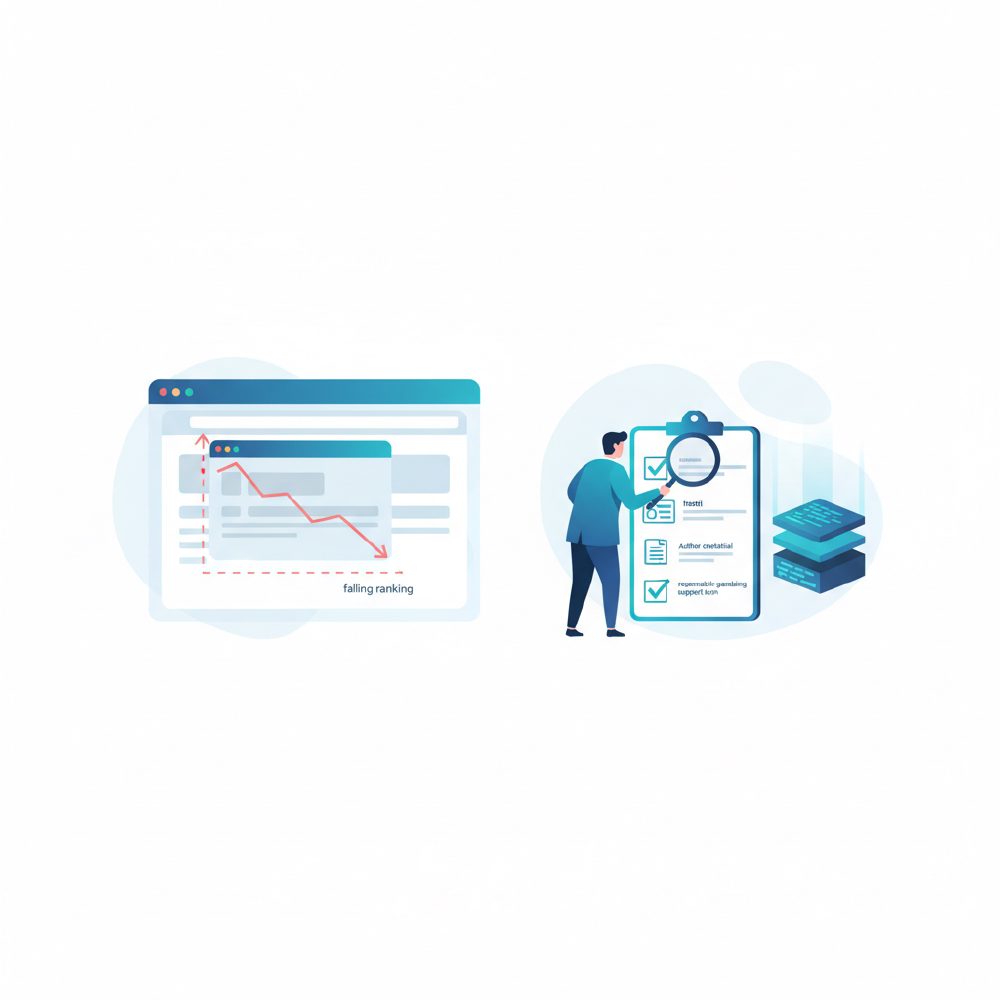
Your casino site likely lost rankings because a broad core update recalibrated how Google's YMYL and E-E-A-T systems evaluate gambling content, not because of one technical error. Thin bonus-table pages, unverified author credentials, outdated licensing claims, and weak responsible-gambling signals are the most common triggers I find during igaming penalty recovery audits.
In the recovery audits I run for affiliate portfolios, the pattern behind a core update drop is rarely one single mistake. It's usually three or four compounding trust gaps that Google's Search Quality Rater Guidelines for YMYL pages were already flagging as risk before the update rolled out and reweighted them harder. Templated 'top 10 online casinos' pages with rotating affiliate links but no verified testing notes are the single most common culprit across both offshore and UK-facing affiliate sites I've reviewed.
The second recurring gap is authorship. Google's guidelines explicitly ask reviewers to check whether YMYL content, and gambling review content sits in that category alongside finance and health, has a named author with relevant experience. Sites publishing 'Casino Team' or no byline at all on odds breakdowns, bonus terms explainers, or licensing claims read as low-trust to both human raters and the systems trained on their judgments.
Third: licensing and compliance accuracy. Reviews listing operators without current MGA, UKGC or Curaçao GCB license numbers, or bonus terms contradicting what's on the operator's own terms page, represent a factual-accuracy failure, not a minor technical issue. Fourth, and often overlooked, is sitewide reputation, if part of your portfolio still promotes unlicensed operators in restricted markets, that drag can suppress rankings across pages that otherwise look clean.
What Exactly Happened in the March 2026 Core Update for iGaming Affiliates?
The March 2026 core update followed the same broad pattern as March 2024, November 2024 and June 2025 rollouts: no vertical-specific targeting, but igaming affiliate sites absorbed disproportionate volatility because templated review content, thin author signals and inconsistent licensing claims match the low-trust patterns these updates are built to demote.
Google never confirms it is 'targeting' gambling content, and it doesn't need to, broad core updates re-run the entire corpus of ranking signals against updated quality models, and YMYL verticals with weak baseline trust simply have more room to fall. Ahrefs' Ranking Volatility Tool and SEMrush's Sensor both flagged casino, sports betting and lottery-result pages among the most volatile categories during the March 2026 rollout window, echoing the March 2024 and September 2023 updates when Helpful Content signals were folded directly into core ranking systems.
What's different in 2026 is the scale of AI-drafted content that flooded this vertical since 2023. Affiliate networks that scaled production with drafting tools, without adding genuine editorial review, author verification, or fact-checked licensing data, built exactly the pattern the update's classifiers are trained to deprioritize. Across several portfolios I reviewed post-rollout, visibility dropped 30-55% on templated 'best casino bonuses' pages, while pages with named, credentialed authors and direct regulator citations held flat or gained.
Treat a 'march 2026 core update affiliate drop' as a symptom, not a diagnosis. The update surfaced trust gaps that existed for months or years, it didn't create them from nothing.
Is My Ranking Drop a Manual Penalty or a Core Update Recalibration?
A manual action appears explicitly in Google Search Console's Security & Manual Actions report with a stated reason and page-level scope. A core update drop shows no such notice and instead correlates in timing with Google's confirmed rollout dates. The two require entirely different recovery paths and timelines.
Before you touch content, check Search Console. If there's a manual action listed, you're dealing with a policy violation Google flagged directly, often link schemes, cloaking, or thin affiliate content abuse, and the fix is a reconsideration request after removing the violation. If nothing is listed, cross-reference your traffic drop dates against Google's confirmed core update rollout windows published on the Search Central blog.
The distinction matters because the fixes don't overlap much. Manual actions respond quickly to targeted remediation, 2 to 4 weeks post-reconsideration is typical. Core update drops respond to sustained trust rebuilding measured across the next rollout, not the next crawl.
| Signal | Manual Action | Core Update Drop |
|---|---|---|
| Search Console message | Explicit notice under Security & Manual Actions | No manual action listed; drop coincides with confirmed rollout dates |
| Traffic pattern | Sudden cliff, often single page or sitewide overnight | Gradual decline over the 1-3 week rollout window |
| Fix mechanism | Remove violation, file reconsideration request | Rebuild trust and content signals, wait for the next core update or refresh |
| Typical recovery window | 2-4 weeks after reconsideration approval | 6-12 months across 1-2 subsequent core updates |
Which E-E-A-T Signals Are Casino Affiliate Sites Most Likely Missing?
Casino affiliate sites most often lack verifiable experience (real-money testing evidence), named expertise (credentialed authors), authoritativeness (direct regulator citations), and trustworthiness (responsible gambling links, clear affiliate disclosure). Each gap maps to a specific, checkable fix rather than a vague 'improve quality' instruction.
Experience gaps show up as review copy that reads like it was assembled from operator marketing pages rather than actual account testing, no screenshots of the cashier flow, no notes on withdrawal times, no mention of specific game providers like Pragmatic Play or Evolution actually loading. Expertise gaps show up as missing or generic bylines with no professional history tying the writer to gambling, compliance, or financial content.
Authoritativeness is the easiest to audit and the easiest to fix: does the page link directly to the operator's license record on the MGA register, UKGC register, or Curaçao GCB lookup, rather than just stating a license number as text? Trustworthiness gaps cluster around disclosure, affiliate relationships buried in a footer rather than disclosed near the top of a review, and no visible link to GamCare, BeGambleAware, or a national self-exclusion scheme.
| E-E-A-T Signal | Typical Gap | Recovery Fix |
|---|---|---|
| Experience | Reviews written without verified real-money play | Publish first-hand testing notes, screenshots, verified account details |
| Expertise | No author credentials tying writer to gambling or finance background | Add byline bios with regulatory or industry experience, link to a professional profile |
| Authoritativeness | No direct citations to licensing bodies (MGA, UKGC, Curaçao GCB) | Cite license numbers and link directly to the regulator's public register |
| Trustworthiness | Missing responsible gambling links, affiliate disclosure buried in the footer | Add GamCare or BeGambleAware links, place disclosure above the fold |
How Do I Audit My Site for the Compliance and Trust Gaps Causing the Drop?
Run a page-by-page audit segmented by template type, reviews, bonus pages, guides, cross-referenced against Google Search Console's before-and-after performance data. Then verify every author byline, every license number against the regulator's public register, and every bonus term against the operator's own terms page before touching a single word of copy.
Start with a full author audit: pull every published byline into a spreadsheet and mark whether each writer has a real bio page, a verifiable professional profile, and disclosed relevant experience. In my audits, sites with zero verifiable author pages typically explain 20-40% of the affected pages' visibility loss on their own.
Then run a compliance pass on every licensing claim: cross-check each listed operator's license number directly on the MGA, UKGC or Curaçao GCB public register, and flag any operator promoted without a currently valid license. Follow with a bonus-terms accuracy check comparing your page's stated wagering requirements against the operator's own terms page, discrepancies here are exactly the kind of factual-accuracy failure Google's raters are trained to catch.
Use this sequence:
- Export all indexed URLs from Google Search Console and segment by template type.
- Cross-reference impressions and clicks pre- and post-update to isolate which templates lost the most visibility.
- Audit those templates first for authorship, licensing accuracy and responsible gambling disclosure.
- Check affiliate disclosure placement against your target market's advertising standards, such as the UK ASA's CAP code.
- Document every fix in a changelog tied to your editorial policy page, this becomes evidence of genuine remediation, not cosmetic editing.
What Does a Realistic iGaming Penalty Recovery Timeline Look Like?
Realistic igaming penalty recovery runs 3 to 12 months depending on the fix, tracking to Google's core update rollout schedule rather than to your publish date. Licensing and disclosure fixes can reflect within weeks of recrawl; deeper content architecture and toxic backlink cleanup usually need two to three update cycles.
Clients often ask me why a fix published in January didn't move rankings until the next confirmed core update six months later. That's the mechanic to internalize: core updates reprocess trust and quality signals in a batch, and most YMYL gambling recovery only becomes visible when the next rollout re-evaluates your site against the improved signals.
Low-effort fixes like adding regulator citation links or responsible gambling disclosures can get recrawled within days but often won't move rankings meaningfully until the next update cycle confirms the pattern has stuck across the site, not just on a handful of pages. Backlink cleanup from historical link-buying campaigns is the slowest lever, Google's link spam systems need time to reassess link graphs, and I've seen full recovery take two to three update cycles, roughly 6-12 months, when toxic link profiles are involved.
| Fix Type | Effort Level | Typical Recovery Window |
|---|---|---|
| Author bylines + editorial policy rollout | Medium | 1-2 core update cycles (3-6 months) |
| Removing thin or duplicate bonus tables | Medium-High | 1 core update cycle (2-4 months) plus reindexing |
| Licensing + responsible gambling disclosure fixes | Low-Medium | Weeks for crawl, 1 update cycle to reflect in rankings |
| Toxic backlink cleanup (link schemes) | High | 2-3 core update cycles (6-12 months) |
| Full topical/content architecture rebuild | High | 6-12 months, sometimes across 2 core updates |
Do Author Bylines and Editorial Policies Really Move Casino Rankings?
Yes, indirectly but measurably. A visible, verifiable byline with real credentials, combined with a public editorial policy explaining how reviews are researched and updated, is exactly the trustworthiness evidence Google's Search Quality Rater Guidelines instruct reviewers to look for on YMYL gambling pages, and it's one of the fastest wins in a recovery plan.
I've watched sites recover visibility faster on templates where bylines were rebuilt properly than on templates where only the body copy was rewritten. That's not coincidence, a named author with a documented history in compliance, gambling operations, or financial journalism gives both human raters and algorithmic trust models something concrete to evaluate, versus an anonymous 'editorial team' credit that offers nothing verifiable.
An editorial policy page matters more than most site owners assume. It should state how often reviews are updated, how bonus terms are verified against operator sources, how conflicts of interest from affiliate commissions are handled, and who has final sign-off on published content. This page doesn't need to be long, but it needs to be specific, vague statements about 'commitment to accuracy' carry no trust weight; a stated review cadence and sourcing method does.
Do Responsible Gambling Signals Actually Influence Google Rankings?
Not as a direct, named ranking factor, but they function as a measurable trust signal. Google's Search Quality Rater Guidelines treat missing safer-gambling information as a trustworthiness deficiency on YMYL gambling pages, and I've seen this correlate consistently with faster recovery once responsible gambling content is genuinely integrated, not just linked once in a footer.
The strongest version of this fix links to recognized support resources, GamCare and BeGambleAware in the UK, the National Council on Problem Gambling in the US, or equivalent national self-exclusion schemes depending on your target market, contextually within review content, not just as a single site-wide footer link. Pages reviewing high-stakes products like slots or live dealer games should reference deposit limits, self-exclusion tools, and age verification requirements as part of the actual review, not as an afterthought.
This also intersects with advertising compliance. The UK's ASA and its CAP code, and equivalent rules under MGA and Malta's advertising standards, increasingly expect gambling advertising and affiliate content to demonstrate awareness of harm-minimization messaging. Sites treating this as a legal checkbox rather than genuine content integration tend to see it show up as thin, disconnected boilerplate, which doesn't move trust signals the way integrated, contextual references do.
How Should I Handle Affiliate Disclosure and Monetization Transparency?
Disclose affiliate relationships clearly and near the top of the page, not buried in a footer, and mark affiliate links with rel="sponsored" per Google's link spam policies. Vague 'we may earn a commission' language positioned below the fold is treated as low-transparency by both regulators and Google's trust evaluation criteria.
Google's guidance on link spam explicitly asks sites to use rel="sponsored" on paid or affiliate links so its systems can correctly classify them rather than treating them as organic editorial endorsements passing PageRank. Sites that skip this markup risk their affiliate links being interpreted as part of a link scheme pattern, which compounds trust problems during a core update evaluation.
On the content side, disclosure needs to be genuinely visible, not technically present. A one-line disclosure statement placed directly above or within the first screen of a review performs better under quality review than the same statement buried at the bottom of a 2,000-word page. In markets under ASA CAP code jurisdiction or FTC endorsement guidance in the US, disclosure timing and prominence are also compliance requirements, not just SEO nice-to-haves, which is exactly why fixing this lever tends to produce trust gains on two fronts at once.
What Structured Data Fixes Support Recovery in Both Google and AI Answer Engines?
Implement Person schema for author bylines, Organization schema with verifiable licensing detail, and FAQPage or Review schema validated through Google's Rich Results Test and Schema.org's validator. These same structured facts are what AI Overviews, Perplexity and ChatGPT lean on to decide whether your content is citable and trustworthy enough to reference.
Structured data doesn't manipulate rankings, but it removes ambiguity for systems trying to verify who wrote something and what claims it's making. Person schema tied to a real author profile, cross-linked to their bio page and professional history, gives both Google's knowledge systems and AI answer engines a verifiable entity to associate with the content rather than an anonymous string.
For AEO specifically, answer-engine crawlers reward content that states facts in extractable, self-contained form, a licensing claim with the regulator name and number stated in plain text near the top of a review, not buried in a table three sections down. I recommend running every updated page through Google's Rich Results Test and a schema validator before republishing, and maintaining consistency between your visible on-page claims and your structured markup; mismatches between the two are exactly the kind of inconsistency that erodes trust scoring on both fronts.
Which Metrics Actually Prove My iGaming Penalty Recovery Is Working?
Track Google Search Console impressions and average position by template segment, Ahrefs or SEMrush visibility scores against your pre-drop baseline, and branded search volume growth. Recovery that's genuinely working shows gradual, template-wide improvement aligned to core update dates, not a sudden spike from a single page change.
Segment your GSC data by template type, reviews, bonus pages, guides, rather than watching sitewide averages, because recovery rarely hits every template evenly. If author bylines and licensing fixes went live on review pages first, that's the segment where you should see impressions recover first, typically within the first update cycle after the fix.
Branded search volume, tracked through Google Trends or Ahrefs' brand overview, is an underused recovery signal. Growing branded search suggests users are starting to trust and remember your site directly rather than only discovering it through generic 'best casino' queries, which is exactly the kind of durable trust Google's systems reward over time. I also watch dwell time and scroll depth in GA4 as secondary confirmation, genuine content improvements tend to increase engagement metrics alongside ranking recovery, while cosmetic rewrites usually don't move either.
What Mistakes Make Core Update Recovery Take Longer Than It Should?
The biggest mistakes are cosmetic fixes disguised as remediation: swapping in a generic 'editorial team' byline instead of a real credentialed author, adding a single boilerplate disclosure line without changing disclosure placement, or disavowing links without addressing the underlying content trust gaps that triggered the drop in the first place.
I see this constantly: a site rewrites the top 500 words of a review, changes nothing about authorship, licensing citation, or disclosure structure, and then reports 'no improvement' after the next core update. That's not a failed recovery, it's an unattempted one. Google's systems are evaluating patterns across the whole template and the whole site, not judging whether one paragraph reads more fluently.
The second common mistake is chasing link removal or disavow files for a pure algorithmic drop with no manual action attached. Disavows matter when there's a genuine link scheme problem tied to a manual action; for core update recalibrations, they rarely move anything because the drop wasn't caused by link signals in the first place. The third mistake is impatience, expecting a 2026 core update recovery to show up in Search Console within days, when the honest timeline runs through the next confirmed rollout, several months out, assuming the fixes are real and sustained.






Comments
No comments yet, be the first.