AEO vs GEO vs SEO for iGaming in 2026: Building One Architecture for Three Engines
What's the Difference Between AEO, GEO and SEO for iGaming?
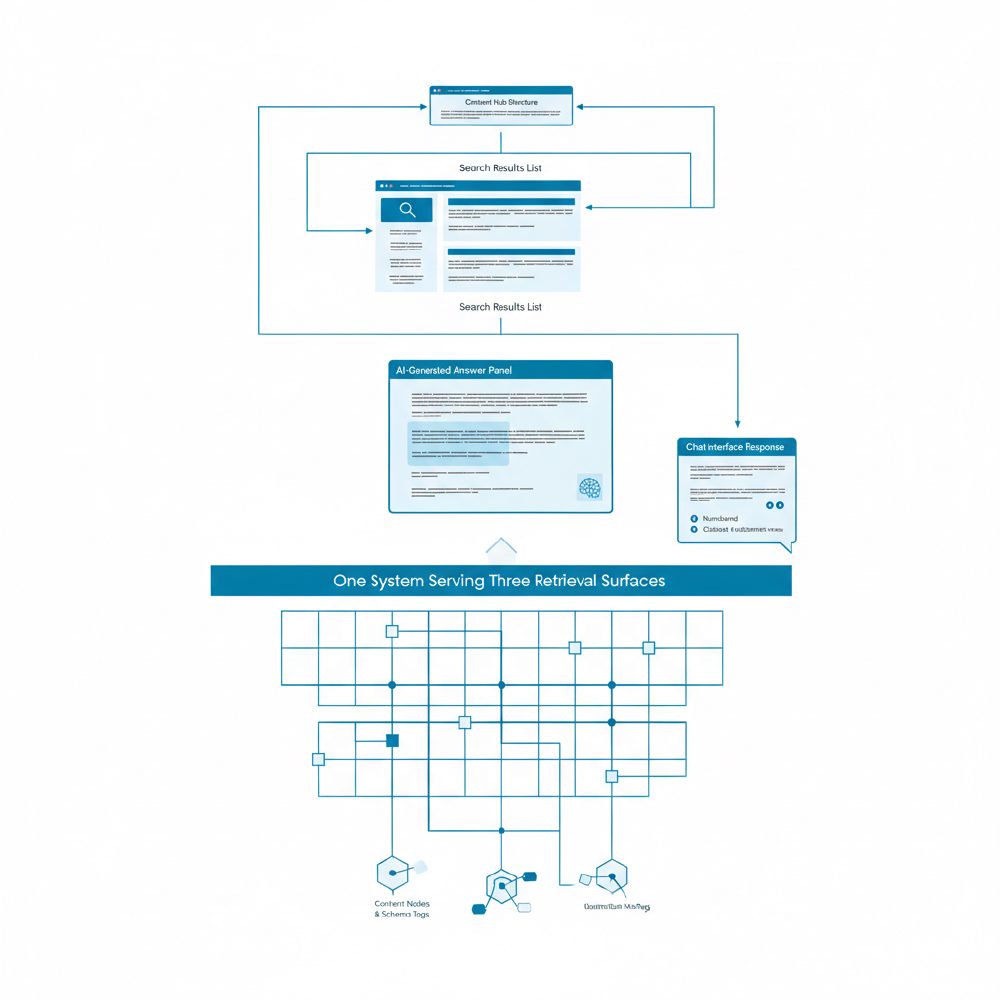
SEO ranks your casino review page as a link in Google's results. AEO gets a specific answer from that page surfaced inside a featured snippet or AI Overview. GEO gets your brand or data cited inside a generative response from ChatGPT, Perplexity or Gemini. Same content, three separate retrieval mechanics.
I treat these as three retrieval layers on top of one content asset, not three content strategies. SEO is document-level: Google's classic index crawls a URL, matches it to a query via hundreds of ranking signals, and returns a list of links. A well-optimized 'best crypto casinos 2026' page competing on that basis needs backlinks, on-page relevance and topical authority the way it always has.
AEO is passage-level. Google's featured snippets and AI Overviews pull a specific 40-70 word chunk out of your page, not the whole document, to answer a question directly in the SERP. The unit of competition shrinks from 'the page' to 'the paragraph.' A page can rank #6 for a keyword and still win the AI Overview citation if one paragraph answers the exact question cleanly.
GEO is corpus-level and happens outside Google's SERP entirely. When someone asks Perplexity 'which offshore casinos accept US players safely,' the model retrieves and synthesizes across multiple sources, then cites two or three. Your inclusion depends on entity clarity, freshness, and how citable your prose is when lifted out of context, not on where you rank in a search results page that doesn't exist in that interface.
The practical difference for an affiliate operation: SEO still drives the bulk of revenue in 2026, AEO is a defensive play to keep visibility as Google absorbs more queries into AI Overviews, and GEO is an early-mover bet on where a growing slice of research-stage traffic is heading. I budget resources roughly 70/20/10 across the three for most client portfolios right now, and I revisit that split every quarter.
| Dimension | SEO | AEO | GEO |
|---|---|---|---|
| Primary surface | Google/Bing SERP blue links | Featured snippets, AI Overviews, PAA | ChatGPT, Perplexity, Gemini, Copilot chat responses |
| Ranking unit | Whole URL/page | Passage or paragraph | Synthesized answer with citation |
| Core signal | Backlinks, topical authority, on-page relevance | Direct-answer clarity, structured data, passage extractability | Entity consistency, freshness, third-party corroboration |
| Content format that wins | Long-form pillar + spoke pages | Self-contained 40-70 word answers under clear H2s | Comparison data, original stats, quotable definitions |
| Primary KPI | Organic sessions, keyword position | AI Overview appearance rate, snippet share | Brand citation frequency, referral sessions from AI domains |
Why Does an iGaming Site Need AEO and GEO if SEO Still Drives Most Revenue?
Because Google now answers a meaningful chunk of commercial gambling queries directly in AI Overviews before a user ever clicks a result, and LLM-referred sessions, while still a low single-digit percentage of most affiliate traffic mixes I audit, are compounding faster quarter over quarter than organic search growth.
I've watched AI Overviews appear on informational gambling queries, 'how does wagering requirement work,' 'is online poker legal in Ontario', at a rate that's climbed noticeably since Google expanded the feature through 2024 and 2025. Commercial head terms like 'best online casino' are more cautious because of YMYL sensitivity, but the informational layer that feeds your topical authority is exactly where AI Overviews now sit first.
The revenue math still favors SEO today. A licensed operator's affiliate deal pays on deposits from a clicked, tracked link, and AI Overviews and LLM answers frequently don't produce a click at all, that's the well-documented 'zero-click' concern. But the citation itself has second-order value: it builds brand recall in a category where trust is the entire conversion lever, and it protects against the scenario where a competitor's site becomes the default cited source for your money terms while you're still optimizing for 2022-era SERP behavior.
I don't recommend abandoning proven SEO fundamentals to chase AEO/GEO citation. I recommend treating them as an extension of the same topical map, with specific technical and structural adjustments layered on. The sites I've seen handle this well are the ones that already had strong hub-and-spoke architecture and E-E-A-T signals in place, AEO and GEO amplify an existing authority position, they don't substitute for one.
How Does Answer Engine Optimization (AEO) Actually Work for Casino Content?
AEO works by structuring content so a single passage can answer a question completely without the reader needing the rest of the page. That means a direct 40-70 word answer immediately under a question-format H2, clean entity naming, and schema markup that helps machines parse the answer's boundaries even when it doesn't produce a visible rich result.
The mechanical shift is smaller than most agencies claim. Google's featured snippets have run on passage-ranking since roughly 2020, and AI Overviews largely reuse that same extraction layer with an LLM rewriting the surfaced passages into a synthesized paragraph. If your content already answers questions directly and completely near the top of a section, you're most of the way to AEO-ready.
What actually changes for a casino review or comparison page: I stop burying the answer under three paragraphs of scene-setting. 'What's the minimum deposit at [operator]?' gets answered in the first sentence after the H2, with the specific figure, currency and any conditions, before I add context about processing times or regional variance. Extraction systems favor content that doesn't make them work to isolate the answer.
Schema still matters here, with a caveat I give every client: Google pulled back visible FAQPage and HowTo rich results broadly in August 2023, so don't expect the little accordion snippet in the SERP anymore for most FAQ blocks. What schema still does is give Google's and LLMs' parsers an unambiguous, machine-readable confirmation of what's a question and what's its answer, that structural clarity increases the odds your passage gets selected for extraction even without the visual rich result payoff.
What Is Generative Engine Optimization (GEO) and How Is It Different From AEO?
GEO is optimizing content to be retrieved, synthesized and cited by generative AI systems, ChatGPT, Perplexity, Gemini, Copilot, that answer a user's question by pulling from multiple sources and blending them into one response with citations, rather than surfacing your page directly the way AEO does inside a search engine's own SERP.
AEO still lives inside Google's or Bing's own retrieval pipeline; you're competing for a slot Google itself controls. GEO happens in a separate retrieval system entirely, Perplexity's own crawler and ranking model, OpenAI's browsing tool, Gemini's grounding against Google's index. Each has different crawlers (GPTBot, PerplexityBot, ClaudeBot, Google-Extended), different freshness windows, and different citation logic, so a page can be invisible to one and prominent in another.
For gambling content specifically, I've found LLMs apply heavier caution than they do for most commercial verticals, comparable to how they treat medical or financial YMYL topics. Perplexity, when asked about casino legitimacy or bonus terms, tends to cite sources with visible licensing detail, clear author bylines and dated last-reviewed stamps over sources without them, that's consistent with the general pattern of generative engines preferring corroborated, attributable claims for anything with real-money risk attached.
The practical GEO checklist I run for affiliate clients: confirm robots.txt isn't blocking GPTBot or PerplexityBot (a surprising number of sites block these by default via a security plugin without realizing it), make sure entity names are consistent site-wide (don't alternate between 'Casino X' and 'CasinoX Ltd' across pages), and structure comparison data as genuinely extractable tables rather than prose paragraphs describing numbers, since generative retrieval systems lift structured data far more cleanly than narrative text.
How Do LLMs Like ChatGPT and Perplexity Actually Cite Gambling Content?
Perplexity runs live web retrieval on every query and shows numbered citations, favoring recently crawled, structurally clear sources. ChatGPT's browsing mode does something similar when browsing is active. Gemini grounds responses against Google's own index. All three weight licensing transparency and dated, attributed content more heavily for gambling than for lower-risk verticals.
Perplexity is currently the most transparent of the three about its sourcing, it shows you exactly which pages it pulled from, which makes it the easiest platform to audit for LLM SEO gambling performance. I run monthly prompt audits for clients: a fixed list of 30-40 real-world queries ('is [operator] legit,' 'best payout casino [region] 2026,' 'how long do casino withdrawals take'), logging which domains get cited and how often. It's manual, it's not perfectly reproducible run to run, but it's the closest thing to a GEO rank tracker available without paying for one of the newer third-party monitoring platforms.
ChatGPT's default mode increasingly answers from its trained knowledge without live browsing unless the query clearly demands current data, which means static facts baked into its training cutoff carry more weight than they do in Perplexity's always-live model. That's a real limitation for time-sensitive content like bonus terms or licensing status changes, a model's training snapshot can simply be wrong by the time a user asks, and I've seen this create hallucination risk specific to gambling: incorrect wagering requirements, outdated license numbers, or defunct operators described as active.
Gemini's grounding against Google's own index means the SEO fundamentals you've already built, backlinks, domain authority, crawlability, carry over into GEO performance on that platform more directly than they do for Perplexity or ChatGPT, which run more independent retrieval. That's one more reason not to treat GEO as a parallel discipline requiring separate content: strong SEO foundations already lift Gemini citation odds.
What Technical Infrastructure Do You Need for AEO and GEO on Top of Existing SEO?
You need crawl access for AI bots (GPTBot, PerplexityBot, Google-Extended, ClaudeBot) confirmed in robots.txt, structured data covering Organization, Review and FAQ types even without rich-result payoff, consistent entity naming across every page, and a hub-and-spoke content architecture that gives each topic one authoritative URL rather than several competing ones.
Start with a crawl audit most teams skip: check robots.txt and your CDN/WAF (Cloudflare, in particular, ships bot-blocking rules that catch AI crawlers by default in some security tiers) to confirm GPTBot, PerplexityBot, ClaudeBot and Google-Extended actually have access. I've found sites unintentionally blocking one or more of these in maybe one out of every four technical audits I run, usually a security plugin update nobody reviewed against the newer bot list.
Structured data comes next. Organization schema with sameAs links to verified social and regulator profiles, Review schema with actual author and date fields populated (not defaulted), and FAQPage markup on genuinely distinct Q&A content. None of this guarantees a visible rich result in 2026's Google SERP, but it gives every downstream parser, Google's own AI Overview system, Perplexity's crawler, Gemini's grounding layer, an unambiguous read on what your page is claiming and who's claiming it.
Architecturally, this is where my programmatic SEO background matters most: a hub-and-spoke model built correctly for topical SEO authority, one canonical hub page per topic cluster, spoke pages targeting specific long-tail questions, internal linking that reinforces the hierarchy, is the exact same skeleton GEO needs for entity consistency. If your site has three different pages half-answering 'what is RTP' with slightly different phrasing, you're diluting both your SEO topical signal and your GEO citation odds, because no single URL reads as the definitive source. Consolidate before you optimize further.
How Do You Measure AEO and GEO Performance Separately From SEO Rankings?
Track AEO through Google Search Console's search appearance filters and rank-tracking tools that flag AI Overview presence (Semrush, Ahrefs now surface this). Track GEO through brand-mention monitoring tools like Ahrefs' Brand Radar, referral traffic from ai.perplexity.ai and chat.openai.com domains in GA4, and manual prompt audits logged monthly against a fixed query set.
Standard rank tracking wasn't built for either of these surfaces, so bolting AEO/GEO measurement onto your existing SEO dashboard produces misleading flat lines. GSC's Performance report does let you filter by search appearance for some AI-related surfaces, and both Ahrefs and Semrush shipped AI Overview tracking columns into their rank trackers through 2024-2025, flag your top 100-200 commercial and informational keywords and check monthly for AI Overview presence and whether your domain is cited within it.
For GEO, referral traffic is the cleanest hard signal you'll get: segment GA4 for sessions where the referrer includes perplexity.ai, chat.openai.com, or gemini.google.com. The absolute numbers will be small for most affiliate sites right now, I'd flag this as a low-hundreds-of-sessions-per-month signal for a mid-size site, not thousands, but the trend line matters more than the baseline in year one.
Brand-mention monitoring closes the gap between 'cited but no click' and zero visibility. Ahrefs' Brand Radar and newer dedicated GEO-tracking platforms (Profound, Rankscale and a handful of others launched through 2024-2025, I'd treat this category as still maturing and worth piloting rather than committing full budget to yet) attempt to sample LLM outputs across query sets and report citation frequency by domain. None of these are as mature or standardized as Ahrefs' or Semrush's decade-old SEO rank tracking, so I pair automated tools with a manual monthly prompt audit as a sanity check.
| Metric layer | What to track | Primary tool | Realistic reporting cadence |
|---|---|---|---|
| SEO | Organic sessions, keyword position, CTR | Ahrefs, Semrush, GSC | Weekly |
| AEO | AI Overview presence, featured snippet share | GSC search appearance, Ahrefs/Semrush AI columns | Monthly |
| GEO | Brand citation frequency, AI-referral sessions | Ahrefs Brand Radar, GA4 referrer segments, manual prompt audits | Monthly to quarterly |
What Content Formats Perform Best for AI Citation in iGaming?
Structured comparison tables, original data (payout speed benchmarks, wagering requirement breakdowns you've compiled yourself), self-contained definitional passages, and clearly attributed author bylines with credentials outperform long narrative prose for AI citation, because extraction systems favor content they can lift cleanly without needing to interpret context.
Original data is the single highest-leverage format I've seen for GEO specifically. If you've built a proprietary dataset, average verified withdrawal times across 40 operators, a scored comparison of KYC friction, a compiled list of license numbers cross-checked against MGA and UKGC public registers, LLMs have nowhere else to source that number, which makes your page the only viable citation. Generic 'best casino' listicle prose gets synthesized and blended across a dozen competing sources with equal weight; unique data gets cited directly.
Definitional clarity matters almost as much. A page that opens a section with 'RTP (Return to Player) is the percentage of total wagered money a slot machine returns to players over its lifetime, expressed as an average across millions of spins' gives a retrieval system a complete, quotable unit. A page that spreads that same definition across two paragraphs with qualifying asides forces the model to do more synthesis work, and synthesis work is exactly where hallucination risk creeps in, which cuts against you getting cited accurately, or at all.
Author attribution earns more weight in gambling content than in most verticals because of the YMYL classification. A byline with a real name, a stated role, and a linked author bio page describing relevant credentials (years covering the vertical, licensing knowledge, editorial standards) is a trust signal both Google's quality raters and generative engines' training data have been calibrated to recognize. I push every client toward visible, consistent bylines and a public editorial policy page, it's cheap to implement and it's one of the few E-E-A-T levers that pays off across SEO, AEO and GEO simultaneously.
What Are the Compliance and E-E-A-T Risks Specific to Gambling Content in AI Answers?
The main risk is AI hallucination on regulated facts, wrong licensing status, outdated bonus terms, or a delisted operator described as active, which exposes affiliate sites to reputational and potential regulatory scrutiny if their content is the cited source. Accurate structured data and dated, reviewed content reduce that exposure but don't eliminate it.
Gambling sits firmly in Google's YMYL category, and I treat any content touching licensing status, deposit limits, self-exclusion, or payout guarantees as high-stakes for accuracy independent of SEO value. The risk with generative engines is that a model can confidently synthesize an answer from a page that was accurate when published but is now six months stale, an operator's UKGC license can be suspended, a bonus structure can change, and if your page is the cited source for outdated information, that's a trust and potential compliance problem, not just an SEO one.
My mitigation approach is unglamorous but effective: visible 'last reviewed' dates on every YMYL page, a defined review cadence (I run quarterly reviews minimum on licensing and bonus-term pages for affiliate clients, monthly on anything with active regulatory volatility), and a linked editorial policy explaining how content gets fact-checked and updated. This doesn't just satisfy Google's quality rater guidelines, it gives generative engines a legible freshness signal that correlates with citation preference in my own prompt-audit observations.
There's also a liability dimension worth flagging honestly: if an LLM misquotes your page's wagering requirement figure and a user acts on it, the reputational fallout can land on your brand even though the model made the error, not you. I can't give you a way to fully prevent that, no operator controls how a third-party model paraphrases their content, but structured data that states the figure unambiguously, and a clear, quotable original sentence stating it, reduces the model's need to interpret or infer, which measurably lowers misquote risk in my experience.
How Should Content Architecture Change to Support AEO/GEO Without Cannibalizing SEO?
Keep one canonical hub page per topic for broad SEO terms, and add spoke pages that target the specific, narrower questions AEO and GEO reward, linked back to the hub. Don't create duplicate near-answers across pages; consolidate overlapping content into a single definitive URL to avoid diluting both keyword rankings and citation authority.
The failure mode I see most often is teams bolting on 'AEO content' as a separate initiative, a new batch of FAQ pages built independently of the existing topical map, which creates internal competition for the same queries the hub page already targets. That's textbook cannibalization, and it hurts SEO rankings while doing nothing useful for AEO, since Google's extraction layer still has to pick one URL as the authoritative source and now has two mediocre candidates instead of one strong one.
The correct pattern: your hub page ('Online Casino Bonuses: Complete 2026 Guide') owns the broad commercial term and links out to spokes answering specific sub-questions ('What's a Wagering Requirement and How Is It Calculated,' 'Are No-Deposit Bonuses Worth Claiming'). Each spoke is genuinely AEO-optimized, direct answer up top, self-contained, and each links back to the hub, reinforcing topical authority for the broad term while the spoke itself competes for the long-tail, question-format query where AI Overviews and LLM citations concentrate.
For GEO specifically, entity consistency has to hold across the entire hub-and-spoke cluster, not just within one page. If your hub uses 'wagering requirement' and a spoke three clicks away uses 'playthrough requirement' for the identical concept without cross-referencing them explicitly, you've fragmented the entity signal a generative retrieval system needs to treat your cluster as one authoritative source rather than several weaker, disconnected ones. This is exactly the kind of index-hygiene problem programmatic SEO teams already manage at scale, it's not a new discipline, it's stricter enforcement of the same rule.
What's a Realistic Rollout Timeline for Adding AEO/GEO to an Existing SEO Program?
Budget 8-12 weeks for the technical and structural foundation, crawl access, schema, entity consolidation, hub-and-spoke cleanup, before expecting any measurable AI Overview presence or LLM citation movement, and treat the first two quarters as measurement-and-iteration rather than expecting immediate GEO traffic volume.
Weeks 1-2: audit crawl access for AI bots, run a schema validator (Google's Rich Results Test still checks the core types, Schema.org's own validator catches structural errors) across your top 200 pages, and pull a cannibalization report in Ahrefs or Semrush to find overlapping URLs competing for the same query.
Weeks 3-6: consolidate duplicate/competing pages into single hub or spoke URLs with proper 301s, rewrite the top 50-100 highest-opportunity pages to lead with direct 40-70 word answers under question-format H2s, and populate Review/Organization/FAQ schema with real, complete field data rather than placeholder defaults.
Weeks 7-12: stand up your measurement layer, GSC search appearance tracking, brand-mention monitoring, a fixed 30-40 query manual prompt audit run monthly, and start a quarterly editorial review cadence on YMYL pages. I tell every client not to expect meaningful GEO citation movement inside this first quarter; LLM training and retrieval systems don't reindex and reweight sources as fast as Google's core web index does, and Perplexity-style live retrieval is the exception, not the rule, across the ecosystem. Months 4-6 is a more honest window for seeing citation frequency and AI Overview presence start trending in a direction you can act on.




Comments
No comments yet, be the first.