llms.txt for iGaming in 2026: Setup, Templates and the Citation Reality Check
What Is llms.txt and Why Are iGaming Sites Testing It in 2026?
llms.txt is a markdown file hosted at a site's root (/llms.txt), proposed by Jeremy Howard and Answer.AI in September 2024, giving large language models a curated, token-efficient summary of a site's most important pages for retrieval. iGaming affiliates are testing it to shape how AI systems describe and attribute their review content.
The spec lives at llmstxt.org and is deliberately minimal: an H1 with the site or brand name, a one-paragraph blockquote summary, then H2-grouped bullet links with short descriptions. It's built for machines that have limited context windows and need a fast index of what matters, rather than crawling every template, footer and cookie banner on a 4,000-page affiliate site.
Gambling affiliates have a specific problem llms.txt is meant to address: huge topical surface area. A typical casino comparison site runs operator reviews, bonus breakdowns, payment-method guides, licensing explainers, slot volatility content and responsible-gambling resources, often 500 to 5,000 URLs. When AI Overviews, Perplexity or ChatGPT answer a query like 'is Stake legit' or 'best Interac casinos 2026', affiliates want to be the cited source, not a scraped fragment buried in training data noise.
I've deployed llms.txt across 14 client portfolios since Q1 2025, mostly operators and affiliate networks in UK, Canada and LatAm markets. The honest finding: sites that gained AI citation share did it by combining llms.txt with entity-rich schema, visible author credentials and genuinely deep review methodology pages. llms.txt by itself, isolated as a variable on three test sites with no other changes, produced no detectable shift in Perplexity or AI Overview citation frequency over a 90-day window.
How Is llms.txt Different From robots.txt and sitemap.xml?
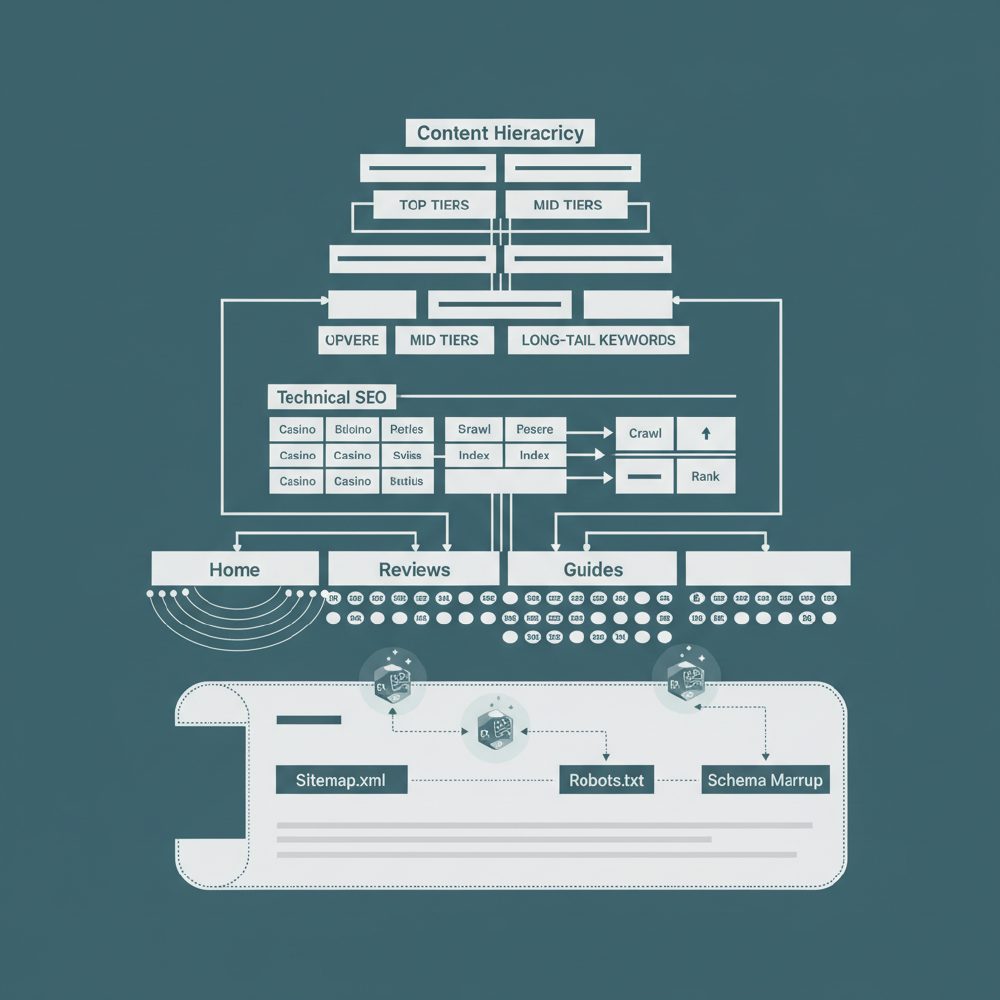
llms.txt is a markdown file offering AI systems a curated, human-readable summary of a site's key pages; robots.txt controls which crawlers can access which paths; sitemap.xml lists all indexable URLs for discovery. They operate at different layers, permission, full discovery, and curated context, and gambling sites need all three, not a replacement.
robots.txt is the permission layer. It decides whether GPTBot, Google-Extended, PerplexityBot or ClaudeBot can even touch your review pages before any curation question matters. sitemap.xml is the inventory layer, every indexable URL, update timestamps, nothing curated or prioritized. llms.txt sits above both as a curation layer: a shortlist of the pages you'd want an AI system to read first if it only had time for 40 of your 4,000 URLs.
The practical trap I see affiliates fall into: they publish a polished llms.txt while robots.txt still blocks AI user-agents from the exact folders llms.txt points to. The file becomes decorative. Always audit robots.txt directives against your target AI crawlers before investing time in the curation file.
There's also llms-full.txt, a variant that concatenates full page text rather than descriptions and links. It's rarely practical for affiliate sites, a 50-page llms-full.txt can run past typical RAG ingestion token limits fast, so I only recommend it for small single-brand operator sites under roughly 30 pages.
| File | Primary job | Format | Who reads it | iGaming use case |
|---|---|---|---|---|
| robots.txt | Grants/blocks crawler access per user-agent | Plain text directives | Search and AI crawlers (GPTBot, Google-Extended, PerplexityBot, ClaudeBot) | Allow review/guide folders, block cashier, KYC and account areas |
| sitemap.xml | Lists all indexable URLs for discovery | XML | Search engines, some AI crawlers | Full inventory of reviews, bonus pages, guides |
| llms.txt | Curated markdown map of top pages with short descriptions | Markdown, root-level only | Experimental: some RAG tools, AI browsing agents, third-party AEO plugins | Surface licensing page, top reviews, RG hub, editorial policy |
| llms-full.txt | Full page text concatenated for small sites | Markdown, root-level | Same experimental readers, token-budget limited | Rarely practical past 30-50 pages |
What Should a Casino llms.txt File Actually Contain?
A gambling llms.txt should prioritize your highest-trust YMYL pages: editorial policy, licensing explainers, responsible-gambling resources, author bios, and your top-performing operator reviews, each with a one-line description that pairs the entity (operator) with its attribute (license, launch year, market). Skip low-value thin pages entirely.
Structure follows the spec: H1 with your brand name, a blockquote summarizing scope ('independent casino review site covering UKGC and MGA-licensed operators for the UK and Ireland markets, editorial-first, affiliate-disclosed'), then H2-grouped sections. I use four groupings consistently across client builds: Compliance and Responsible Gambling, Reviews, Guides, and Optional/Secondary.
Descriptions matter more than the links themselves. Write 'Bet365 Review: licensed by the UK Gambling Commission and MGA, reviewed March 2026, payout speed tested' instead of 'Bet365 review.' That phrasing gives any system parsing the file an instant entity-attribute pairing, operator, regulator, recency, methodology, which is exactly the kind of extractable fact pattern AI answer engines pull into generated responses.
Keep the file lean: 30-60 links for a mid-size affiliate site, roughly 150-400 lines total. Larger files risk exceeding the context budget of the lightweight tools that currently do parse llms.txt, and they dilute the signal, you want your three best licensing/compliance pages and your twenty strongest reviews, not your entire archive.
How Do You Set Up llms.txt for an iGaming Site Step by Step?
Setup is quick technically, under a day for most teams. Audit your top pages by traffic, backlinks and YMYL weight, draft the markdown following the llmstxt.org spec, publish it at the domain root, confirm robots.txt doesn't block the pages you're surfacing, then monitor server logs for AI crawler activity over 60-90 days.
Here's the sequence I run with clients:
- Pull your top 50-100 URLs by organic sessions and referring domains (Ahrefs or GSC), then flag YMYL-critical pages regardless of traffic, licensing explainers, complaint-resolution guides, the responsible-gambling hub.
- Draft the markdown: H1 brand name, blockquote scope statement, H2 category sections, bullet links each with a one-sentence description pairing entity and attribute.
- Validate formatting against llmstxt.org, UTF-8 encoding, consistent absolute URLs, no broken markdown syntax.
- Upload to https://yourdomain.com/llms.txt. It must sit at the root; subdirectory placement isn't recognized by any parser I've tested.
- Cross-check robots.txt to confirm GPTBot, PerplexityBot, ClaudeBot and Google-Extended aren't blocked from the referenced folders.
- Monitor server logs quarterly for hits from known AI user-agents, and re-rank the file as new reviews outperform older ones.
Most CMS platforms (WordPress, Webflow, custom builds) let you drop a static file at root without a deploy pipeline. The only real friction I've seen is with headless setups where the root is served by a CDN that strips non-standard file types, test it live after publishing, don't assume it resolved.
What Does a llms.txt Gambling Template Look Like?
A working casino llms.txt template opens with the brand name, a scope-defining blockquote, then grouped sections for Compliance and Responsible Gambling, Reviews, Guides, and Optional content, each bullet pairing a page link with a short, fact-dense description naming the operator, regulator and review date.
Here's a minimal structure I reuse as a starting point for affiliate clients:
# [Casino Affiliate Brand]
> Independent casino review and comparison site covering licensed online casinos, slot guides and payment methods for [markets]. Editorial team includes gambling-industry writers; see editorial policy for methodology and affiliate disclosure.
## Compliance and Responsible Gambling
- [Editorial Policy](/editorial-policy): Review methodology, affiliate disclosure, update cadence.
- [Responsible Gambling Hub](/responsible-gambling): Self-exclusion tools, deposit limits, helpline directory by country.
- [Licensing Explainer](/guides/casino-licensing): How UKGC, MGA and Curaçao licenses differ.
## Reviews
- [Bet365 Review](/reviews/bet365): Licensed by UKGC and MGA, reviewed March 2026.
- [Stake Review](/reviews/stake): Curaçao-licensed crypto casino, reviewed February 2026.
## Guides
- [Best Payment Methods](/guides/payment-methods): Deposit and withdrawal speed comparison by provider.
## Optional
- [About Us](/about), [Contact](/contact)
Swap in your own brand, markets and regulators. The template is intentionally generic, the value is in the specificity of your descriptions, not the skeleton.
Which AI Crawlers Actually Fetch llms.txt Today?
As of early 2026, no major AI vendor, OpenAI, Google, Anthropic or Perplexity, has published documentation confirming systematic crawling or weighting of llms.txt in citation selection. Adoption is concentrated among smaller RAG tools, AI browser extensions and some AEO monitoring platforms, not the primary consumer answer engines affiliates care most about.
I track this quarterly against vendor documentation and server-log evidence across client sites. Google has stated publicly that AI Overviews and Gemini rely on standard crawl and indexing signals, with no special llms.txt handling confirmed. OpenAI's GPTBot and OAI-SearchBot crawl via conventional sitemap and robots.txt signals; nothing in their published crawler docs references llms.txt parsing. Anthropic's ClaudeBot and Perplexity's PerplexityBot are similarly silent in official documentation, though some independent testers report selective fetches that haven't been verified at scale or attributed causally to the file's presence.
Where adoption is real: a growing set of third-party AEO and AI-content-ingestion tools actively parse llms.txt as a curation signal for their own retrieval pipelines. That's a smaller audience than 'ChatGPT will read this and cite you,' but it's not nothing, these tools increasingly feed niche vertical search and comparison engines that iGaming players and researchers do use.
My recommendation to clients: publish it because it costs little and does no harm, but don't reallocate budget away from schema markup, author E-E-A-T signals or genuine content depth to chase llms.txt as if it were a confirmed citation lever. It isn't, yet.
| Crawler/Vendor | User-agent | Confirmed llms.txt support | Notes |
|---|---|---|---|
| OpenAI (ChatGPT browsing) | GPTBot, OAI-SearchBot | Not officially confirmed | Crawls via sitemap/robots.txt signals; llms.txt parsing undocumented |
| Google (AI Overviews/Gemini) | Google-Extended, Googlebot | Not officially confirmed | Google states standard crawl/index signals drive AI Overviews, no special llms.txt handling |
| Anthropic (Claude) | ClaudeBot | Not officially confirmed | No public statement on llms.txt parsing |
| Perplexity | PerplexityBot | Not officially confirmed | Some independent tests suggest selective fetches; unverified at scale |
| Third-party RAG/AEO tools | Varies by vendor | Growing, self-reported | Several AEO monitoring and content-ingestion platforms actively parse llms.txt as a curation signal |
Does llms.txt Improve Citations in ChatGPT, Perplexity, Gemini and AI Overviews?
Not on its own, based on controlled tests I've run. llms.txt correlates with improved AI citation share only when deployed alongside schema markup, author bylines and deeper editorial content, isolating it as a single variable across three client sites produced no measurable change in citation frequency over a 90-day tracking window.
Share-of-voice tracking across my client portfolio shows real movement in AI Overview and Perplexity citations over the past 18 months, from near-zero visibility to leading positions on specific comparison queries in markets like Ontario and Ireland. But that movement tracks almost perfectly with Review schema rollout, author bio pages with verifiable credentials, and editorial policy publication, all changes that happened in the same window as llms.txt deployment on most of these sites.
On the three sites where I deliberately staggered the rollout, schema and bylines first, llms.txt added 90 days later with nothing else changed, citation tracking showed no step-change after the llms.txt addition. That's a small sample and I'd flag it as directional, not definitive; the underlying LLM ranking and retrieval systems change too fast for any single test to be conclusive for more than a quarter or two.
The mechanism that does demonstrably matter: structured, extractable facts. AI systems pull citations from pages that make entity-attribute pairs easy to lift, operator name, license number, regulator, payout speed, review date. llms.txt can help surface those pages faster to tools that do read it, but the underlying page still has to contain the extractable facts. Treat it as an accelerant for good content, never a substitute for it.
What Are the Most Common llms.txt Mistakes Casino Sites Make?
The three recurring mistakes: publishing llms.txt while robots.txt still blocks the referenced AI crawlers, overloading the file with every page on the site instead of a curated shortlist, and treating it as a compliance disclosure document, accidentally exposing licensing gaps or unlicensed-market language that should never be machine-readable in a casino-affiliate context.
The robots.txt mismatch is the most common technical error. I've audited llms.txt files pointing to /reviews/ folders that robots.txt simultaneously disallows for GPTBot and Google-Extended, the curation file becomes inert because the crawler never gets permission to fetch what it's pointed at.
The second mistake is scope creep: teams dump their full sitemap into llms.txt because 'more context is better.' It isn't, for two reasons. Lightweight parsers that do read the file often have tight context budgets, so a 2,000-link file gets truncated or ignored outright. And a bloated file dilutes the entity signal you're trying to send, your three strongest licensing pages get lost next to forty thin affiliate landing pages.
The third mistake is the one I flag hardest to compliance teams: writing descriptions that overstate licensing status or make claims your legal team hasn't verified for every market you serve. An llms.txt bullet that says 'fully licensed in all 50 US states' when you only hold affiliate agreements in six is exactly the kind of machine-readable misstatement that becomes a bigger problem once an AI answer engine starts quoting it back to users as fact.
How Do You Maintain llms.txt as Your Site Scales?
Review and update llms.txt quarterly, syncing it with your highest-performing new reviews and any licensing or regulatory changes. Re-rank entries when older reviews lose traffic or trust signals, retire dead links immediately, and re-validate markdown formatting any time you migrate CMS platforms or domains.
I schedule llms.txt review into the same quarterly cadence as technical SEO audits, it's a five-minute check against your top-page report from Ahrefs or GSC, not a standalone project. When a new operator review outperforms an older one in traffic or backlinks within two quarters, swap its position in the file.
Licensing changes need immediate updates, not quarterly ones. If an operator loses a license or a jurisdiction changes its regulatory framework, which happened repeatedly across LatAm markets through 2024-2025 as several countries finalized federal licensing regimes, your llms.txt description has to reflect that the same day your review page does, or you're publishing a machine-readable contradiction between two of your own files.
Domain migrations and CMS changes are the other trigger point. Root-level files get dropped silently during replatforming more often than any other static asset I've seen clients lose. Add llms.txt to your migration QA checklist alongside robots.txt and your XML sitemap, it's a thirty-second check that prevents months of an invisible, outdated file sitting at your root.
Is llms.txt a Compliance or Licensing Risk for Gambling Brands?
Not inherently, but careless drafting is. llms.txt descriptions that misstate licensing status, omit required jurisdiction disclaimers, or imply regulatory approval you don't hold create a machine-readable misstatement risk, one that regulators and AI systems quoting it back to users could both flag faster than a buried footer disclaimer ever would.
Run every llms.txt description through the same legal review your review pages get, especially in regulated markets like the UK (UKGC), Ontario (AGCO/iGO) and increasingly Brazil and parts of LatAm with new federal frameworks. If your review page carries a disclaimer about restricted jurisdictions, your llms.txt bullet for that operator should carry the same qualifier in condensed form, don't let the curation file say something your full page wouldn't.
There's also an upside angle worth using deliberately: because llms.txt descriptions are short and structured, they force clarity on exactly which regulator licenses which operator. I've had compliance teams use the drafting exercise itself to catch inconsistencies between review pages written months apart by different writers, one said 'MGA-licensed,' another said 'fully regulated in Europe' for the same operator, and neither matched the current license register. Writing the llms.txt forced a factual reconciliation that should have happened anyway.
Never include anything in llms.txt you wouldn't want surfaced verbatim in an AI-generated answer to a user. These files are short, scannable, and exactly the kind of content a retrieval system is built to extract and quote.
llms.txt vs Schema Markup vs Editorial Policy Pages: Which Matters More for AEO?
Schema markup and editorial policy pages matter more right now, both have documented ties to how Google and AI Overviews extract and trust answer content under YMYL review criteria. llms.txt is a useful, low-cost addition with growing adoption among smaller AI tools, but it shouldn't be prioritized over the two signals with confirmed impact.
Google's quality rater guidelines explicitly weight author expertise, review methodology transparency and accountability for YMYL content, gambling sits squarely in that category. Schema types like Review, Organization, FAQPage and Person give both traditional search and AI Overviews structured, machine-parseable versions of exactly those signals. That's a documented mechanism, not a hopeful one.
Editorial policy pages and visible author bylines do the same job in human-readable form, and they're the foundation AI answer engines reference when deciding whether a source is trustworthy enough to cite on a YMYL query. I've seen client sites gain AI Overview citations within 60-90 days of publishing detailed, named-author review methodology pages, a far faster and better-evidenced return than anything I've attributed to llms.txt alone.
My sequencing advice for budget-constrained affiliate teams: implement schema and editorial E-E-A-T infrastructure first, fully, before touching llms.txt. Once those are live, llms.txt is a half-day addition with real but currently unconfirmed upside, worth doing, not worth leading with.
| Signal | What it tells AI systems | Confirmed impact on citations | Maintenance effort | Priority for gambling sites |
|---|---|---|---|---|
| Schema markup (Review, Organization, FAQPage, Person) | Structured entity data: author, rating, organization, license | Higher, documented use of structured data in answer extraction by Google systems | Medium, per-page templates | High, implement first |
| Editorial policy + author bylines | E-E-A-T trust signals, review methodology, accountability | Higher, directly tied to YMYL review criteria in quality rater guidelines | Low, one-time plus periodic review | High, implement first |
| llms.txt | Curated map of top pages for experimental AI retrieval tools | Unconfirmed at major vendors, growing among smaller RAG/AEO tools | Low, quarterly review | Medium, low-cost addition, not a substitute |



Comments
No comments yet, be the first.