LLM Share of Voice in iGaming: The 2026 Measurement Playbook
What is LLM share of voice, and why should iGaming affiliates track it in 2026?
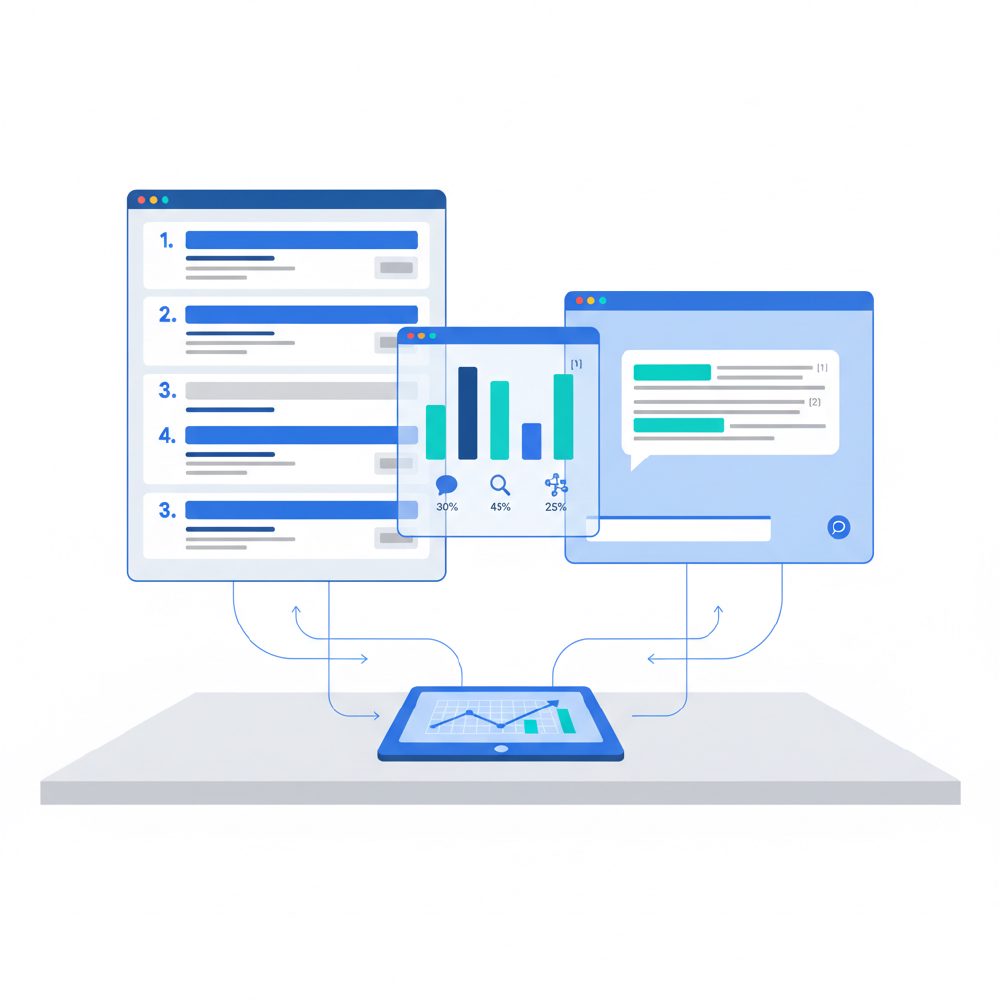
LLM share of voice measures how often and how favorably your brand appears inside AI-generated answers for commercial casino queries. It matters because research-stage traffic increasingly starts and finishes inside a chat window, and if you're absent from that answer, the click never reaches your comparison page at all.
I've spent the last decade watching affiliate traffic patterns shift, and this is the first structural change since mobile-first indexing that actually threatens the click model affiliates depend on. When someone asks Perplexity or ChatGPT "best crypto casino for US players," the model synthesizes an answer from a handful of sources and names two or three brands. If yours isn't one of them, you're invisible at the exact decision moment you built years of content to capture.
Share of voice as a concept isn't new, it's borrowed from paid search and broadcast media, where you measured your ad impressions against total category impressions. The AI version does the same job but for generative answers: what percentage of relevant AI-generated responses mention you, cite you with a link, or frame you positively versus a competitor. Track it the way you'd track keyword rankings, except the SERP now regenerates itself slightly differently every time someone asks.
The honest caveat: we don't have industry-wide benchmark data yet on what percentage of casino research queries route through LLMs versus traditional search. Treat any precise stat you see quoted with skepticism. What's not in doubt is the direction, every operator and affiliate I work with is now asking for this in quarterly reporting, which tells you where budget is heading even before the data fully matures.
How do you actually calculate AI share of voice for a casino brand?
Run a fixed set of 30-50 seed prompts per market against each target LLM, repeated multiple times to average out variance, then score each run for mention presence, citation with link, position within the answer, and sentiment. Divide your weighted score by the total across your tracked competitor set for that query cluster.
Start with prompt design, because sloppy prompts give you sloppy data. Build query sets that mirror real research intent: "best UK casino no deposit bonus," "is [operator] licensed in Ontario," "safest crypto casino 2026." Segment by market and by funnel stage, informational, comparison, and transactional intent behave differently inside LLM outputs.
Run each prompt 5-10 times per model per week minimum. LLMs are probabilistic; the same prompt run twice can return different brand sets, different order, even different tone. A single snapshot tells you almost nothing defensible. What you're after is a rolling average that smooths out that noise so you can spot a genuine trend versus a random fluctuation.
Score three dimensions separately: presence (are you mentioned at all), citation (are you linked or footnoted as a source), and sentiment (are you framed as recommended, neutral, or flagged with a warning). A brand that's mentioned in 80% of runs but never linked is in a weaker position than one mentioned in 50% of runs with a direct citation, link-backed mentions are what eventually drive click-through, and they're also the signal most correlated with strong entity and schema data on your site.
Which AI platforms actually matter for casino query tracking in 2026?
Prioritize Google AI Overviews and Perplexity for commercial intent because they cite sources directly and drive click-through; track ChatGPT and Gemini for volume and brand-awareness signal even where citation is inconsistent; monitor Copilot as a secondary indicator since Bing's index still feeds it.
Not every platform deserves equal tracking weight. Google AI Overviews sits directly inside the SERP you already rank for, so it's the highest-leverage target, improving your organic ranking signals often improves AI Overview inclusion simultaneously, giving you a two-for-one on effort. Perplexity behaves similarly, leaning heavily on indexed, citable web content rather than pure model memory.
ChatGPT and Gemini are trickier. Both blend training-data recall with live retrieval depending on the query and mode, so a brand can appear in ChatGPT's answer from memorized training data with zero live citation, which is good for awareness but doesn't move traffic. Gemini's integration with Google's own index gives it more citation consistency than ChatGPT in my testing, but that's shifted before and will shift again.
Copilot rides on Bing's index, which matters more in markets where Bing holds meaningful share, Canada and parts of the US corporate/enterprise search environment, for instance. I'd rank it fourth in priority for most casino affiliate portfolios, but don't ignore it if a chunk of your traffic comes from Microsoft-default browsers.
| Platform | Data Source | Tracking Method | Casino Query Behavior | Practical Note |
|---|---|---|---|---|
| Google AI Overviews | Live index + Google's ranking signals | SERP scraping tools, manual sampling | Pulls heavily from top-ranking pages | Highest overlap with existing SEO effort |
| Perplexity | Live web retrieval, citation-first | API + prompt scripts | Cites sources explicitly, click-through possible | Strong signal for content depth and freshness |
| ChatGPT | Training data + browsing mode (variable) | Manual + limited API testing | Mentions brands from memory, inconsistent citation | Good for awareness, weak for direct traffic |
| Gemini | Google index integration | Manual sampling, some API access | More citation-consistent than ChatGPT currently | Behavior shifts with Google product updates |
| Copilot | Bing index | Manual sampling | Secondary relevance, market-dependent | Watch closely in Bing-heavy markets like Canada |
What tools give reliable LLM visibility tracking for casino affiliates right now?
No single tool covers every platform reliably in 2026. Combine dedicated AI-tracking platforms like Peec AI, Otterly.ai, or Profound with in-house API scripts hitting model endpoints directly, and cross-check results against Semrush's AI visibility toolkit or Ahrefs Brand Radar for a second data source.
Dedicated AI-visibility platforms have matured fast over the past year but still have blind spots, most rely on sampled prompt runs rather than exhaustive coverage, and pricing scales quickly once you add markets and competitor sets. For a mid-size affiliate portfolio, budget somewhere in the low-to-mid four figures monthly if you want proper multi-platform, multi-market coverage rather than a single-dashboard toy.
I still recommend building a lightweight in-house tracker on top of that. Hit the OpenAI, Anthropic, and Perplexity APIs directly with your prompt set on a schedule, log raw responses to BigQuery or a simple Postgres table, and run your own scoring logic. It's more engineering effort, but it gives you response-level data you fully control and can audit, critical when a client or stakeholder asks exactly why a number moved.
Semrush and Ahrefs have both shipped AI-visibility modules recently. Treat them as a sanity check against your primary tracker rather than a sole source, I've seen meaningful discrepancies between platforms on the same query set, largely because sampling methodology and model version pinning differ. Reconcile monthly rather than trusting any single dashboard blindly.
| Tool / Method | Platforms Covered | Approx. Pricing Tier | Best For | Key Limitation |
|---|---|---|---|---|
| Dedicated AI-tracking SaaS (Peec, Otterly, Profound) | Multi-platform, varies by vendor | Mid to high monthly, scales with volume | Fast dashboards, competitor benchmarking | Sampling methodology often opaque |
| In-house API scripts | OpenAI, Anthropic, Perplexity | Engineering time + API usage costs | Full data control, custom scoring | Requires dev resource to build and maintain |
| Semrush AI toolkit | Google AI Overviews, some LLMs | Bundled with existing Semrush plan | Teams already on Semrush | Coverage still expanding, less granular |
| Ahrefs Brand Radar | Web + AI Overview crossover | Bundled with Ahrefs plan | Existing Ahrefs users, secondary check | Limited standalone LLM chat coverage |
| Manual prompt audits | Any platform | Analyst time only | Qualitative sanity checks, edge cases | Not scalable for weekly tracking |
How is AI mention monitoring different from traditional rank tracking?
Traditional rank tracking measures a fixed URL's position on a fixed SERP that changes predictably. AI mention monitoring measures probabilistic appearance in a generated answer that varies by model version, prompt phrasing, and even session, and it captures brand mentions that carry no link at all, which rank trackers never had to account for.
The single biggest mindset shift I push clients toward: stop expecting a stable number. A page ranking #3 for a keyword tends to stay near #3 for weeks absent a core update. An LLM mentioning your brand in 6 of 10 runs this week might mention it in 3 of 10 next week with zero change on your end, purely from model drift or a training-data refresh upstream. You're measuring a trend line, not a position.
The second shift is accounting for unlinked mentions. Rank tracking only cared about URLs. LLMs regularly name a brand from memorized training data with zero live citation and zero link, good for brand recall, useless for attributable traffic. You need to separate "mentioned" from "cited" in your reporting or you'll oversell a vanity metric to stakeholders who then can't reconcile it against GA4 sessions.
Sentiment adds a third layer rank tracking never had. A #1 ranking is unambiguously good. Being the top-mentioned brand in an AI answer that also flags "check licensing carefully" or "some users report withdrawal delays" is a mixed result you have to score and act on, often by fixing the underlying content gap the model is pulling that framing from.
What content and technical signals actually move LLM citations for gambling content?
Structured data (Review, FAQPage, Organization schema), explicit author bylines with disclosed credentials, a published testing methodology page, fast server-rendered pages without JS-blocked content, and consistent entity signals across Wikidata, Crunchbase-style profiles, and your own site all measurably improve citation likelihood.
Schema markup does more work here than most affiliate teams give it credit for. Review and FAQPage schema give LLM retrieval systems a clean, structured chunk to pull and attribute rather than forcing them to parse prose. Run every commercial page through Google's Rich Results Test and Schema.org's validator, I still find broken or missing schema on high-traffic review pages during almost every audit I run, and that's free citation potential left on the table.
Author bylines matter more in gambling content than almost any other vertical because it's textbook YMYL. A reviewer with a named profile, disclosed testing process, and verifiable history gets treated as a more reliable source than an anonymous "Editorial Team" byline, both by Google's YMYL raters and, increasingly, by the retrieval layers feeding LLM answers, which weight source credibility signals to reduce hallucination risk in high-stakes categories.
There's an emerging conversation around llms.txt files, modeled on robots.txt, letting sites signal preferred content for AI training and retrieval. I'll be blunt: adoption and actual model compliance with llms.txt is inconsistent right now, and I wouldn't prioritize it over schema and authorship work that already has proven pull-through. Watch it, don't bet your roadmap on it yet.
How do you build a topical authority map that AI models actually trust?
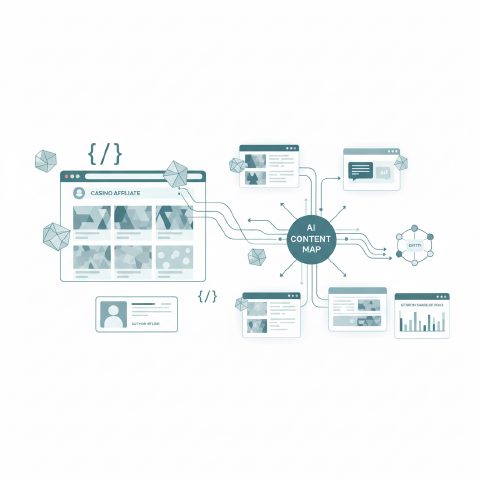
Map every commercial and informational query in your niche into clusters, bonus types, payment methods, licensing bodies, RTP data, then build pillar-and-spoke pages that interlink tightly and cite verifiable primary sources like regulator databases and payment provider documentation for every factual claim.
Hub-and-spoke architecture isn't just a Google ranking tactic anymore, it's how retrieval systems establish that your domain has depth on a topic rather than a single lucky page. If your "crypto casino" pillar links out to spokes on specific coins, specific withdrawal speeds, specific licensing jurisdictions, and those spokes link back and cross-link to each other, you're building the kind of entity density that both Google's topical authority signals and LLM retrieval layers reward.
Primary sourcing is non-negotiable in this niche. When you claim a brand is licensed in Malta, link directly to the MGA register entry. When you cite an RTP figure, source it from the game provider's own published data, not a scraped aggregator. This does two things simultaneously: it survives a Google YMYL quality review, and it gives an LLM a verifiable chain it can cite with confidence rather than flag as unsupported.
Avoid thin programmatic pages built purely to capture long-tail volume, "best casino for [obscure payment method] in [small city]" templates with swapped variables and no unique content. These get filtered hard in helpful-content evaluations, and they're exactly the kind of low-signal page LLM retrieval systems learn to deprioritize as a source over time, which drags your whole domain's perceived authority down with it.
How does E-E-A-T actually influence whether LLMs cite your casino content?
LLMs are tuned to favor sources with demonstrable experience and expertise because those signals reduce hallucination risk in YMYL categories. Bylines, disclosed testing methodology, and independently verifiable claims all function as trust proxies the same way they do in Google's quality rater guidelines, there's no separate AI-only trust track.
I get this question in almost every client call now: is there a different set of rules for ranking with an AI model versus Google? No. The retrieval layers behind ChatGPT, Perplexity, and AI Overviews are trained and evaluated against source-quality heuristics that overlap heavily with what Google's quality raters have documented in the search quality guidelines for over a decade. Experience and expertise signals aren't a Google-only quirk, they're a general solution to the same problem: how does a system trust a claim it can't independently verify.
Concretely, that means real testing evidence beats generic description every time. A review page showing a timestamped screenshot of an actual withdrawal, a named author who's demonstrably tested dozens of operators, and a clearly stated methodology page outperforms polished but generic "top-rated, highly recommended" copy in both search rankings and AI citation rate. I've watched this play out directly, clients who added disclosed author testing logs saw citation mentions in Perplexity answers increase within weeks, well before any core update touched their organic rankings.
The flip side: anonymous, templated, PBN-adjacent content that survived on link volume alone for years is getting squeezed from both directions simultaneously. Google's helpful-content signals suppress it in the SERP, and LLM retrieval systems trained to prefer verifiable expertise simply skip citing it. There's no separate shortcut for AI visibility, it's the same durable-authority work, just measured through a new lens.
What's a realistic timeline and KPI framework for growing LLM share of voice?
Expect roughly 3-6 months between structural changes, authorship rollout, schema fixes, topical map expansion, and measurable movement in AI citation rate. Track mention rate, citation rate, position-within-answer, and sentiment score monthly, and treat quarter-over-quarter percentage-point gains of 5-15 in a competitive vertical as a realistic, defensible target.
Set a real baseline before touching anything. Run your full prompt set across all target platforms for at least four weeks untouched, log every result, and resist the urge to start optimizing mid-baseline, you need a clean before-picture or you'll never prove attribution later when a client or your own leadership asks what actually moved the number.
From there, sequence your work: months one and two on schema and authorship fixes since those are the fastest to implement and the most directly correlated with citation improvements in my testing. Months two through four on topical map gaps, filling the spoke content that's missing and interlinking it properly. Months four through six on earned authority signals, digital PR, expert quotes, and third-party citations that feed back into both Google's link graph and the broader web corpus models draw from.
Don't chase week-to-week noise. Given the non-determinism in LLM outputs, a single week's dip means nothing. Report on rolling four-week averages, and flag a trend only once you've seen three consecutive periods moving the same direction.
| Phase | Timeframe | Primary Actions | KPI to Watch |
|---|---|---|---|
| Baseline | Weeks 1-4 | Run prompt set untouched, log raw data | Mention rate, citation rate (starting point) |
| Structural fixes | Months 1-2 | Schema validation, author bylines, methodology page | Citation rate delta vs baseline |
| Topical expansion | Months 2-4 | Fill spoke content gaps, interlink hub pages | Query coverage breadth, mention rate |
| Authority building | Months 4-6 | Digital PR, expert citations, third-party mentions | Sentiment score, position-within-answer |
How do you benchmark your AI share of voice against competitors?
Run the identical prompt set against 5-8 direct competitors monthly, log which domains get mentioned versus actually cited with a link, and track the delta over time exactly like a share-of-search analysis, except the battlefield is generative answers instead of a static SERP.
Pick competitors deliberately, not by vanity. Include the two or three brands that consistently outrank you organically, one or two aggressive newer entrants who might be winning AI visibility before they've built full domain authority, and your own brand as the control. That mix tells you both where you're losing ground and where a threat is emerging early enough to react.
Weight your benchmark by commercial intent. A competitor dominating informational queries ("how does wagering requirement work") matters less than one dominating transactional queries ("best casino to join today"), even if their raw mention count looks higher across your full prompt set. Segment your scoring by funnel stage before you draw conclusions from an aggregate number.
Watch for new entrants specifically. I've seen smaller, newer affiliate sites with strong structured data and disclosed authorship punch above their domain authority weight in AI citations well before their organic rankings caught up, because the citation signals LLMs favor aren't purely link-graph dependent. That's your early warning system for a competitor about to eat into your organic share too.
What compliance risks come with chasing AI visibility in regulated gambling markets?
The real risk is treating AI visibility as a separate game with looser rules, spun-up citation-bait content, fake review farms, or misleading claims to trigger favorable mentions. That backfires directly because AI ranking signals overlap heavily with Google's YMYL criteria, so tactics that trigger a core update penalty also collapse your AI mention rate.
I've turned down client requests to build "AI answer bait" pages stuffed with unverifiable superlatives designed purely to get quoted by a model. It doesn't hold up. LLM retrieval systems trained against source-quality heuristics increasingly flag exaggerated, unsupported claims the same way a Google quality rater would, and gambling content sits squarely in YMYL territory where both systems apply extra scrutiny to financial and safety claims.
Regulatory exposure compounds this. If your AI-optimized content overstates bonus terms, misrepresents licensing status, or omits required responsible-gambling disclosures to read cleaner for citation purposes, you're not just risking an algorithmic penalty, you're risking action from bodies like the UKGC or MGA, and breach of most affiliate program terms, which almost universally require accurate, compliant marketing regardless of channel.
Run every AI-visibility content change through the same compliance review you'd apply to standard organic content: verified licensing claims, accurate T&Cs, required disclaimers present, and affiliate disclosure clearly stated. Durable AI visibility and regulatory compliance aren't in tension, the sources that survive both are the same accurate, well-sourced, properly disclosed pages you should already be publishing.


Comments
No comments yet, be the first.